


Satin Floats Explained: Why Satin Shines and Snags
What is a float in a satin weave?
A float is a stretch where a yarn travels over several crossing yarns without being tied down. In a satin weave, each lengthwise (warp) yarn floats over four or more crosswise (weft) yarns before it dips under one and locks the fabric together. Those long, unlocked stretches are the satin’s signature. They give it a smooth, glossy face, and they also make it easier to snag.
Every woven fabric is a pattern of locking points. Where a warp yarn goes over a weft yarn, it is on top. Where it goes under, the weft is on top. Satin keeps the locking points as few and as far apart as possible, and spreads them so no two touch. This guide explains how that works, how float length compares across weaves, why floats create both shine and snags, and how to spot a long-float fabric by eye and by hand. For the bigger picture of the weave, see our guide to what satin weave is.
How does a satin weave arrange its floats?
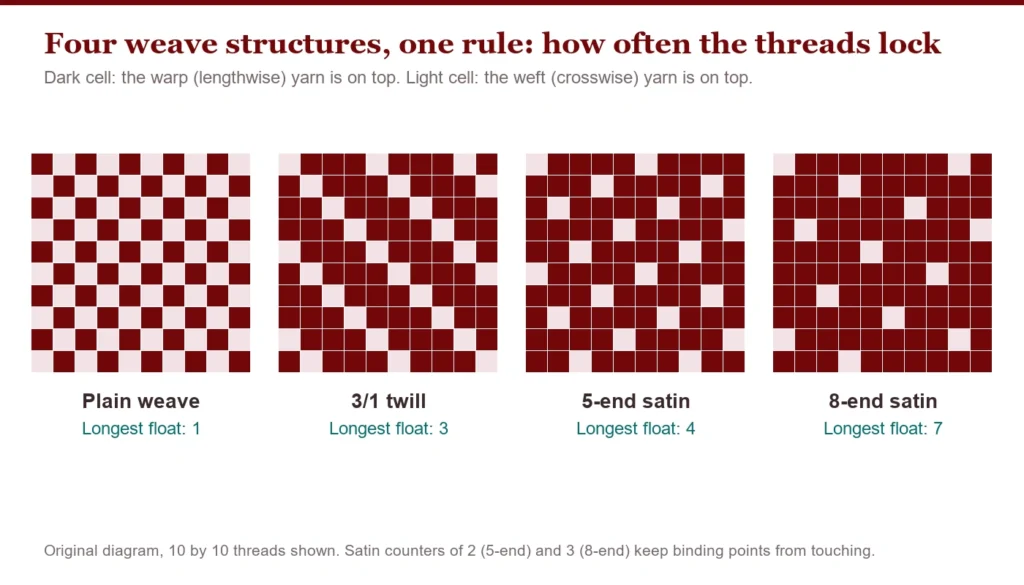
A satin weave places one locking point per yarn in every repeat and spaces those points evenly with a fixed step. A 5-end satin repeats over five yarns. The step, called the counter or move number, decides which pick the next yarn locks on. An article in the EXARC Journal on weaving satin on a warp-weighted loom puts the rule plainly: “The only possible counters for a 5-end satin are two and three” (Olsen, EXARC Journal 2024/3). A step of one or four would line the locking points up diagonally, and the cloth would be a twill, not a satin.
In the diagram above, the dark cells show where the warp yarn is on top. In the 5-end satin, each column has one light cell, and the light cells step across with a counter of two, so none of them touch. The 8-end satin uses a counter of three, which stretches the float to seven. The same article notes that a warp-faced satin has long floats in the warp direction, and a filling-faced satin has them in the filling direction.
- 5-end satin, counter 2. Each warp yarn passes over four weft yarns and under one. This is the most common satin structure.
- 8-end satin, counter 3. Each warp yarn passes over seven weft yarns and under one. The floats are longer, so the fabric is glossier on paper and easier to snag.
- Warp-faced and weft-faced. If the long floats lie in the warp, the fabric is a satin. If they lie in the weft, it is a sateen. Our guide to satin vs sateen covers the difference in use.
How long is a float in different weaves?
Float length grows as locking points get rarer. In a plain weave every yarn locks at every crossing, so the longest float is one. In a 3/1 twill, a yarn floats over three and locks under one, so the longest float is three. A 5-end satin reaches four, and an 8-end satin reaches seven. The longest float is simply the repeat length minus one.

| Weave | Repeat | Locks per yarn per repeat | Longest float | Typical surface |
|---|---|---|---|---|
| Plain weave | 2 | 1 | 1 | Even, matte texture, strong and tightly locked |
| 3/1 twill | 4 | 1 | 3 | Diagonal lines, with more sheen than plain weave |
| 5-end satin | 5 | 1 | 4 | Smooth, glossy face with no visible lines |
| 8-end satin | 8 | 1 | 7 | Very smooth and glossy, more snag-prone |
These numbers count yarns, not millimetres. A float over four fine yarns is physically shorter than a float over four thick ones, so two satins with the same structure can feel quite different. We come back to that below.
Why do long floats make satin shine?
Long floats make a flatter, smoother surface, and a smooth surface reflects light together instead of scattering it. Wikipedia’s summary of satin, which cites standard textile references, explains that floating yarns mean light is not scattered as much when it hits the fibres, so the fabric reflects more strongly (Wikipedia, Satin). The yarn matters too. Satin is made from filament fibres such as silk, polyester or nylon, which are long, smooth strands. Short-staple yarns such as cotton produce a duller fabric called sateen.
Reflectance depends on angle, so shine moves as you move. A study of polyester filament fabrics in plain, twill and satin weaves by Kim and co-authors in the Textile Research Journal (2004) photographed them under set illumination and viewing angles because reflectance is highly angle-dependent. It also reported that as yarn twist increases, “the luster unit size diminishes accordingly, resulting in macrolevel gloss decreases” (Kim et al., Textile Research Journal, 2004). In plain terms, a tightly twisted yarn glitters in smaller patches and looks less glossy overall. That likely helps explain why loosely twisted satin yarns look richer than hard-twisted crepe yarns, though the study does not compare those two directly.

Why do long floats snag?
Long floats snag because they sit on the surface with little holding them down. A float is a bridge of yarn that is free over its whole length. A ring, a rough nail, a zipper tooth or velcro can hook it and pull a loop out of line, and the locking points on either side cannot stop it. Wikipedia’s satin article says the fabric is not especially durable and tends to snag. That is the price of the smooth surface, and it is built into the structure.
The longer the float, the more yarn is free to be pulled, and the farther a snag can travel before a locking point stops it. We are not aware of a published test that gives a safe float length for woven satin, so treat the pattern as a general structural truth, not a number. In practice, an 8-end satin of the same yarn is likely to snag more easily than a 5-end satin. If one does snag, our guide to fixing snagged satin explains how to ease the loop back, not cut it.
How do floats affect strength and wear?
More floats mean fewer locking points, so the cloth has less holding it together. A plain weave is bound at every crossing and is firm and hard-wearing. A satin is bound once per repeat, so it is smoother and more fluid, and it is also more fragile at the surface. This is a trade between hand, shine and durability, and weavers choose it on purpose.
- Smoothness. Long floats make the face feel slick and cool.
- Drape. Fewer locking points let the fabric flex and flow, which is why satin hangs the way it does.
- Surface wear. The floats take the rubbing, so wear shows first as roughness, fuzz or dull patches along seams, cuffs and anywhere the fabric rubs.
- Tear and seam strength. Fewer locking points can mean seams pull out more easily. A closer set of yarns or a more durable fiber helps.
Fiber and yarn size change the picture. A polyester satin is usually tougher than a silk one of the same weave, and a heavier yarn can be more snag-resistant than a fine one. See our guide to polyester satin for the practical differences.
How can you spot a long-float fabric by eye and by hand?
You can check float length with a light, a fingernail and a loupe. None of these needs equipment, and each tells you something about the weave. Try them on a swatch or on a seam allowance.
- Tilt it in the light. Turn the fabric slowly under a lamp. A long-float satin shows a broad band of shine that slides across the surface, while a plain weave shows only a faint, even sheen.
- Look for the face and the back. A satin has a glossy face and a duller back, because the floats lie on one side. A plain weave looks the same on both sides.
- Use a loupe or phone zoom. At 10x you can see long parallel yarns on the face, with a locking point peeking up at regular intervals. Count the yarns between locking points to estimate the float.
- Run a fingernail across it. A satin face slides, and a plain weave drags. If your nail catches and lifts a thread, that fabric will snag easily in wear.
- Check the weave direction. Warp floats run along the length of the cloth, which is why satin has a visible grain and sometimes looks different from the end than from the side.

Does yarn thickness change how floats behave?
Yes, because a float is measured in yarns, not in millimetres. A float of four fine filament yarns is physically short, and the fabric feels silky and shows a dense, fine sheen. A float of four thick yarns is physically long, and the fabric feels coarser and catches more. That is why two fabrics with the same weave diagram can behave very differently.
Yarn density changes it again. A satin woven with the yarns set close together supports its floats from the sides, so they sit flat and resist catching. A loose set leaves the floats exposed. When a seller quotes thread count or weight, you can use it as a rough guide to how well the floats are supported, but we do not have a measured threshold to give you. Check a sample under rubbing before you buy.
How do you protect a long-float fabric in daily use?
Reduce friction and sharp contact, and the floats will last. This is practical advice that follows from the structure, not from a lab test.
- Wash in a mesh bag so the surface does not rub the drum or other items. Our how to wash satin guide has fiber-specific steps.
- Close zippers and velcro before washing, and keep satin away from them in drawers and bags.
- File or cover rough nails and rings when handling it, or wear soft gloves for delicate pieces.
- Choose a lined cut for places that rub, such as seat areas and underarms.
- Store on a padded hanger or flat, not stuffed against a rough surface.
- If a float is pulled, ease the slack back along the thread with a blunt pin, as in our snag guide, and do not cut it.

What do floats mean for cutting and sewing satin?
Because the floats run in one direction, satin has a shine direction, and mixing directions in one garment shows. Float yarns reflect light differently when you look along them and when you look across them, so two pieces cut with the floats running different ways can look like two shades. Cut every pattern piece with the floats running the same way, usually along the length of the garment, and mark the direction on the wrong side.
- Cut on a single layer with sharp scissors or a rotary cutter, because floats slide and shift under the blade.
- Use a fine, sharp needle and a short stitch length that does not perforate the floats along a seam line.
- Finish the seams with French seams or a clean overlock, since loosely held floats can fray and pull at a raw edge.
- Press gently with low heat and a pressing cloth. A hot iron can flatten floats into a glassy patch or leave a mark.
- Test on a scrap before you commit, because fiber and finish change how the floats respond.
Our how to sew satin guide covers needles, thread, seams and pressing in more detail, fiber by fiber.
Why should you trust this guide?
We do not sell fabric and earn nothing from any brand named here. The weave diagrams and the float-length chart are original and come from the structure of the repeats, which you can check on paper. The counters for a 5-end satin come from the EXARC Journal article, the shine mechanism from Wikipedia’s satin article and the Kim study, and the snagging statement from Wikipedia. We could not find a published test that gives a float length at which satin begins to snag, so our statements about snagging and wear are about direction, not numbers. We did not test fabrics for this guide.
Frequently asked questions
Is satin weave the same as satin fabric?
Not exactly. Satin weave is the structure, with long floats on one face. Satin fabric is any cloth woven that way, whatever the fiber. A silk satin, a polyester satin and a nylon satin all share the weave and differ in feel, strength and care.
Why does satin catch on rough hands?
The long floats sit loose on the surface. A rough nail or dry skin hooks the exposed yarn and pulls a loop out of line. Smoother hands, a lined cut and gentle handling reduce it.
Is an 8-end satin shinier than a 5-end satin?
Often, because its floats are longer and the surface is flatter. The difference depends on the yarn, the twist and the finish, and a longer float is also easier to snag. A well-made 5-end satin can out-shine a poor 8-end one.
What is the difference between satin and twill?
A twill locks the yarns in a diagonal line, which you can see as ridges. A satin spreads the locking points so no two touch, which hides any diagonal and leaves a smooth face. Both can be glossy, but satin is smoother.
Can a satin snag be repaired?
Often. If the loop has not broken, ease the slack along the yarn back to where it came from, using a blunt pin or a fine crochet hook. Do not cut the loop. Our snag guide shows the steps.
Does sateen have floats too?
Yes. Sateen has long floats on the weft side instead of the warp, and it is usually made from short-staple yarns such as cotton. It is softer and less glossy than satin.
Do all satins have the same float length?
No. 5-end satin is the most common, and 8-end satin and longer repeats exist. The yarn and the set of the fabric change how the float feels, even when the repeat is the same.
Is a satin stripe the same thing?
No. A satin stripe is a woven pattern where bands of satin weave sit next to bands of another weave, so some stripes are glossy and others are matte. The floats are the same, but they appear only in the satin bands.
Final word
A satin float is the whole story in one structure: a long, unlocked stretch of yarn that gives the smooth face, the shine and the fluid hand, and also the snagging. Count the repeat, look at how the light moves, and protect the surface from rough contact. For more on how the weave is made, read the weave guide again alongside the diagrams here, and for the weight side of the same fabric, see our guide to satin GSM.


