


Satin Duvet Covers: Fibre, Fit, Warmth and How to Wash Them
What is a satin duvet cover?
A satin duvet cover is a removable cover for a duvet, made from cloth woven in a satin weave, so one side shows a smooth, glossy surface. It is the bedding equivalent of a pillowcase: you slide the duvet inside, and the cover protects it and can be washed. Satin duvet covers are usually polyester or silk, and the fibre decides how warm, how breathable and how easy to care for the cover will be.
This guide explains what a duvet cover does, how satin differs from sateen, which fibre to choose, how closures, sizes and tog ratings affect the choice, how to put the cover on without a struggle, and how to wash it safely. If you are choosing a whole bedding set, our guide to satin bedding compares sheets, pillowcases and covers.

What does a duvet cover do?
A duvet cover protects the duvet and makes it easy to clean. Wikipedia’s article on the duvet describes a duvet as a soft, flat bag filled with insulating material, usually protected by a removable cover, much as a pillow is protected by a pillowcase. It adds that many sleepers use a duvet without a top sheet, because the cover can be laundered as often as the bottom sheet.
That detail matters for satin. If the cover is the layer against your skin, it needs to wash well and to feel good, and a delicate cover that needs dry cleaning is a poor choice for a layer you may wash weekly. Wikipedia notes that duvet covers are usually cotton or a cotton-polyester blend, so satin is a deliberate step up in feel and in fuss.
The duvet itself is cleaned much less often. Wikipedia says down or feather duvets cannot be machine washed at home and may need specialist dry cleaning. The cover is what takes the daily wear, which is another reason to choose one you can wash.
Is a satin duvet cover the same as a sateen duvet cover?
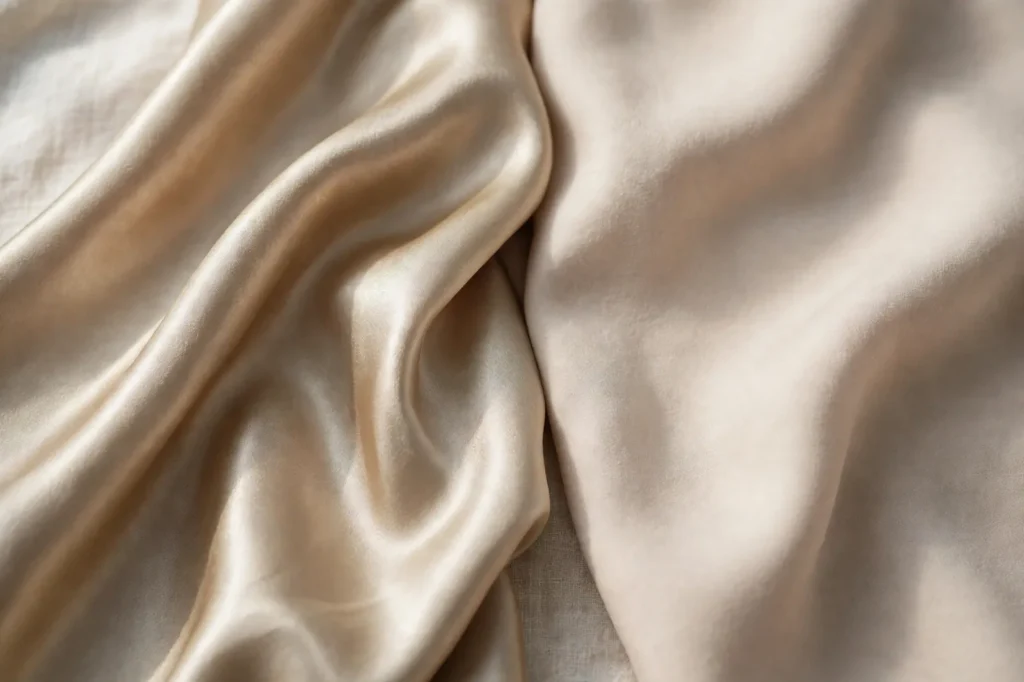
No. Satin and sateen use the same weave pattern in mirror image. Satin shows long warp floats and is usually made from filament yarns such as silk or polyester, so it is glossy. Sateen shows long weft floats and is usually made from spun cotton, so it is softer and less glossy. Our guide to satin vs sateen explains the difference in detail.
| Feature | Satin duvet cover | Sateen duvet cover |
|---|---|---|
| Usual fibre | Polyester or silk filament | Cotton, often combed |
| Surface | Glossy and slippery | Soft with a gentle sheen |
| Feel | Cool and smooth | Softer, with a gentle sheen |
| Breathability | Depends on fibre: silk breathes better, polyester less | Cotton is absorbent, so usually comfortable |
| Slip | High, so the cover can slide on the duvet and the bed | Lower |
| Care | Check the label; silk prefers gentle care | Usually machine washable |
If you want the shine and the cool, slippery feel, choose satin. If you want softness, warmth and easy care, choose sateen or plain cotton.
Which fibre should a satin duvet cover be made from?
Polyester satin is the practical choice, silk satin is the luxury choice, and cheaper acetate or nylon satins carry more care risk. The University of Georgia Cooperative Extension’s Understand Your Fibers guide gives the key facts, and our page on whether satin is breathable explains how the fibre changes airflow.
| Fibre | Strengths | Weaknesses | Care starting point |
|---|---|---|---|
| Polyester satin | Strong, wrinkle resistant, affordable | Absorbs body oils and odour, melts if too hot, breathes less | Gentle wash if the label allows; low iron with steam |
| Silk satin | Soft hand, absorbent, breathes well | Loses strength when wet, takes up body oils and grease, costs more | Dry cleaning or gentle hand wash; press cloth |
| Nylon satin | Very strong, low moisture absorption | Melts and fuses with heat, picks up dirt and dye, grays or yellows with age, damaged by strong sunlight | Avoid heat; wash with like colours |
| Acetate satin | Silky drape | Loses strength when wet, melts at low heat | Dry cleaning preferred, not for daily bedding |
For most households, polyester satin is the sensible fibre for a cover that will be washed often. Silk satin makes sense if you will accept gentle washing and a higher price, and our guide to satin vs silk sheets compares the two in detail. Acetate and nylon are better suited to occasional use than to bedding.
Will a satin duvet cover make you hot or cold?
A satin duvet cover changes how the duvet feels more than how warm it is. The warmth comes mainly from the duvet’s filling and its rating. Wikipedia explains that togs measure thermal insulation, with a higher tog meaning a warmer duvet, and that tog is a fixed rating, so a single duvet may be too warm or too cool for some seasons. It gives the example of paired 4.5 and 9.0 tog duvets that combine to 13.5 tog for winter, and notes that some duvets reach 15 tog.
The cover then adds a surface feel. Polyester satin is smooth and cool at first touch, but it absorbs less moisture than silk or cotton, so it can feel clammy for some sleepers on warm nights. Silk satin breathes better. If you sleep hot, choose a lighter-tog duvet and a breathable cover, and if you sleep cold, a higher tog and a heavier cover. We cover the airflow question in our guide to satin sheets.
- Hot sleeper. Choose silk satin or sateen, and a lower tog duvet.
- Cold sleeper. Choose a higher tog duvet and a thicker cover. Polyester satin feels cool at first and warms quickly.
- Shared bed. Two duvets, each with its own tog and cover, solve different needs.
- Seasonal use. Swap the cover with the season: satin in cooler months for a smooth look, a lighter cotton cover in summer.
What closure should a satin duvet cover have?
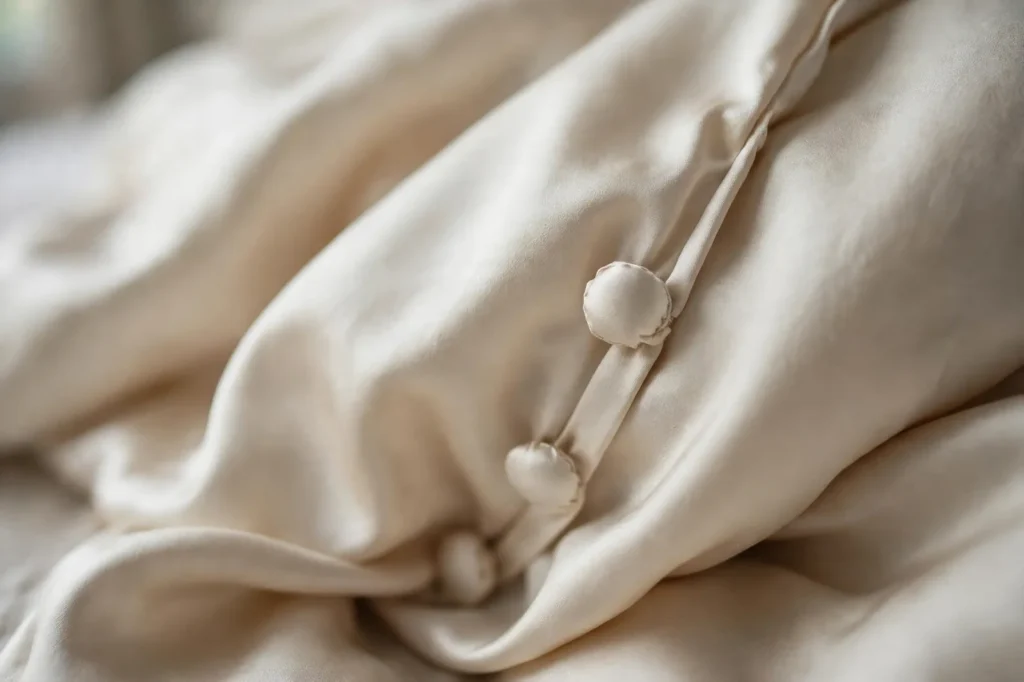
Choose a closure that holds the duvet in place and does not snag the satin. Satin is slippery and the long floats catch on rough edges, so a cheap metal zip or a hard button can mark or catch the cloth. The usual closures are buttons, zips and an envelope opening, and corner ties help hold the duvet in place.
| Closure | Advantages | Watch out for |
|---|---|---|
| Fabric-covered buttons | Smooth against the skin, look neat | Can open in the wash and take longer to fasten |
| Zip | Quick, secure, keeps the duvet in | A cheap zip can snag satin; do the zip up before washing |
| Envelope opening | No hardware, nothing to snag | Duvet can slip out unless the overlap is deep |
| Corner ties | Anchor the duvet to the cover, stopping it from bunching | Make sure the ties are sewn firmly into the seams |
Buttons on a satin cover should be flat and smooth, and the buttonholes should be neat. Run a finger along the edge in the shop. A rough edge will snag the floats within weeks.
How do you choose the right size?
Choose a cover that matches the duvet’s dimensions, not the bed’s name. Duvet sizes vary by country and by brand. Wikipedia notes that manufacturing conventions have produced many sizes and standards, so the label on the duvet is more reliable than the bed name. Measure the duvet laid flat, and choose a cover that is close to the same size.
- Lay the duvet flat and measure the width and the length.
- Read the size on the cover’s label or product page, and compare it with the duvet.
- Avoid a cover much larger than the duvet. A loose cover bunches and slides, especially in satin.
- Avoid a cover much smaller. It stretches the satin and pulls the seams.
- Allow for shrinkage if the fibre can shrink, and check the label.
A cover that is slightly generous is easier to fit than one that is tight, but satin’s slipperiness makes a very large cover annoying. Ties in the corners solve this.
Which colour of satin duvet cover is best?
Choose a colour that suits the room and hides the marks you worry about. Satin shows light and shade strongly, so pale colours look soft and rich, and dark colours show every crease as a highlight. Ivory, champagne and blush are the most popular, because they flatter skin and look calm in daylight.

- Ivory and cream. Warm and classic. They show body oils and marks over time, so wash regularly.
- Champagne. A pale gold, kind to creases and marks.
- Blush. A soft pink that suits a restful room.
- Deep colours. Navy, burgundy and emerald look rich, but they show every wrinkle and can fade or bleed when new. See our Satin Color Library for how shades behave in light.
How do you put on a satin duvet cover?
Turn the cover inside out, grip the duvet corners through it, and shake. This is the easiest way to dress a duvet, and it works well with satin because the cover does not need to be dragged over the filling. Corner ties make the job easier and keep the duvet in place afterwards.

- Turn the cover inside out and lay it flat on the bed with the opening at the bottom.
- Place the duvet on top and tie or clip the corners to the cover’s corner ties.
- Reach inside the cover through the opening, take hold of both top corners of the cover and the duvet together.
- Lift and shake, so the cover drops down over the duvet and turns right side out.
- Smooth the cover and pull the corners to the corners of the duvet.
- Fasten the closure and arrange the cover so the opening faces the foot of the bed.
If the duvet bunches, tie the corners more tightly, or add duvet clips. Satin slides against the filling, so anchoring the corners is the single most useful step.
How do you wash a satin duvet cover?
Read the care label first, then wash gently. In the United States, the Federal Trade Commission’s Care Labeling Rule requires care instructions on clothing, and good bedding labels follow the same logic: the label tells you what the fibre can take. Polyester satin usually tolerates gentle machine washing, and silk satin prefers hand washing or dry cleaning, per the University of Georgia guidance.

- Fasten the closure. Do up buttons, zips and ties so nothing catches in the wash.
- Turn the cover inside out. This protects the glossy face.
- Use a mesh bag or a large pillowcase for smaller covers, and give a large cover plenty of room.
- Choose a gentle cycle and cool water for polyester satin, with a mild detergent. Hand wash silk satin in cool water.
- Do not wring. Silk loses strength when wet, so squeeze gently.
- Dry flat or hang away from heat. If you tumble polyester, use the lowest setting, because polyester melts if too hot.
- Iron only if needed. Use the lowest heat on the wrong side with a press cloth. Our guide to how to wash satin gives a fibre-by-fibre method.
Wash the cover as often as you would wash your sheets. The cover takes the body oils, and the duvet does not. Because many people use a duvet without a top sheet, as Wikipedia notes, a weekly or fortnightly wash is a sensible habit.
How do you stop a satin duvet cover from slipping and bunching?
- Use corner ties. They anchor the cover to the duvet.
- Match the sizes. A cover that is too big bunches.
- Add duvet clips. Small clips hold the cover at the corners.
- Choose a deeper envelope overlap. The duvet stays in and the cover stays flat.
- Fluff before sleeping. Shake out the duvet to spread the filling.
- Pair with a cotton fitted sheet. A grippy bottom layer stops everything sliding.
What should you check before you buy a satin duvet cover?
| Check | What to look for |
|---|---|
| Fibre | The label should state polyester, silk or another fibre in percentages |
| Weave | A true satin weave, with smooth floats and an even sheen |
| Closure | Smooth buttons, a good zip or a deep envelope, plus corner ties |
| Size | Match the duvet’s dimensions as well as the bed name |
| Seams | Flat, even seams, with no puckering |
| Care label | Clear washing instructions that suit your routine |
| Colour | A shade that suits your room and your washing habits |
What mistakes do people make with satin duvet covers?
- Choosing by the word satin. The label tells you the fibre, and the fibre decides care.
- Buying a cover that is too big. It bunches and slides.
- Washing hot. Hot water and a hot dryer damage polyester and silk.
- Skipping the ties. The duvet slides around in the cover.
- Washing with rough items. Zips and Velcro snag satin.
- Ignoring the duvet’s washing needs. A down duvet cannot be machine washed at home, according to Wikipedia, so keep the cover clean to protect it.
How is a satin duvet cover different from satin sheets?
A satin duvet cover sits over the duvet and is touched less than a sheet, so it matters more for look and warmth than for skin contact. Satin sheets are touched all night, so feel, breathability and friction matter most. Many people buy one and not the other, and the right choice depends on what you want from satin.
| Question | Satin duvet cover | Satin sheets |
|---|---|---|
| Skin contact | Light, unless you sleep without a top sheet | Constant |
| Main benefit | The look of the bed and a smooth outer surface | Smoothness against skin and hair |
| Slipperiness | Slides against the duvet; use ties | Slides on the mattress; use deep pockets |
| Washing | Large and bulky, so it needs a roomy drum | Easier to wash and dry |
| Cost | One large item | A set of items |
If your main reason for choosing satin is the feel against skin and hair, sheets and a pillowcase deliver most of it. If you want the visual effect of a glossy, luxurious bed, the duvet cover is the larger surface. Our comparison of satin and silk sheets covers the sheet question in detail.
Does thread count matter for a satin duvet cover?
Thread count is a weak guide for satin, because satin is judged by weave, fibre and weight rather than by thread count alone. Thread count is the number of warp threads per inch plus the number of weft threads, as Wikipedia’s glossary of textile manufacturing defines it. Sellers may quote a large number for polyester satin, but a high number made from very fine filaments does not mean a heavier or better cloth.
- Ask for the weight. A figure in grams per square metre, or momme for silk, tells you more about durability than thread count.
- Ask about the fibre. Polyester and silk behave very differently, whatever the thread count.
- Feel the cloth. A good satin feels smooth and substantial, not thin and slick.
- Check the seams. Flat, even seams and a firm closure say more about quality than a number on a label.
How should you store a satin duvet cover?
Store a satin duvet cover clean, dry and folded loosely in a breathable bag or a cotton pillowcase, away from direct sunlight. Satin holds creases, so avoid tight folds, and refold along different lines each time you store it. Sunlight fades dyes, and plastic bags can trap moisture, so choose a cupboard or a drawer instead.
- Wash and dry the cover completely before storing it. Body oils left in the cloth can discolour it over time.
- Fold it loosely, with a sheet of acid-free tissue between the folds if you want to avoid creases.
- Use a breathable cotton bag or an old pillowcase, not a sealed plastic bag.
- Keep it away from rough shelves and zips that can snag the floats.
- Give it a shake and a gentle steam before you use it again.
How long does a satin duvet cover last?
A well-made polyester satin duvet cover can last for years with gentle washing, and a silk satin cover lasts as long as you care for it. The weakest points are the seams and the closure, so check them first if a cover looks worn. The main enemies are heat, rough handling and sunlight, which fade colour and weaken fibres.
- Wash cool and gently. Hot water and hot dryers shorten the life of polyester and silk.
- Avoid rough items in the wash. Zips and Velcro snag satin.
- Rotate covers. Two covers used in turn wear more slowly than one used every night.
- Repair early. A small split seam is easy to fix and hard to ignore for long.
- Replace when it feels thin. If the cloth is shiny at the seams and thin in the middle, it has had its time.
Frequently asked questions
Is a satin duvet cover good?
It is good if you like a smooth, glossy, cool surface and will wash it gently. Polyester satin is practical, and silk satin is more luxurious and needs more care.
Are satin duvet covers hot?
Polyester satin absorbs less moisture than cotton or silk, so some sleepers find it warm. Silk satin breathes better, and the tog of the duvet matters more than the cover.
Can you machine wash a satin duvet cover?
Often, for polyester satin, on a gentle cycle in cool water if the label allows. Silk satin usually needs hand washing or dry cleaning.
Why does my satin duvet cover slip?
Satin is slippery against the duvet and the bed. Use corner ties, duvet clips and a cover that matches the duvet’s size.
What is the difference between satin and sateen duvet covers?
Satin is usually polyester or silk filament and is glossy. Sateen is usually cotton and softer. They use the same weave in mirror image.
How often should you wash a duvet cover?
Wikipedia notes that many sleepers use a duvet without a top sheet because the cover can be laundered as often as the bottom sheet, so wash it on a similar schedule.
What tog should the duvet inside a satin cover be?
Choose the tog by season and sleeping temperature. Wikipedia explains that a higher tog is warmer, and that tog is a fixed rating, so a single duvet may suit only some seasons.
Can you iron a satin duvet cover?
Yes, on the lowest heat setting, on the wrong side, with a press cloth. Test on a hidden seam first, because polyester melts if too hot.
Where to go next
If you are still deciding between fibres, the Satin Database compares them in tables, and the Satin Glossary defines terms such as float, tog and sateen. The Satin Visual Library shows the fabrics close up.


