What Is Satin Weave? The Complete Guide
Satin is a weave structure, not a fiber. That single fact opens up everything else on this site. But most explanations stop there. The interesting part is how the weave works, because the mechanics explain the shine, the snags, the water spots, and why some satins cost far more than others. This guide covers the structure the way textile schools teach it, translated into plain English.
The one-paragraph version
In a satin weave, each yarn floats over four or more yarns before diving under one. The tie-down points are scattered so they never line up. That is the whole trick. Long, uninterrupted floats on the surface reflect light smoothly, which is why satin shines. Those same long floats are exposed and easy to catch, which is why satin snags. Everything else is detail.
Woven fabric in 30 seconds: plain, twill, satin
Every woven fabric is an arrangement of warp yarns (running lengthwise, held taut on the loom) and weft yarns (woven across). The three basic weaves differ only in how often the yarns interlace.
Plain weave interlaces at every possible point: over, under, over, under. Maximum interlacing. The surface is matte and the fabric is strong and stable. Think muslin, percale sheets, canvas.
Twill weave staggers the interlacing so a diagonal line forms. Think denim. That diagonal is the giveaway.
Satin weave is a twill with its tie-down points rearranged so no diagonal line can form. Textile textbooks call it an interrupted or rearranged twill. The tie-downs scatter across the surface instead of lining up, which leaves long floats of yarn lying smooth and parallel. Fewer interruptions, more shine.
If plain weave is a brick wall and twill is a staircase, satin is a calm lake. Hold that image. It explains most of what follows.
How is a satin weave actually drafted?
Here is something no consumer site has ever published in plain English: the actual drafting math. Weavers design satin on graph paper, and the recipe has two numbers.
R is the repeat. It counts how many yarns the pattern spans before it starts over. Common values are 5 and 8, written 5H and 8H. The H stands for harness, the set of shafts on the loom that controls the pattern. Bigger repeat, longer floats.
S is the shift, also called the move number or counter. Each row, the single tie-down point moves over by S yarns. This number is the entire secret of satin.
Watch what happens on a 5 by 5 grid with a shift of 2. X marks where the yarn ties down. Dots are floats.
Row 1:  X . . . .
Row 2:  . . X . .
Row 3:  . . . . X
Row 4:  . X . . .
Row 5:  . . . X .
Row 1 ties down at position 1. Row 2 moves over 2 to position 3. Row 3 moves to position 5. Row 4 wraps around to position 2. Row 5 lands on position 4. No two tie-downs touch. No diagonal line forms. The surface is almost entirely long, parallel floats.
Now try a shift of 1. Each row’s tie-down sits right next to the last one, and they march across the grid in a neat diagonal. That is a twill, not a satin. This is why the shift can never be 1, and by symmetry never R minus 1 either. Textile sources (CottonWorks, INFLIBNET) give the full validity rules: the repeat must be at least 5, the shift and repeat must share no common divisor, and the shift cannot be half the repeat. For a 5-end satin, only shifts 2 and 3 work. For 8-end, only 3 and 5. Everything else either draws a diagonal or clumps the tie-downs together.
That is genuinely all the math there is. Five numbers, one grid, and you now understand satin better than most people selling it.
What do 4H, 5H, and 8H mean in satin?
The harness count tells you the repeat size, which tells you the float length, which tells you how the fabric behaves.
5H is the workhorse. Floats span four yarns. This is the standard apparel satin: dresses, blouses, linings that need to look good without drama.
8H is the luxury grade. Floats span seven yarns, nearly twice as long. The surface is smoother, the luster deeper, the drape more liquid. This is bridal satin and couture territory.
4H is the utility grade. Shorter floats, less shine, more durability. Linings, ribbons, and fabrics where shine matters less than toughness. (Textbook drafting rules say a true satin needs a repeat of at least 5, but the trade sells 4-harness satin widely enough that the term is standard. Another case where practice outruns the textbook.)
As a rough trade rule of thumb: 4H means utility, 5H means apparel, 8H means luxury. Treat that as a tendency, not a law. But the physics holds everywhere: longer floats mean more shine and more snagging. You cannot have one without the other.
Satin vs sateen: mirror images
Satin and sateen use the same weave family. The difference is which yarn dominates the face.
In satin, the warp yarns float on the surface. It is warp-faced. The lengthwise yarns, held taut and smooth on the loom, lie flat and reflect light evenly.
In sateen, the weft yarns float on the surface. It is weft-faced. Same structure, flipped.
Sateen is usually made of cotton, which is why you see “cotton sateen” on sheet labels. It gives you the sheen of the satin weave with the breathability of cotton. Neither is fake or inferior. They are siblings, and knowing which face you are looking at explains a lot about how the fabric will behave.
the full satin vs sateen comparison
Why is satin so shiny?
Light behaves differently on satin than on other weaves, and the reason is purely structural.
On a plain weave, light hits yarns going over and under at every point. Each interlacing scatters the light in a new direction. The reflection is diffuse, and your eye reads it as matte.
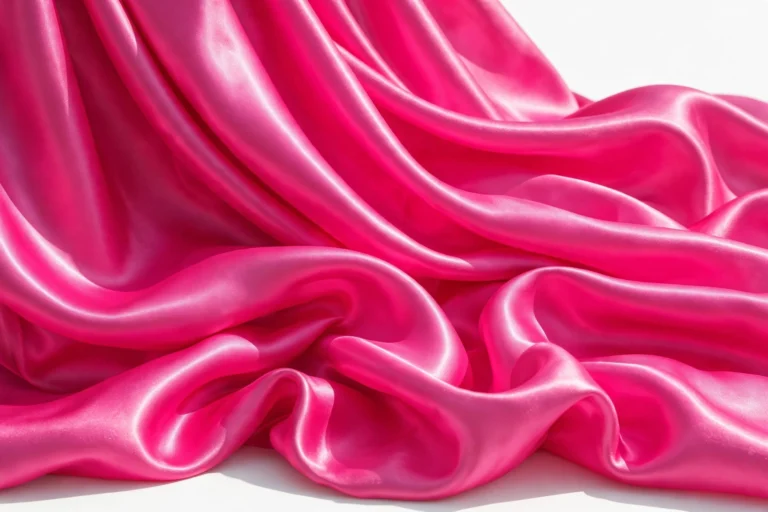
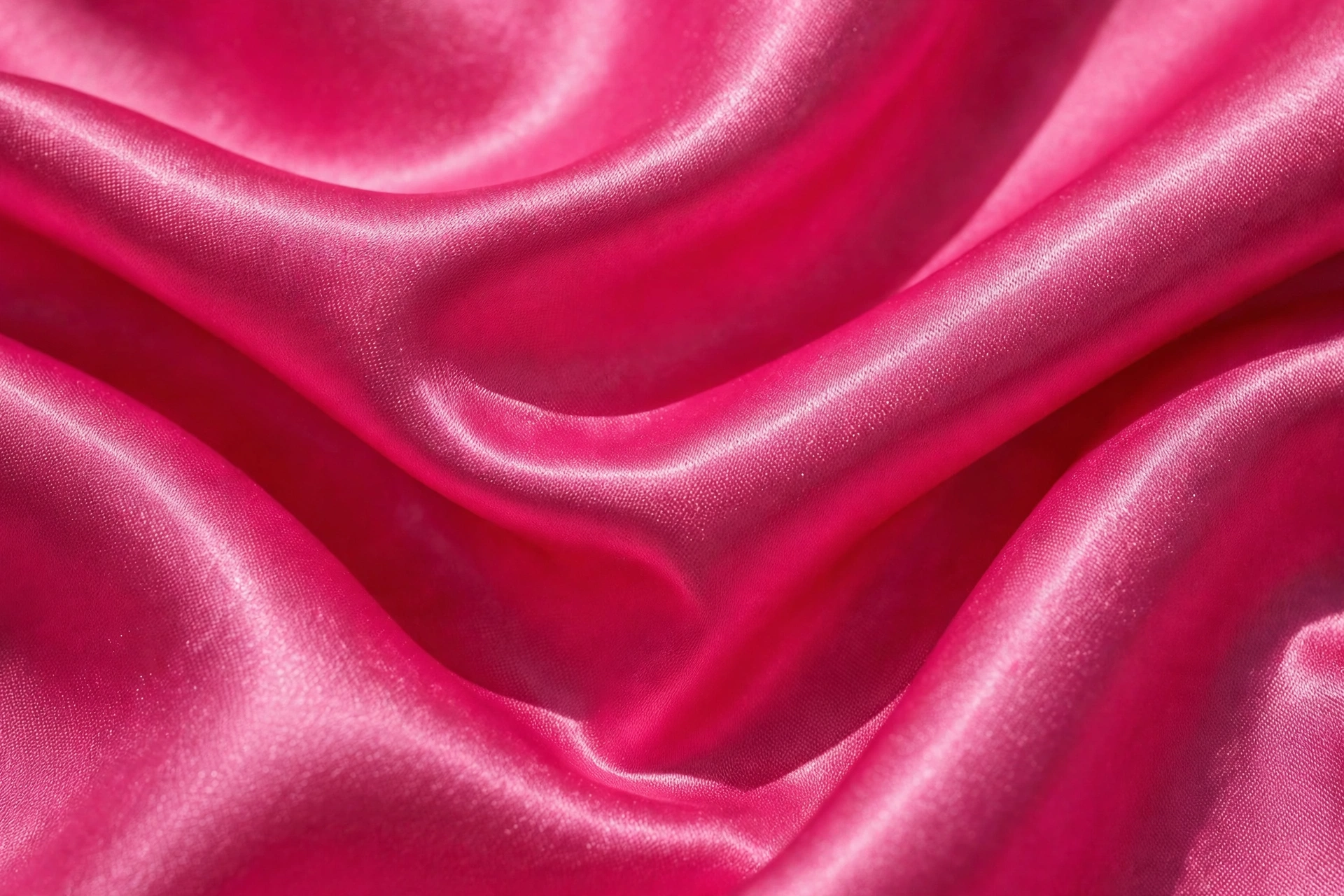
On satin, light hits long floats all lying parallel in the same direction. The reflection stays orderly, like sunlight on calm water versus choppy waves. Your eye reads that coherent reflection as shine.
Two things amplify the shine. Longer floats mean fewer interruptions, so 8H satin outshines 5H. And filament yarns, single continuous strands like silk or polyester filament, are smoother than staple yarns spun from short fibers like cotton. Smoother yarn plus longer floats is the formula for maximum luster. That is why silk satin glows and cotton sateen merely gleams.
Why does satin snag so easily?
A snag is a caught float. Nothing more.
Those long, exposed yarns that reflect light so beautifully are sitting on the surface with minimal anchoring. A fingernail, a ring, a zipper tooth, the corner of a table, all of them can hook a float and pull it out of alignment. The pulled thread forms a little loop or a visible line across the grain.
The tradeoff is worth stating plainly: the shine and the snagging are the same structural feature. Shorten the floats and you lose the shine. Anyone selling “snag-proof satin” is selling a contradiction. What you can do is choose shorter floats (5H over 8H) for hard-wear uses, keep sharp objects away from the good stuff, and if a snag happens, never cut the pulled thread. Work it back through to the wrong side with a needle and the damage mostly disappears.
Why does satin get water spots?
Water spots are the most misunderstood satin problem, and the weave explains them too.
A drop of water on satin disturbs the precise alignment of the floats, moves water-soluble finishes around, and on natural fibers like silk makes the yarns swell slightly before they relax as they dry. On a matte fabric none of this would matter. But on a mirror-smooth surface, the boundary between the disturbed area and the undisturbed area reflects light differently, and your eye reads that boundary as a ring.
That is why spot-treating a water spot usually makes it worse: you just draw a new boundary. The counterintuitive fix used by textile professionals is to wet the entire area evenly so no boundary exists, then let it dry uniformly. Strange advice until you understand the mechanism. Obvious once you do.
Which fibers can be woven as satin?
Almost any fiber can be woven as satin, and the fiber changes the fabric more than the weave does. Silk satin is the original luxury version: breathable, temperature-regulating, biodegradable, expensive. Polyester satin (polysatin) is the common one: cheap, colorfast, nearly indestructible, machine washable, but it does not breathe. Nylon satin is strong and elastic, used in lingerie and linings, though it yellows in sun. Rayon and viscose satin drape beautifully and breathe better than polyester but weaken when wet. Acetate satin is lustrous and drapy but fussy: it water-spots badly and melts under a hot iron. Cupro makes a breathable, washable satin that behaves like silk’s quiet cousin in linings. Cotton in a satin weave is called sateen: same family, weft-faced, softer gloss. Bamboo rayon, Tencel/lyocell, and modal all appear in satin weaves, generally soft and breathable. Recycled polyester (rPET) satin is a real and growing category, used the same way as virgin polyester satin.
every named type of satin compared
the honest satin vs silk comparison
One practical consequence: fiber determines dye behavior. Silk takes acid dyes, polyester takes only disperse dyes, and rayon and cotton take reactive dyes. Same weave, different fiber, different care labels.
What do momme and GSM mean in satin?
Satin weight is measured two ways, and the split follows the fiber.
Momme (pronounced “mommy”) is the traditional silk measure: the weight in pounds of a 45 inch by 100 yard piece of fabric. One momme equals about 4.34 GSM. Silk satin goods typically run 12 to 40 momme. Higher momme means heavier, more opaque, more durable.
GSM, grams per square meter, is the universal measure used for everything else. As rough bands: light satin runs 70 to 110 GSM (linings, scarves, ribbons), mid-weight 120 to 185 GSM (dresses, blouses, pillowcases), and heavy 190 to 210 GSM and up (bridal duchess satin, upholstery).
Weight tells you how the fabric will behave in your hands before you buy it. A 75 GSM satin will be floaty and translucent. A 200 GSM satin will stand away from the body and hold a sculptural shape. When a listing hides the weight, that is information too.
How to spot satin weave and buy it well
You do not need a lab. Three checks work in a store or at home.
First, the face and back test. Satin has a glossy face and a noticeably duller back. If both sides look the same, it is probably not a satin weave.
Second, the float check. Look closely, or use a phone magnifier. You should see long parallel yarns with almost no visible interlacing points breaking them up. Compare with a plain-weave cotton next to it and the difference is obvious.
Third, read the fiber content, not the marketing name. The label tells you what the satin is made of, and the fiber decides the care, the breathability, and the price. “Satin” alone on a label means polyester satin in practice. “Silk satin” at a polyester price is polyester with a fancy name.
What looks like satin but isn’t?
Sateen is the weft-faced member of the same weave family, usually cotton: different face, same logic, not a fake. Surah looks satiny but it is a twill; if you see a diagonal line, it is not satin. Faille is a ribbed plain weave with visible crosswise ribs: shiny, but not a satin weave. Crepe-back satin (satin face, crepe back) is not satin-backed crepe (crepe face, satin back), and retailers mix them up constantly. And a “satin finish” is not always a satin weave: calendering, pressing fabric between hot rollers, can iron a temporary shine onto plain weaves. It washes out. The weave is permanent; the finish is a rental.
What is satin best used for?
Every use traces back to the structure. Bridal gowns use high-harness satin because long floats photograph with a liquid glow. Linings use satin because the smooth face slides with almost no friction. Eveningwear uses it for drape plus shine in low light. Lingerie and sleepwear use it because the smooth surface feels good against skin for hours. Ribbon makers use woven-edge satin ribbon because the weave holds a crisp edge. Ballet companies cover pointe shoes in satin because the smooth surface glides on stage floors and catches the light.
How do you sew and care for satin?
Satin’s structure dictates how you handle it. The long floats shift under a standard presser foot, which is why sewists reach for a walking foot. Cut it in a single layer and mark on the wrong side. For care, the fiber sets the rules: silk and acetate want hand washing or dry cleaning, polyester and nylon tolerate a cool machine wash. Press on the wrong side with a cloth between iron and fabric. And remember the water-spot rule: never spot-treat, wet evenly or not at all.
how to sew satin without puckering
how to wash satin by fiber type
Frequently asked questions
Why is satin so shiny?
Because of its long floats. In a satin weave, yarns run uninterrupted across four or more yarns before tying down, so light reflects off parallel yarns in an orderly way instead of scattering. Fewer interruptions means more shine.
Is satin a natural fabric?
Satin is a weave, not a fiber, so the answer depends on the yarn. Silk satin is natural. Polyester satin is synthetic. The word “satin” alone on a label almost always means polyester.
What is the difference between satin and sateen?
They use the same weave family. Satin is warp-faced, meaning the lengthwise yarns dominate the surface. Sateen is weft-faced, meaning the crosswise yarns dominate. Sateen is usually cotton.
Why does satin snag so easily?
The same long floats that create the shine sit exposed on the surface with little anchoring. Anything sharp can hook one and pull it out of line. Shine and snagging are two sides of the same structure.
What do 5H and 8H mean in satin?
H is harness, and the number is the repeat size of the weave pattern. 5H means the pattern repeats every 5 yarns, 8H every 8. Higher numbers mean longer floats, deeper luster, and easier snagging.
Is charmeuse the same as satin?
Charmeuse is a type of satin: a lightweight, fluid satin weave, usually in silk or polyester. All charmeuse is satin weave. Not all satin is charmeuse.
Why trust this guide? It was written from textile-school sources on weave drafting (CottonWorks, INFLIBNET) and the site’s own research dossier, not rewritten from competing pages. Where trade practice varies, it says so. If you spot an error, we want to know: corrections make the guide better for everyone.