


Satin Bow Ties: Black Tie Rules, Satin vs Grosgrain and How to Tie One
What is a satin bow tie?
A satin bow tie is a bow tie made from cloth woven in a satin weave, which gives the tie a smooth, glossy face that catches the light. Black satin is the classic partner for a tuxedo, because tuxedo lapel facings are usually satin or grosgrain and the traditional rule is that the bow tie matches them. Satin is a weave and not a fibre, so a satin bow tie can be silk, polyester or another filament, and that choice matters for formal events.
This guide explains what black tie traditions say about the bow tie, how satin compares with grosgrain and silk, which style to buy, how to size and tie one, and how to look after it. If you are choosing the whole outfit, our guide to satin suits and tuxedos covers the jacket, trousers and facings.

Where does the bow tie come from?
The bow tie grew out of the neck scarves of Croatian mercenaries in the seventeenth-century Thirty Years’ War, according to Wikipedia’s article on the bow tie. The French upper classes adopted the scarf as the cravat, and it stayed popular through the eighteenth and nineteenth centuries. Historians do not agree on whether the cravat evolved into the bow tie and the four-in-hand necktie, or whether the bow tie came first.
The link to evening wear came later. The earliest known tailless evening coat, a midnight blue silk smoking jacket, was ordered in 1865 by the Prince of Wales, later Edward VII, from the Savile Row tailors Henry Poole and Company, and the word tuxedo comes from an American club in Tuxedo Park, New York, where tailless dress coats appeared at an autumn ball in 1886. Both details come from Wikipedia’s article on black tie. The bow tie became part of that evening outfit and has stayed there.
What do black tie rules say about the bow tie?
Black tie says the bow tie should be black, self-tied and silk, and it should match the lapel facings. That is the summary of Wikipedia’s black tie article, which also notes that the lapel facings are usually grosgrain or satin, with silk barathea as another option. The same article quotes Emily Post in 1909 listing silk, satin or grosgrain as acceptable.
- Colour. Black. It is traditionally the only appropriate neckwear.
- Tying. Self-tied, with a common shoelace knot.
- Material. Silk, matching the lapel facings.
- Pre-tied bow ties. Wikipedia says wearing one at a black or white tie event is generally considered a faux pas, while it is more accepted at school proms or among people with little experience of bow ties.
- Cummerbund or waistcoat. One, never both. Cummerbunds are traditionally black, in silk satin, grosgrain or faille, or barathea, with upward-facing folds.
- Trouser braid. A single silk or satin braid along the outer seam, matching or complementing the lapel facing.
There is one detail to hold onto. The rule says silk, and satin is a weave. A silk satin bow tie meets the rule, but a polyester satin bow tie only looks like it. Most people will not notice. A purist might, so for a strict black tie event, choose silk satin or silk grosgrain, and check the label. Our guide to satin vs silk explains the difference between a weave and a fibre.
Satin, grosgrain or silk: which bow tie material should you choose?
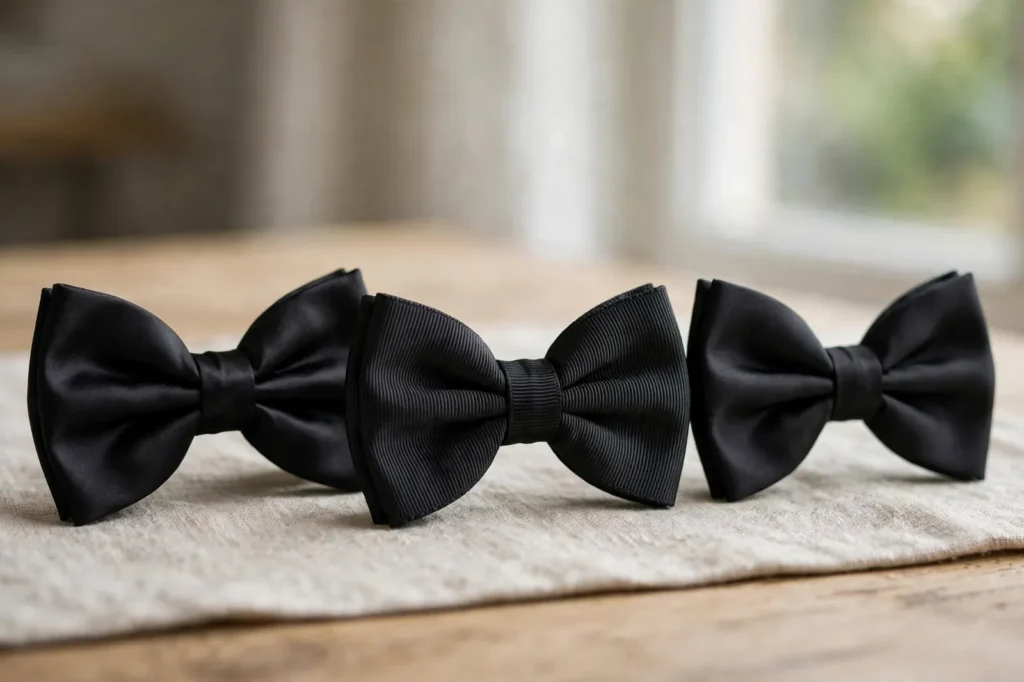
Choose the material that matches your lapel facing. Satin is smooth and glossy, grosgrain has fine crosswise ribs and a matte look, and silk describes the fibre and can be woven as either. Wikipedia describes silk, polyester and cotton as the most common bow tie materials, and it says lapel facings are usually grosgrain or satin.
| Material | Look | Best with | Watch out for |
|---|---|---|---|
| Satin | Smooth, glossy, catches light | Satin lapel facings and satin trouser braid | Shows creases, snags and finger marks; polyester satin is not silk |
| Grosgrain | Matte, finely ribbed | Grosgrain facings; a quieter, more traditional look | Can look dull next to a satin cummerbund |
| Silk (plain or twill) | Softer sheen, natural fibre | Silk facings or a softer evening look | Loses strength when wet, dry cleaning preferred |
| Polyester satin | Bright gloss, low cost | Costume, prom and everyday formal | Melts if the iron is too hot; looks flatter than silk |
If the facings are satin, a satin bow tie echoes them, and if they are grosgrain, a grosgrain bow tie does the same. Mixing the two is a choice, not a mistake, but matching is the safest rule. Look at the weave close up before you buy: a good satin tie shows smooth, flat floats and clean edges.

Pre-tied, self-tie or clip-on: which style should you buy?
A self-tie bow tie is the formal choice, a pre-tied one is the easy choice, and a clip-on is the quickest. Wikipedia lists all three. A self-tie, also called freestyle or tie-it-yourself, is a strip of fabric tied by hand. A pre-tied bow tie has the bow sewn onto a band that fastens around the neck. A clip-on clips directly to the collar points.

| Style | How it works | Formal level | Good for |
|---|---|---|---|
| Self-tie | A strip of fabric tied by hand with a shoelace knot | Highest, the correct choice for black tie | Weddings, black tie events, anyone who wants the classic look |
| Pre-tied | Bow sewn onto a band that fastens at the neck | Acceptable at proms and casual events; considered a faux pas at black tie | Beginners and quick changes |
| Clip-on | Clips directly to the collar points | Lowest | Children and events where speed matters |
Choose the self-tie for any formal event, and practise with an old one. If you cannot tie it, a pre-tied bow tie is better than a badly tied self-tie, but be aware of the faux pas at strict dress codes.
Which bow tie shape should you choose?
The shape of a self-tie bow tie is decided by how the ends are cut. Wikipedia names three: the butterfly, also called thistle, with flared ends; the batwing, with parallel-sided ends like a cricket bat; and the diamond point, with pointed tips at both ends. The butterfly is the fullest, the batwing is the narrowest, and the diamond point is the sharpest.
- Butterfly. The classic, full shape, with flared ends.
- Batwing. A slimmer, straight-sided shape with a more severe line.
- Diamond point. A shape with pointed tips at both ends, and the sharpest of the three.
Choose the shape you like, because none is required by the dress code. The size of the bow matters as much as the shape. A bow that is too wide looks like a costume, and one that is too narrow looks lost under the chin.
How do you size a satin bow tie?
Size a bow tie by your neck, in the same way you size a shirt collar. Wikipedia notes that traditional bow ties are a fixed length sized to the neck, roughly 14 to 19 inches or 36 to 48 centimetres. Adjustable ties exist, and one-size-fits-all ties are a later, lower-cost development.
- Fixed length. Suits wing-collar shirts, because an adjustable buckle would show.
- Adjustable. Suits lie-down collars, which cover the neckband.
- Self-tie. The length of the strip is adjusted by the knot, and most self-ties are long enough to fit a wide range of neck sizes.
Measure your neck at the base, where the collar sits, and add about half an inch for comfort. If you are between sizes, choose the larger.
How do you tie a satin bow tie?
You tie a bow tie with the same knot as a shoelace. Wikipedia says the modern bow tie is tied with a common shoelace knot, which is why it is also called a bow knot, and the fabric is wrapped symmetrically around the shirt collar. The steps below are the general method, since the Wikipedia article refers readers to an illustrated guide. Satin is slippery, so it takes a few attempts to get a neat result.

- Raise the collar and drape the tie around the neck, with one end about an inch and a half longer than the other.
- Cross the longer end over the shorter one and bring it up behind, through the loop at the neck.
- Fold the short end into a bow shape, and hold it at the centre of the collar.
- Drop the long end over the front of the bow, and fold it back through the loop behind the front of the bow.
- Pull both loops gently until the knot is firm and the bow is level.
- Adjust the wings so they are symmetrical, and fold the collar down.
Satin slips, so use a light hand. If the knot slides, dampen your fingers slightly or tie the bow with a little less tension and then tighten it at the end. Practise before the event, so you do not have to learn on the day.
How do you wear a satin bow tie with a tuxedo?
Wear the bow tie centred and snug, with the wings level, and match its finish to the jacket. A tuxedo with a satin lapel facing and a satin bow tie looks coordinated and calm, and our guide to men’s satin fashion explains how to wear gloss without looking costumed. The key is to keep the number of shiny elements small and consistent.

- Match the facings. Satin lapel, satin bow tie and satin trouser braid make a consistent set.
- Keep the shirt plain. A white dress shirt lets the bow tie stand out. Marcella shirts fasten with shirt studs, and soft-front shirts use mother-of-pearl buttons.
- Choose a cummerbund or a waistcoat. One, never both. Satin or grosgrain, in black.
- Keep the knot centred. Check it in a mirror before you leave.
- Match your shoes. Black patent or polished black leather completes the look.
If your event does not require strict black tie, you have more freedom. A deep burgundy, navy or emerald satin bow tie can work with a dark suit, as long as the rest of the outfit stays quiet.
How do you care for a satin bow tie?
Care follows the fibre. Silk satin prefers dry cleaning, and polyester satin is more tolerant of gentle washing but melts under a hot iron. The University of Georgia Cooperative Extension’s Understand Your Fibers page says silk loses strength when wet and should be pressed with a cloth, and that polyester melts if it is too hot and needs a low iron setting with steam.
- Untie after wearing. Do not leave a satin bow tied overnight. The knot creases the cloth.
- Steam, do not press. Hold a steamer a few inches away, or use the lowest iron setting with a press cloth. See how to iron satin for the full method.
- Blot spills. Dab with a clean white cloth and never rub. Satin marks easily.
- Keep it away from perfume. Alcohol-based products can harm some fibres, and spray marks show on satin.
- Store it flat or hung. Roll or lay flat, or hang from a bar. Do not fold it tightly.
- Wash with care. If the label allows hand washing, use cool water and a mild detergent, squeeze gently and dry flat.
What should you check before you buy a satin bow tie?
Check the fibre, the finish, the size and the type, in that order. A good satin bow tie costs a little more and lasts for years, and a poor one looks flat and creases quickly.
| Check | What to look for |
|---|---|
| Fibre label | Silk or silk blend for formal events, or polyester for casual wear. See polyester satin for how it behaves. |
| Weave | Smooth, flat floats and an even sheen, with no pulls or fuzz |
| Edges | Clean, sewn edges with no fraying |
| Lining | A soft interlining that gives body without stiffness |
| Size | A neck size that matches yours, or a self-tie long enough for your neck |
| Type | Self-tie for formal events, pre-tied for easy use |
| Colour | Black for black tie, any colour for other events |
If you wear a satin shirt as well, our guide to the satin shirt covers how to keep the gloss balanced.
What mistakes do people make with satin bow ties?
- Wearing a pre-tied bow tie to a strict black tie event. It is generally considered a faux pas.
- Mismatching the facings. A satin bow tie with grosgrain facings looks careless to some eyes.
- Choosing polyester for a silk dress code. The rule says silk.
- Leaving it tied. The knot creases the cloth.
- Wearing a bow that is too big. Choose a size that matches the collar and the face.
- Pressing it hot. Polyester melts, and silk can scorch.
Which bow tie colour should you choose when it is not black tie?
Outside strict black tie, you can choose any colour, and satin takes colour very well. The rule that the bow tie must be black applies to black tie, and Wikipedia is explicit that black is traditionally the only appropriate neckwear for it. At a wedding, a party or a themed event, a coloured satin bow tie is a normal choice and not a mistake.
- Burgundy and wine. A deep, formal colour that sits well with black and charcoal suits.
- Navy and midnight blue. Close to black in dim light, and softer in daylight.
- Emerald and forest green. Rich and seasonal. Satin makes green read brighter than matte cloth.
- Blush and soft pastels. Popular for spring and summer weddings. They show marks, so keep them clean.
- Gold and champagne. Metallic satin catches the light. Use it sparingly, with a plain shirt and a dark suit.
- White. White tie is a separate and stricter dress code with its own rules. Do not wear a white satin bow tie with a tuxedo unless the invitation says so.
Match the bow tie to the rest of the colours at the event. If the bridesmaids wear burgundy, a burgundy bow tie and pocket square tie the group together. If the dress code is black tie, return to black.
How do you coordinate a satin bow tie with studs, cummerbund and pocket square?
Keep the accessories consistent in finish and tone. A satin bow tie looks best with matching or complementary details, and one shiny element too many makes an outfit look busy. Wikipedia’s black tie article gives the traditional set: a stiff-front Marcella shirt fastened with matching shirt studs, usually in gold or silver settings with onyx or mother-of-pearl, or a soft-front pleated shirt with mother-of-pearl buttons, plus either a low-cut waistcoat or a cummerbund but not both.
| Item | Traditional choice | How it works with a satin bow tie |
|---|---|---|
| Shirt studs | Gold or silver, with onyx or mother-of-pearl | Choose one metal and keep it to the studs and cufflinks |
| Cummerbund | Black silk satin, grosgrain or faille, or barathea, with upward-facing folds | Match the finish of the bow tie, or use grosgrain for contrast |
| Waistcoat | Low-cut, V or U shaped, usually black | A satin bow tie and a satin-backed waistcoat make a matched pair |
| Trouser braid | A single silk or satin braid on the outer seam | Matches the lapel facing and the bow tie |
| Pocket square | White cotton or linen, traditionally | A matte square balances the gloss of satin |
The pocket square is a place to relax the rule. Because satin is glossy, a matte white linen or cotton square gives a calm contrast. Avoid a satin pocket square with a satin bow tie unless the colours are chosen to match, because two shiny pieces in different shades can clash.
How do you pack and travel with a satin bow tie?
Pack a satin bow tie untied and flat, or rolled loosely, so the knot and the wings do not crease. Satin holds a crease and shows it, and creases are hard to remove without heat. Keep the tie in a shirt pocket or a small pouch, away from rough fabrics and zips that could snag the floats.
- Untie the tie after wearing and let it hang or lie flat for a few hours before packing.
- Roll it loosely around a clean cardboard tube or fold it once along its length, never into a tight knot.
- Keep it away from cufflink posts and studs, which can snag satin.
- Carry a small steamer or hang the tie in a steamy bathroom to relax light creases, and never use a hot iron.
- Pack a spare. A bow tie is small, cheap to carry and impossible to replace in a hurry.
Frequently asked questions
Is a satin bow tie formal?
Yes. Black satin is the classic partner for a tuxedo with satin lapel facings. For strict black tie, choose a silk satin self-tie.
Should a bow tie match the lapel?
Traditionally yes. Wikipedia says the bow tie is silk and matches the lapel facings, which are usually grosgrain or satin.
Is satin or grosgrain better for a bow tie?
Neither is better. Satin is glossy and grosgrain is matte and ribbed, and the best choice is the one that matches your lapel facings.
Can you wear a pre-tied bow tie with a tuxedo?
You can, but at black or white tie events it is generally considered a faux pas. A self-tie is the correct choice for formal dress codes.
What colour should a black tie bow tie be?
Black. It is traditionally the only appropriate neckwear for black tie.
How do you stop a satin bow tie from slipping?
Tie it with a light hand and tighten the knot at the end, and make sure the collar is dry and flat. Satin is slippery, so practise first.
How long should a bow tie be?
Fixed-length bow ties are sized to the neck, roughly 14 to 19 inches or 36 to 48 centimetres, according to Wikipedia. Self-tie ties are long enough for most necks.
Can you wash a satin bow tie?
It depends on the fibre. Silk satin is best dry cleaned, and polyester satin can be hand washed gently if the label allows. Never use a hot iron.
Where to go next
For the rest of the outfit, see the Satin Database for fibres and care, and the Satin Glossary for terms such as grosgrain, barathea and facing. Store ties untied and flat, or hung from a bar, so they stay free of creases between events.


