

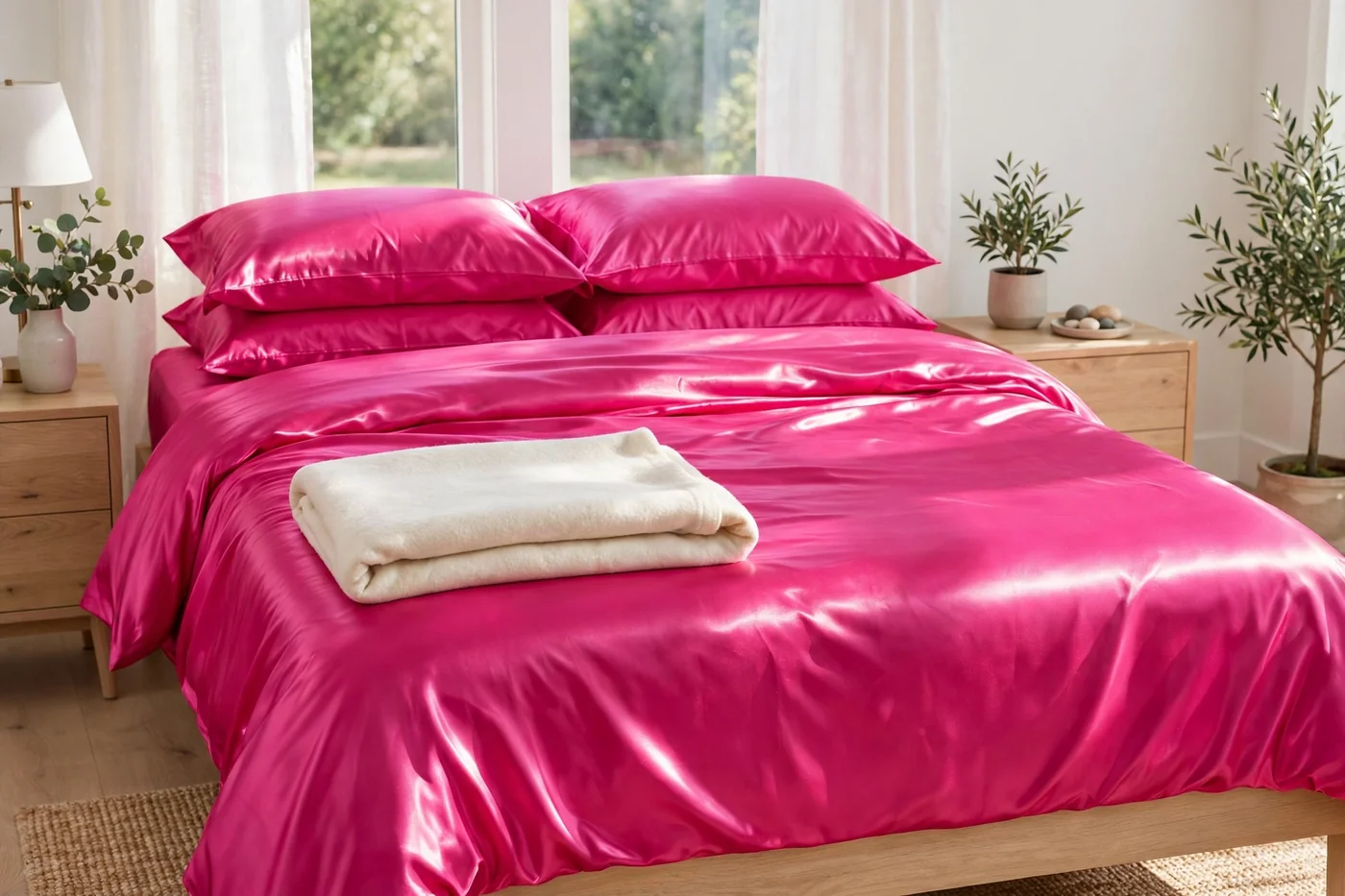
Satin vs Flannel Sheets: The Honest Guide
You walk into a bedding aisle, or you open a bedding tab, and two sets promise you the best night of sleep you have ever had. One shines. One looks like a cloud. The labels do not tell you the one fact that changes the whole comparison. Satin and flannel are not two versions of the same thing.
Satin names a way of weaving. Flannel names a brushed finish put on cloth that is usually cotton or wool. So this guide does not crown a fiber champion. It compares a smooth, glossy weave against a soft, fuzzy finish, and it tells you which bed each one suits.
If you want a short verdict first, here it is. Pick satin for smooth, cool, low friction sleep. Pick flannel for instant warmth on a cold night. If you run hot, or you toss and turn under a heavy duvet, satin will probably serve you better. If your bedroom stays cold and you love climbing into a warm bed, flannel is hard to beat.
What is the real difference between satin and flannel sheets?
Satin is a weave, and flannel is a brushed finish, so the two names describe different layers of how a sheet is made. A satin sheet gets its shine from long yarn floats on the face of the cloth. A flannel sheet gets its softness from fibers brushed up into a nap.
That single distinction explains almost everything that follows. Satin weave, as described by the Museum of Fine Arts, Boston materials database CAMEO, is a basic weave pattern with a shiny face and a dull back. Each weft strand floats over several warp strands before it goes under one, and those floating threads reflect light strongly. That is why a satin sheet shines. It is also why the surface feels so smooth under your cheek. Very few threads cross on the face, so very little stands up to catch your skin.
Flannel works the other way round. The cloth underneath is usually a plain or twill weave, and then the maker brushes the surface to raise fine fibers into a nap. Merriam-Webster defines flannel as a soft twilled wool or worsted fabric with a loose texture and a slightly napped surface, and it also defines a napped cotton fabric that copies the texture of wool flannel. The University of Kentucky extension guide agrees: cozy flannel sheets are made by brushing the surface of plain weave fabric. In bedding, cotton flannel is the common version. The nap is the point. It traps air, it feels warm the moment you touch it, and it gives flannel that matte, fuzzy look.

Which sheet feels smoother against your skin?
Satin feels smoother, and the reason sits right on the surface of the cloth. Long floats leave an almost unbroken face, so your skin meets a flat, glossy plane with very little texture to catch on. Flannel feels softer in a different sense, because its raised nap cushions your skin, but it is not smooth in the same way.
Think of the difference between sliding a hand over glass and pressing it into a thick towel. Glass is not soft, but nothing catches. A towel is soft, but your hand meets thousands of tiny fibers. Satin is the glass side of that comparison, flannel the towel side. Both can feel pleasant. They please different senses.
For hair and skin, the smooth face is where satin earns its reputation. Less friction means less tugging as you turn in the night. That matters most on a pillowcase, where your face and hair stay in contact for hours. On a full sheet set, the effect is subtler, because your body moves across a larger area and your sleepwear sits between skin and sheet. Still, if you wake with creased cheeks or tangled hair, the sheet surface is one place to look.

Which sheet keeps you warmer?
Flannel keeps you warmer, and the nap is the mechanism. Brushing raises fine fibers that stand up from the cloth, and the spaces between those fibers hold still air. Still air insulates. Your body warms that trapped layer, and the layer stays put instead of drifting away.
Satin does not work that way. Its face is flat and dense with floats, and it holds very little air on its surface. A satin sheet can still be part of a warm bed, because warmth also comes from your duvet, your mattress pad, and the room itself. But the sheet alone adds little insulation. If your bedroom drops cold in winter and your duvet is light, a satin sheet will not close the gap. A flannel sheet will help, at least for the layer closest to your skin.

Which sheet breathes better on a warm night?
Satin usually breathes better on a warm night, because its flat face traps little air against your body. Heat can move away from your skin more easily, and the smooth surface does not cling when you sweat. Flannel, by design, holds air close, and that trapped layer becomes a drawback when the room is warm.
Fiber decides how much of this holds true. Cotton flannel breathes better than a heavy synthetic flannel, because cotton fibers take up moisture and release it. Polyester satin can feel clammy to some sleepers, because polyester does not absorb moisture the way cotton or silk does. So a silk satin sheet and a polyester satin sheet are not the same summer sheet, even though both use the satin weave. Check the fiber before you trust the weave name alone.
How do satin and flannel sheets compare side by side?
The table below sums up the comparison in one place, so you can check a row, make a call, and move on. It compares the weave against the finish, not one fiber against another, because fiber changes several rows on its own.
| Feature | Satin sheets | Flannel sheets |
|---|---|---|
| What it is | A weave with long floats and a glossy face | A brushed finish, usually on cotton or wool cloth |
| Surface feel | Smooth, slick, cool to the touch | Soft, fuzzy, warm at first touch |
| Warmth | Low on its own, adds little insulation | Higher, because the nap traps air |
| Breathability | Better on warm nights, less trapped air | Lower in practice, because the nap holds warm air close |
| Slip | High, skin and hair slide easily | Low, the nap grips gently |
| Pilling and snagging | Snags more easily, long floats catch | Pills more easily, raised fibers ball up |
| Care | Gentle handling, protect the face from abrasion | Gentle cycle, low heat, skip fabric softener |
| Look | Glossy, formal, light catching | Matte, cozy, casual |
| Best season | Warm months, or warm rooms | Cold months, or cold rooms |
A heavy silk satin and a thin polyester satin do not behave alike. A light cotton flannel and a heavy wool flannel do not behave alike either. Use the table to narrow the field, then read the fiber line and the care label before you buy.

Which sheet pills, snags, or wears out first?
Each sheet fails in its own way, and that weakness follows from the very structure that makes it pleasant. Satin snags. Flannel pills. If you know which failure bothers you more, you know which risk you are accepting in advance.
Satin snags because its floats are long and exposed. CAMEO notes that the low frequency of interruptions in a satin weave makes a flexible fabric that drapes well, but also snags easily. A sharp nail, a rough heel, a zipper left open in the wash, or a pet claw can catch one float and pull it out of line. Once pulled, that thread shows. You cannot always press it back. So satin sheets reward careful handling: trimmed nails, closed zippers, no rough Velcro in the same load, and no dragging the sheet across a rough mattress edge.
Flannel pills because its nap is made of raised fibers, and raised fibers rub, break, and roll into tiny balls. The softer and fuzzier the flannel at first, the more fiber sits ready to pill. Washing with rough items, drying on high heat, and using fabric softener all speed the process, because they stress the fibers and coat them. Pilling does not always mean a sheet is ruined. A fabric shaver can clear light pilling, and a good flannel sheet can keep its warmth after the surface settles. But a cheap, loosely spun flannel can pill fast and look tired within a season.
Durability, then, is less about satin against flannel and more about quality within each type. A well made satin sheet in a strong fiber can last years with gentle care. A well made, densely woven flannel sheet can last years too, and its nap will flatten a little with use, which is normal. A thin satin sheet will snag early. A thin flannel sheet will pill early and thin out. Price alone does not guarantee quality, but very cheap sheets in either type usually cut the fiber or the weave density, and that shows up first in wear.
How should you wash each sheet?
Wash satin gently and protect its face, and wash flannel gently and protect its nap. Both sheets dislike rough treatment, but they dislike it for different reasons, so the same wash routine does not fit both perfectly. Care that suits one can damage the other.
For satin, turn the sheets inside out if you can, close every zipper and fastener in the load, and wash on a gentle or delicate cycle in cool water with a mild detergent. Keep the load light, so the sheets do not twist hard against each other. Skip harsh bleach, and do not wash satin with towels, jeans, or anything with hooks or Velcro. Dry on low heat or line dry, and take the sheets out while they are still slightly damp if your label allows it, so you can smooth them by hand. Heat and abrasion are the enemies here, because both break floats and dull the shine.
For flannel, use cool water and a gentle cycle too, with a mild detergent, and dry on low heat or line dry. Skip fabric softener and dryer sheets. Softener coats fibers, and coated fibers lose the soft, open feel that makes flannel pleasant, and they can pill more as the coating builds up. Wash flannel on its own or with other soft items, and do not overload the machine, because a packed drum rubs the nap harder. Shake the sheets out before drying, so the nap does not dry in clumps.
Which costs more, and what should you check on the label?
Silk satin costs the most, polyester satin costs far less, and cotton flannel usually sits in the middle, so the price contest has no single winner. The fiber sets the price more than the weave or the finish does, and the brand, the weight, and the construction add their own layers on top.
That is why two listings with the same headline can differ wildly in price. One “satin sheet set” might be silk, woven in a satin weave, with a strong fiber and a careful finish. Another might be thin polyester, woven the same way, with less fiber and looser construction. Both are satin sheets in the weave sense. They are not the same product. The same split applies to flannel. A dense cotton flannel and a thin synthetic flannel share a brushed finish, but they do not share a lifespan.
Before you pay, check five things on the label or listing. First, the fiber and its percentage. Second, whether the satin is silk, polyester, or something else, and whether the flannel is cotton, wool, or a blend. Third, the care instructions, because a sheet you cannot wash the way you live with will not last. Fourth, the pocket depth and the mattress size it truly fits. Fifth, the return policy, because feel is personal and a photo cannot tell you how a sheet will feel at night.
Be wary of three label tricks. One, a thread count quoted for flannel, where weight tells you more than thread count. Two, a “satin” claim with no fiber named, where you cannot tell silk from polyester. Three, a “luxury” claim with no construction detail at all, where the word does the work that the fiber should do. If a listing hides the fiber, treat that as information, and shop elsewhere.
Who should pick satin, and who should pick flannel?
Pick satin if you run hot, if you move a lot in your sleep, or if you want low friction for hair and skin. Pick flannel if your bedroom stays cold, if you love instant warmth, or if you like a soft, matte, cozy bed.
Season is the simplest way to decide. In summer, or in a warm room, satin gives you a cooler, slicker surface and lets heat escape. In winter, or in a cold room, flannel gives you a warm layer that greets you at once. In spring and autumn, either can work, and the rest of your bedding decides. A light duvet pairs well with flannel in early autumn. A heavier duvet pairs well with satin in late spring, when the nights are warm but not hot.
Sleep type refines the choice further. Hot sleepers should lean satin, and they should check the fiber, because a light silk or cotton rich satin will serve them better than a heavy polyester satin. Cold sleepers should lean flannel, and they should check the weight, because a heavier flannel holds more warmth. Restless sleepers who turn often may prefer satin, because the low friction surface lets them move without tugging the sheet. Still sleepers who stay in one spot may prefer flannel, because the gentle grip keeps the sheet where they left it, and the nap keeps the spot warm.

Can you mix satin and flannel on one bed?
Yes, and mixing is often the smartest answer to a comparison that pretends you must pick one fabric for the whole bed. A bed is a system, not a single sheet, and different layers can do different jobs without fighting each other.
The most useful mix is satin pillowcases with flannel sheets in winter. Your face and hair get the low friction surface, while your body gets the warmth of the nap. The pillowcases also last longer that way, because they take less of the wear that a full flannel set takes, and they are cheaper to replace than a whole set if they snag.
Frequently asked questions
Is satin warmer than flannel?
No. Flannel is warmer in normal use, because its brushed nap traps a layer of still air against your body. Satin has a flat, glossy face that holds little air, so it adds little warmth on its own. Your duvet and room temperature still matter, but the sheet comparison leans clearly toward flannel for warmth.
Is flannel a type of satin?
No. Flannel is a brushed finish, usually applied to cotton or wool cloth, while satin is a weave defined by long floats on the face of the cloth. The two names describe different stages of making fabric. A sheet can be woven in a satin weave, or finished as flannel, but flannel is not a kind of satin.
Are satin sheets good for hot sleepers?
Yes, satin sheets usually suit hot sleepers better than flannel, because the flat face traps less warm air and lets heat move away more easily. Fiber still matters, so check it. A light silk or cotton rich satin will feel cooler than a heavy polyester satin, and the rest of your bedding must stay light too.
Do flannel sheets make you sweat?
Flannel can make warm sleepers sweat, because the nap holds warm air close to the body, and that trapped layer builds up through the night. Cotton flannel breathes better than heavy synthetic flannel, but it still holds more warmth than satin. If you often wake damp, switch to satin in warm months and save flannel for cold nights.
Which is better for curly hair, satin or flannel?
Satin is better for curly hair, because its smooth face creates less friction as you turn, and less friction means less tugging, frizz, and breakage overnight. Flannel grips gently, and that grip can disturb curls. A satin pillowcase alone can give you most of the benefit, even if you keep flannel sheets on the rest of the bed.
Do satin sheets slip off the bed?
Satin sheets can slip more than flannel, because the smooth face grips less, and the fitted corners can ride up if the pocket depth is wrong. Fix the fit first: measure your mattress depth, buy a pocket that truly fits, and check that the elastic holds. A fitted sheet that fits will stay put far better than a loose one, whatever the fabric.
Which lasts longer, satin or flannel sheets?
Neither lasts longer in every case, because each fails differently and quality matters more than the category. Satin snags when floats catch, and flannel pills when raised fibers rub into balls. A well made set in either type, washed gently and kept away from rough items, can last years. A thin, cheap set in either type will show wear early.
Can I use satin sheets in winter and flannel sheets in summer?
You can, but the pairing works against each fabric. Satin in winter adds little warmth, so you will need a heavier duvet to stay warm. Flannel in summer holds warm air close, so you may overheat. The natural rotation is satin for warm months and flannel for cold months, with a plain cotton set for the weeks in between.


