


What Needle to Use for Satin: Size and Type by Fabric Weight
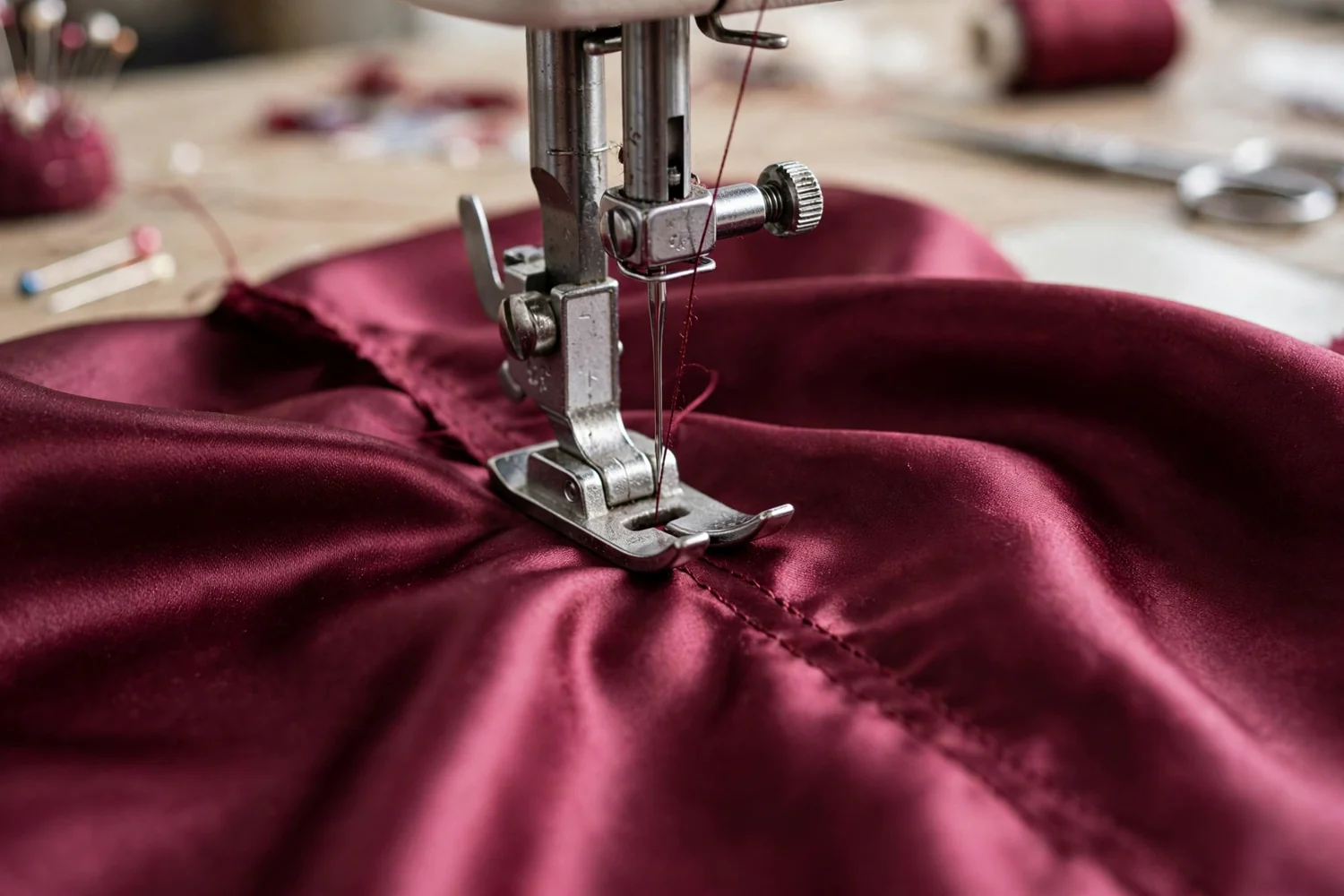
You bought the satin and threaded the machine. Then the seam came out puckered, or the fabric shows a row of tiny holes you cannot press away. The needle is usually the reason, and it is the cheapest part of the whole project to fix. Satin forgives almost nothing. Its smooth face shows every puncture, and its long floating yarns snag when a point drags instead of piercing cleanly. A needle that works fine on quilting cotton can wreck a satin bodice in one seam. The fix is a fine, sharp needle in the right size, tested on a scrap first. This guide covers needle choice only, not the full sewing steps. For cutting, seam finishes, and pressing, read our guide on how to sew satin. Here you get the decision itself: point, size, weight, fiber, and the scrap test.
What needle should you use for satin?
Use a fine, sharp needle. For most satin, that means a Microtex (sharp) needle or Schmetz’s Black Super Fine needle in size 60/8 or 70/10. Start with 70/10 for medium satin, drop to 60/8 for light satin, and test on a scrap first. That short answer covers most projects, but satin is not one fabric. It is a weave made in many weights and from several fibers, and the right size shifts with both. Schmetz lists satin in its Needle ABC guide under one line: “Satin: Black Super Fine Needle 60, 70.” That is the only satin-specific size the maker publishes, and it puts satin at the fine end of the range. The Black Super Fine needle has a slim, slightly rounded point and a nonstick coating, and Schmetz describes it for very fine, light fabrics such as silk, organza, voile, and viscose. The Microtex needle is sharper, with a particularly acute, slim point for very fine or densely woven materials. Pick Black Super Fine for light satin and the gentlest handling. Pick Microtex for the sharpest point, for topstitching or for satin that resists the needle. A fine universal needle in 70/10 can work when neither is on hand. Universal needles have a slightly rounded point and suit a wide range of materials, so they are the fallback, not the first pick. On satin the rounded point shows up as snags or a faintly puckered seam. If you sew satin often, keep Microtex 60/8, 70/10, and 80/12 in the drawer.
Why does satin punish the wrong needle?
Satin shows needle damage because its weave leaves long yarns floating on the face, and those floats catch, shift, and hold every mark. A dull or thick needle pushes those floats aside instead of slipping between them, and the hole it leaves stays visible. The Museum of Fine Arts, Boston, conservation reference CAMEO puts it plainly: each weft strand floats over 3 to 12 warp strands then under a single strand, and the floating threads reflect light, which produces the characteristic satin sheen. The same entry adds the catch: the low frequency of weft and warp interruptions makes a flexible fabric that drapes well, but also snags easily. Few interruptions mean few places where a displaced yarn can hide, so a snag on satin sits on a mirror. Weight makes the problem worse in both directions. Light satin has little body, so a thick needle punches a hole the fabric cannot close around. Heavy satin has dense yarns, so a dull needle forces its way through and drags yarns with it. You cannot press a needle hole out of satin. The hole stays. This is also why a fresh needle matters more for satin than for most fabrics. Schmetz warns that worn or damaged needles lead to frayed threads, thread breakage, skipped or uneven stitches, seam puckering, damaged textiles, and a popping sound during sewing. Schmetz recommends replacing the needle after about 8 hours of sewing time, or at the start of each new project. For satin, take the stricter version.
What do the numbers on a needle packet mean?
A packet marked 70/10 carries two numbers for one needle. The first is the European metric size, the second is the American size. Both describe the blade diameter, and in both systems a higher number means a thicker needle. Read the first number and you already know the blade thickness in tenths of a millimeter. Schmetz explains the metric side directly: the NM number equals 100 times the blade diameter in millimeters, so NM 90 means a 0.9 millimeter blade. The SIZE standard is common in many English speaking and Asian countries, and the rule holds for both. So a 60/8 needle is finer than a 70/10, which is finer than an 80/12. Size is only half the packet. The other half is the type, which is the point shape. Schmetz marks the type with a color band on the shank: purple for Microtex. The type decides how the point meets the yarns: a slim acute point pierces densely woven fabric, a medium ball point slips between knit loops, and a cutting point slices leather. Buying by size alone and ignoring type is how people end up with a fine needle that still damages satin. Schmetz gives one more rule: choose the needle size according to thread thickness and the needle type according to fabric application, because the thread must run freely through the needle eye. Schmetz offers a quick check: hold the threaded needle at an angle of about 45 degrees, and if the size and thread match well, the needle will slowly slide down the thread under its own weight. If it sticks, the thread is too thick for the eye. If it drops fast, the eye is too big for the thread.

Which needle size fits each satin weight?
Start from what the maker publishes, then let the scrap test settle the rest. Schmetz lists satin at sizes 60 and 70, so those two sizes are the confirmed ground. Heavier satin needs a thicker needle, but no published satin chart gives those sizes. Britannica notes that satin is made in a wide variety of weights for various uses, including dresses, evening wear, linings, bedspreads, and upholstery. A lining satin and a duchess satin share a weave and almost nothing else, so they do not take the same needle. The table gives a starting needle for each weight class, plus what to do when the scrap test disagrees.
| Satin weight | Start with | If the scrap test fails | Note |
|---|---|---|---|
| Light satin: charmeuse, blouse weight, lingerie weight | Microtex or Black Super Fine 60/8 or 70/10 | Holes show: drop to 60/8. Skipped stitches: check the thread match and fit a new needle | Schmetz publishes 60 and 70 for satin |
| Medium satin: dress weight, standard bridal satin | Microtex or Universal 70/10 | Needle bends or skips on layered seams: test 80/12 on a scrap | 80/12 is a scrap test step up, not a published satin figure |
| Heavy satin: duchess, bridal satin with body, upholstery weight | Microtex or Universal 80/12 | Thick layers or interfacing fight back: test 90/14 on a scrap | 90/14 is a scrap test step up, not a published satin figure |
Layers change the answer too. A single layer of medium satin sews happily on 70/10, but the same fabric doubled at a waistband seam, plus interfacing, may need 80/12. Test the thickest part of your project, with the same layers and interfacing.

How do fiber and finish change the choice?
Satin is a weave, not a fiber, so the fiber under the weave changes how the needle behaves. Silk satin, polyester satin, and acetate satin all shine the same way, but they do not sew the same way. The needle that glides through silk satin can drag on polyester satin, so check the fiber before you choose. Britannica puts the point plainly: satin was originally a silk fabric, but it is now made of yarns of other fibers. CAMEO names the common ones: silk, polyester, and nylon fibers are commonly used with this construction. Silk satin has fine, smooth yarns and a soft hand, so it takes the finest needle happily and shows holes most clearly. Polyester satin has springier, tougher yarns that resist the needle a little more, so a sharp Microtex point earns its keep. Acetate satin is soft and heat sensitive, so it needs a fine needle and gentle handling, and it marks if pressed wrong, a care problem covered in our guide on how to get wrinkles out of satin. Finish changes the choice as well. Matte satin has a duller face because its yarns or finish scatter more light, and it can hide a small needle mark better than a high shine satin. That does not mean you can use a thick needle on it. It means a small mistake costs less. Read our guide on what is matte satin if you are unsure which finish you hold. Crepe backed satin has a dull crepe reverse that grips a little more under the foot, but the satin face still needs the same fine, sharp needle. Linings add one more wrinkle: a lined garment sews satin against lining, and the needle has to suit both layers. When the lining is fine, the finer needle wins. When you sew satin to a heavier fabric, test the combination, not each fabric alone, because the needle that suits the satin may bend on the heavier layer. The scrap test on the real layer stack settles it.
What about hand sewing satin?
Hand sewing satin calls for the same idea in a smaller package: a fine, sharp hand needle, short stitches, and no dragging the needle through the fabric. Machine needle sizes do not carry over to hand needles, so judge by eye and by test, not by number. Pick a sharp hand needle, sometimes sold as a sharp or milliners needle, in a fine size that passes through your satin without leaving a visible hole. Thread it with a fine thread to match. Sew short, even stitches, pulling the thread in the direction of the weave, not against it, so yarns are not dragged sideways. For holding pieces before machine sewing, use fine pins inside the seam allowance. Hand baste first when the fabric shifts.
How do you test a needle on a scrap before you sew?
Cut a scrap from the same satin, sew a short seam on it, and read the result before the needle touches your project. The whole test takes five minutes and saves a garment. Use the same thread, the same layers, and the same interfacing, or the test will flatter a needle that fails on the real seam. Start with a scrap at least as large as your hand, cut from the same fabric and on the same grain. Fold it the way your seam will fold, and add the same interfacing or lining if your seam has any. Fit a new needle, not the one left in the machine, thread it with the thread you plan to use, and sew a straight seam about 10 centimeters long. Then stop and look. Check four things in order. First, the face under good light: a row of holes means the needle is too thick or dull, so drop a size or fit a new needle. Second, the seam itself: puckering points to a needle that is too thick, a thread that is too heavy, or tension that needs easing, so change one thing at a time and sew again. Third, the stitches: skipped or uneven stitches can mean a damaged needle or a thread that does not suit the eye. Fourth, the back: looping thread means the thread and needle are mismatched. Run the test again with the next size down or up, and keep the winning scrap. Pin it to your pattern with a note of the needle size and thread you used. A new fabric means a new scrap, even if the last one sewed beautifully.

Which needles should you skip for satin?
Skip ballpoint, stretch, jeans, and leather needles on satin. Each one is built for a different job, and each one damages satin in its own way. Ballpoints push yarns aside, jeans needles run too thick, and leather needles cut instead of parting the weave. Ballpoint and jersey needles have a medium ball point made to slip between the loops of knit fabric without breaking fibers. Schmetz describes the jersey needle exactly that way: a medium ball point for knitwear, designed to avoid breakage of fibers at stitch creation. Satin is woven, not knit, so there are no loops for the ball to slip between. The rounded point pushes woven yarns aside, which shows up as puckering or skipped stitches. Stretch needles fail satin for the same reason. Jeans needles have a reinforced blade and a medium ball point for denim and similar rigid woven fabrics. They are strong, but strength is not what satin needs. A jeans needle is too thick for light and medium satin, and its point is not sharp enough for the dense satin weave. Leather needles are worse: they carry a cutting point, and Schmetz states plainly that leather needles are not suitable for woven or knitted fabrics. A cutting point slices yarns instead of parting them. Topstitch and embroidery needles are special tools, not defaults. A topstitch needle has a long eye for thick or multiple threads, which suits decorative topstitching if the thread is heavy. An embroidery needle has a wide eye and groove for specialty threads. For plain seams, Microtex, Black Super Fine, or a fine universal needle is the right tool.

Why is your satin puckering, skipping, or tearing?
Most satin needle problems trace to five causes, and each one has a different fix. Work through them in order instead of changing everything at once. Change one thing, sew a fresh scrap, and read the result before you move to the next suspect. Holes along the seam line mean the needle is too thick or dull. Fit a new needle one size finer and sew a fresh scrap. If the holes vanish, you found it. If they stay, the point type is wrong, so switch from a universal to a Microtex or Black Super Fine needle. Puckering means the fabric gathers along the seam instead of lying flat. A needle that is too thick is one cause, because the hole it makes is bigger than the thread can fill. A thread that is too heavy is another. Tension that is too tight is a third. Change the needle first, since it is the cheapest fix, then check the thread match, then ease the tension and test again. Schmetz lists seam puckering among the signs of a worn or damaged needle. Skipped stitches mean the machine missed forming a stitch. A damaged needle is the first suspect, and Schmetz lists skipped stitches with frayed threads and puckering as the classic signs of a worn needle. A wrong needle type is the second suspect, especially a ballpoint on a woven fabric. A thread that is too thick for the eye is the third. Fit a new, correct needle, check the thread match, and sew a scrap first. Thread breaks point to friction. A needle eye that is too small for the thread shreds it on every stitch. A burr on a worn needle does the same. Schmetz notes that the industrial blade design with rounded edges on the thread groove minimizes thread breakage. Fit a new needle of the right size for the thread. Bent or broken needles mean the needle is too fine for the job or the fabric is being pushed. A 60/8 needle will bend on thick layered seams, which tells you to step up a size. Pulling the fabric instead of letting the machine feed it bends any needle. Step up one size and test on the real layer stack.
Frequently asked questions
Can I sew satin with a regular universal needle?
Yes, if it is fine and new. A universal needle in 70/10 will sew most medium satin acceptably, because its slightly rounded point suits a wide range of materials. It is not the best choice, though. On light satin or on topstitching, a Microtex or Black Super Fine needle pierces more cleanly and leaves less marking. Use the universal needle when it is what you have.
What size needle is best for charmeuse?
Charmeuse is a light satin, so start with 60/8 or 70/10 in a Microtex or Black Super Fine needle. Schmetz lists satin at sizes 60 and 70, which covers charmeuse directly. Sew a scrap first and look at the face under good light. If you see holes, drop to 60/8.
Do I need a different needle for silk satin versus polyester satin?
Start with the same fine, sharp needle for both, then let the scrap test decide. Silk satin has fine yarns and shows holes most clearly, so it rewards the finest needle that sews cleanly, usually 60/8 or 70/10. Polyester satin has tougher, springier yarns, so a Microtex point helps it pierce cleanly, and you may land on 70/10 or 80/12 for heavier polyester satin.
Why does my satin show holes after I sew it?
The needle is too thick, dull, or the wrong point type. A thick blade punches a hole the yarns cannot close around, and a dull point drags yarns instead of parting them. Fit a new Microtex or Black Super Fine needle one size finer and sew a scrap. If the holes vanish on the scrap, the needle was the problem. If they stay, the thread may be too heavy for the eye.
How often should I change the needle when sewing satin?
At the start of every satin project, and sooner if problems appear. Schmetz recommends replacing the needle after about 8 hours of sewing time, or at the start of each new project. Satin shows wear earlier than cotton does, so take the project rule. If skipped stitches, puckering, or thread breaks appear mid project, change the needle first.
Can I use a ballpoint needle on satin?
No. Ballpoint needles are built for knits, where the rounded point slips between loops without breaking fibers. Satin is woven, so there are no loops to slip between, and the rounded point pushes yarns aside instead of piercing them. The result is puckering, skipped stitches, or snags. Use a sharp or Microtex point for satin.
What needle should I use to sew satin by hand?
Use a fine, sharp hand needle, sometimes sold as a sharp or milliners needle, with a fine thread to match. Machine sizes do not apply to hand needles, so judge by test: the needle should pass through your satin without leaving a visible hole. Sew short, even stitches, keep pins inside the seam allowance, and baste by hand first when the fabric shifts. Satin rewards a small, careful choice before the first seam. A fine, sharp needle in the right size, a thread that matches its eye, and a five minute scrap test will save a garment that took hours to cut. When you are ready for the rest of the job, our guide on how to sew satin covers the steps that come after the needle. For keeping the finished piece looking new, read our guides on how to store satin, does satin shrink, and how to remove stains from satin.


