


Acetate Satin: What It Is, How to Care for It and When to Choose It
What is acetate satin?
Acetate satin is satin woven from acetate, a man-made fibre made from cellulose. It has a silky, glossy surface and a fluid drape, it costs less than silk, and it is one of the most common fibres in linings and occasion wear. It is also one of the most delicate: it loses strength when wet, melts at low heat and dissolves in acetone. Those three facts decide almost everything about how to buy, wear and clean it.
Satin is a weave and acetate is a fibre, so acetate satin is simply the satin weave done in acetate. This guide explains where acetate comes from, how it differs from rayon, triacetate and polyester, what its strengths and weaknesses are, and how to wash, press and store it without damage. Our comparison of satin vs rayon covers the closest relative.
What is acetate made from?
Acetate is made from cellulose, usually wood pulp or cotton linter, that is chemically modified and spun into filament. According to Wikipedia’s article on cellulose acetate, the pulp is purified, treated with acetic acid and acetic anhydride, using sulfuric acid as a catalyst, and partly hydrolysed to reach the properties wanted. The product is dissolved in acetone and pushed through spinnerets, and the solvent evaporates in warm air in a process called dry spinning.
Most textile acetate has acetate groups on about two of every three hydroxyl sites on the cellulose chain. That detail explains why acetate is called a derivative and not a regenerated fibre, and it is the basis of the legal definition below.
The legal definition matters when you read a label. Under the US Federal Trade Commission rules, acetate is a manufactured fibre in which the fibre-forming substance is cellulose acetate, and the name triacetate may be used when at least 92 percent of the hydroxyl groups are acetylated. You can read the wording at Cornell Law School’s Legal Information Institute.
How did acetate become a satin fibre?
Acetate has been a commercial textile fibre for about a century. Wikipedia’s account runs like this:
- 1865: Paul Schützenberger showed that cellulose reacts with acetic anhydride to form cellulose acetate.
- 1903: Arthur Eichengrün and Theodore Becker made soluble forms.
- From 1904: Camille Dreyfus and his brother Henri developed the material, and they produced continuous filament yarn in 1913.
- 1924: Celanese made the first commercial acetate fibre in the United States, after the First World War delayed production.
Continuous filament is what makes satin possible, because the long smooth floats of a satin weave need long smooth yarns. Acetate filament gave weavers an affordable, glossy alternative to silk. Wikipedia lists satins, brocades, knits and taffetas among its typical fabrics.
How is acetate different from triacetate, rayon and polyester?
Acetate differs from the others in origin and in behaviour. Rayon is regenerated cellulose, acetate is a cellulose derivative, triacetate is a more fully acetylated version of acetate, and polyester is a fully synthetic polymer. The family tree shows the relationships, using the FTC definitions.

For satin buyers, the practical differences matter more than the chemistry. UGA Cooperative Extension’s Understand Your Fibers guide supports the comparison below.
| Fibre | Heat | Wet strength | Solvents | Care starting point |
|---|---|---|---|---|
| Acetate | Melts at low heat; creases and pleats are hard to set | Loses strength when wet | Destroyed by acetone, acetic acid and alcohol | Dry clean preferred; press damp, wrong side, lowest setting |
| Triacetate | Less heat sensitive; keeps creases and pleats | Not stated | Dissolves in acetone, nail polish remover and some perfumes | Usually machine washable |
| Rayon | Does not melt, may scorch | Weaker when wet | Strong acids and mildew damage it | Some dry clean; gentle wash |
| Polyester | Melts if too hot | Strong | Resists most strong chemicals | Low iron setting with steam |
| Silk | Does not melt, may yellow at high heat | Loses strength when wet | Not stated | Dry clean preferred; press cloth |
The weave is the same in all five, so the label is the only way to know which you are holding. Our guides to silk satin and polyester satin cover the two fibres you are most likely to compare it with.
What are the properties of acetate satin?
Acetate satin is lustrous, fluid and silky to the touch, and it dries quickly. Wikipedia describes acetate as having good drape and a smooth, satiny feel, and notes that it is often used to add sheen and body to fabrics. It also lists acetate as hypoallergenic, quick drying and resistant to static cling and mildew. UGA Extension agrees on the quick drying, good drape and silky feel.
Its weaknesses are just as clear, and they come from the same two sources:
- Weak when wet. Acetate loses strength quickly when wet.
- Poor abrasion resistance. It wears at seams, cuffs and folds sooner than polyester or nylon.
- Heat sensitive. It is thermoplastic, so it melts under a hot iron. UGA also notes that creases and pleats are hard to set.
- Solvent sensitive. It dissolves in acetone and several other organic solvents, and it is weakened by strong alkalis and oxidisers.
- Does not take ordinary dyes. The dyes used for cotton and rayon do not work on it.
Wikipedia notes that acetate generally does not shrink and usually survives washing or dry cleaning, though it recommends hand washing or dry cleaning. That is a useful reminder that acetate is not fragile in every respect. It simply has a few specific weaknesses that you must avoid.
Is acetate satin a good fabric?
Acetate satin is a good fabric for the right job and a poor one for the wrong job. It suits garments that are worn gently, cleaned professionally and valued for their drape. It suits linings, because a lining is protected from abrasion and heat. It is a weaker choice for items that will be washed hard, ironed hot or worn in the rain.
| Strengths | Weaknesses |
|---|---|
| Silky drape and gloss at a modest price | Weak when wet |
| Dries quickly | Melts at low heat |
| Resists static and mildew | Dissolves in acetone |
| Does not usually shrink | Poor abrasion resistance |
| Smooth against the skin, and suits linings | Needs special dyes, so colour options may be narrower than for polyester |

Where is acetate satin used?
Acetate satin is used where gloss, drape and low cost matter more than toughness. Wikipedia lists linings, wedding gowns and other bridal wear, dresses, blouses, party attire, award ribbons, buttons, and home furnishings such as draperies and slipcovers. In the satin world the most common uses are these.
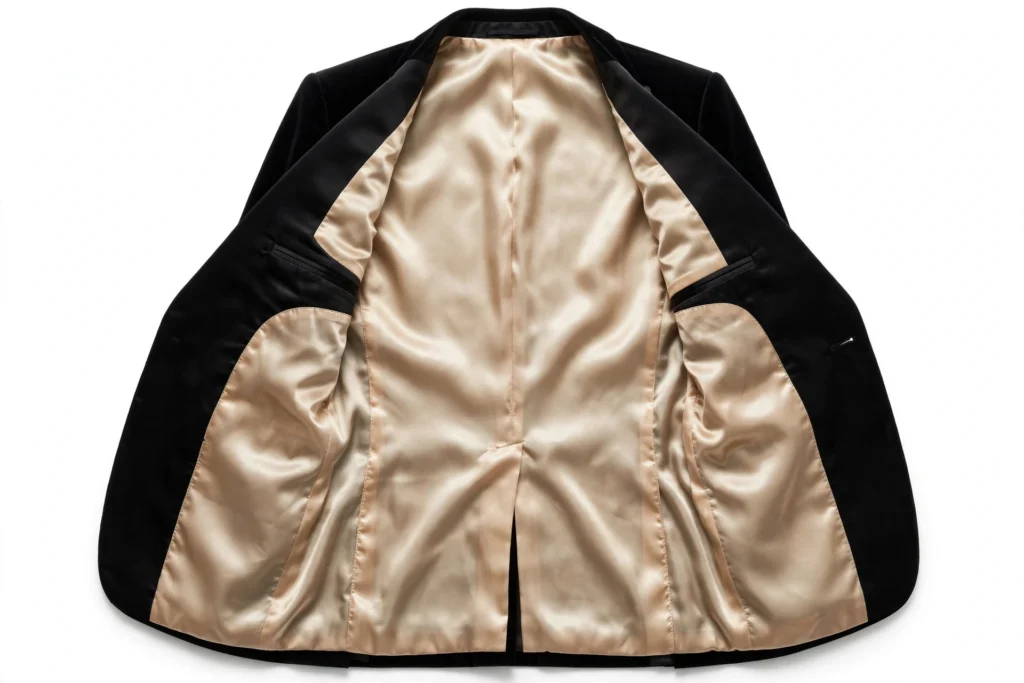
- Linings. Smooth, slippery and affordable, so a jacket slides on and off easily. A satin lining like the one in the photo is often acetate or polyester, and the label tells you which.
- Bridal and occasion wear. Dresses and gowns that are worn once or twice and cleaned professionally.
- Ribbons and trims where wear is light.
- Blouses and party dresses in a fluid satin.
- Blends with silk, cotton, wool and nylon, which Wikipedia notes are common.
If you are choosing between a lining that will last and one that looks good, polyester is stronger. If you want a silky hand at a lower price than silk, acetate is a sensible option. See how to wash satin for the care by fibre.
How can you tell acetate satin from silk or polyester satin?
Read the fibre content label. That is the only reliable test. Under US rules the label must name the fibres, and acetate and rayon must be listed separately, so a label that says acetate means acetate. Photos and feel will not tell you, because the three look similar in satin.
- Check the label or listing. Look for “acetate” or “triacetate” in the fibre line.
- Look at the care instructions. “Dry clean only” is a clue, though not proof.
- Ask the seller if there is no label, as with fabric by the yard.
- Do not test with acetone. Acetone does dissolve acetate, which is how labs identify it, but a home test destroys the sample and can harm you and your surfaces.
- Order a swatch and test heat on a hidden edge with the lowest iron setting.
How do you wash acetate satin?
The safest way to clean acetate satin is dry cleaning. UGA Extension lists dry cleaning as the preferred care, and if you do wash acetate, it advises lukewarm water and gentle squeezing, with no wringing. Always follow the label first.
- Check the label. If it says dry clean only, do not wash it.
- Test a hidden seam in lukewarm water for colour running.
- Fill a basin with lukewarm water and a mild detergent.
- Submerge and press gently for a minute or two. Do not rub or twist.
- Rinse in lukewarm water and squeeze out the water. Never wring.
- Roll it in a clean towel to blot, then dry flat or on a padded hanger away from heat.
The reason for the gentleness is that acetate is weakest when wet. Our general guide to washing satin by fibre gives the same advice in more detail.
How do you iron acetate satin?
Iron acetate satin on the lowest setting, damp, on the wrong side, with a press cloth on the right side. That is the UGA Extension advice, and it follows from acetate melting at low heat. Test on a hidden seam, because a mark cannot be undone.

- Set the iron to its lowest heat, usually marked with one dot.
- Press while the fabric is slightly damp, or use a steamer held at a distance.
- Always put a clean cloth between the iron and the fabric.
- Keep the iron moving, and never rest it on the cloth.
- Lift and press, do not drag. Dragging can stretch the weave.

Pleats and creases are hard to set in acetate, so do not expect a pressed pleat to last through washing. Our guide to how to iron satin gives the full method for each fibre.
What can damage acetate satin?
Four things damage acetate: heat, solvents, water and rubbing. The care card summarises the rules from UGA Extension and the FTC.

- Acetone. Nail polish remover is acetone based and will dissolve acetate on contact. Keep it away from garments, and keep garments away from nail work.
- Alcohol and acetic acid. UGA lists both alongside acetone as substances that can destroy acetate, so treat alcohol-based products with caution and test first. Some perfumes and hair sprays contain alcohol.
- A hot iron or dryer. Acetate melts at low heat.
- Hard rubbing. Its abrasion resistance is poor, so seams and folds wear first.
- Wringing wet cloth. Acetate is weakest when wet.
How do you remove stains from acetate satin?
Blot a stain quickly and take the garment to a dry cleaner if the stain is anything more than a light spill. Chemical spot cleaners are risky on acetate, and one wrong product can melt the fibre. Tell the cleaner it is acetate and mention what the stain is.
- Water-based spills: blot with a clean cloth. Do not rub.
- Oil and grease: blot and take it to a dry cleaner.
- Makeup and ink: do not use acetone or nail polish remover.
- Nail polish: do not use remover. Take it to a professional.
Our guide to removing stains from satin covers fibre-by-fibre treatments, and the acetate rules above take precedence where they differ.
How is acetate satin dyed?
Acetate needs special dyes. Wikipedia notes that the ordinary dyes used for cotton and rayon do not work on it, and it describes two ways colour is added: cross-dyeing, in which yarns of different fibres are dyed to make patterns, and solution-dyeing, which adds colour before the fibre is spun and gives strong fastness to sunlight, perspiration and washing. The article does not name a dye class, and neither do we.
For you, the practical message is simple. Do not try to dye acetate at home with a general-purpose dye. It will not take it, and the heat of a dye bath can damage the fibre.
When should you choose acetate satin?
Choose acetate satin when you want a silky drape at a low price and the item will be cleaned gently. Choose something else when the item will be washed hard or worn in the rain. The table matches uses to fibres.
| Use | Acetate satin | Better choice if it fails |
|---|---|---|
| Jacket or coat lining | Good: protected from wear and heat | Polyester for toughness |
| Wedding or evening dress, dry cleaned | Good for the drape and price | Silk for breathability and feel |
| Everyday blouse that is washed often | Weak, because of wet strength and wear | Polyester or silk |
| Ribbon and trims | Good for light use | Polyester for durability |
| Pleated skirt | Poor: pleats do not hold | Polyester, which keeps heat-set pleats |
How should you store acetate satin?
Store acetate satin clean, dry and away from heat and solvents. Wikipedia describes acetate as quick drying and resistant to mildew, but its weaknesses make storage choices important. Stains and body oils set over time, and creases can be hard to press out because UGA Extension notes that creases and pleats are hard to set in acetate.
- Clean the garment before storing it, since stains set in storage.
- Hang it on a padded hanger in a breathable garment bag, not in plastic.
- Keep it away from mothball chemicals, nail polish remover and sprays that contain solvents.
- Fold delicate pieces in acid free tissue and store flat if the garment is heavy.
- Avoid a hot attic or a car boot, since acetate melts at low heat.
How can you recognise acetate damage?
Acetate damage looks different from ordinary wear. Learn the signs so you can stop the problem from spreading.
| Sign | Likely cause | What to do |
|---|---|---|
| Shiny, hard or glazed patch | Iron too hot, so the fibre has softened and fused | Cannot be reversed; avoid ironing there |
| Hole with melted edges | Heat or acetone contact | Cannot be mended invisibly; consider a patch or a seam change |
| Wear at folds and seams | Poor abrasion resistance | Add a stay tape or line the seam |
| Stretched or torn wet area | Wet strength is low | Do not wring; dry flat |
| Colour change near a spill | A solvent has reacted with the dye or fibre | Take it to a professional cleaner at once |
What are the common myths about acetate satin?
A few beliefs about acetate are partly true and partly misleading. Sorting them saves you from avoidable mistakes.
- “Acetate cannot be washed.” Not quite. Wikipedia notes that it usually survives washing or dry cleaning, and UGA Extension gives a method for washing it. Dry cleaning is simply the preferred route.
- “Acetate is the same as rayon.” No. Rayon is regenerated cellulose and acetate is a cellulose derivative, and the FTC defines them separately.
- “Acetate is a type of silk.” No. It is a man-made cellulose fibre, though it can look similar in satin.
- “Acetate is cheap and therefore bad.” Price is not the issue. Acetate is a good lining and a pleasant drape fabric, and it is weak only where its weaknesses apply.
- “Acetate and triacetate are identical.” No. Triacetate has at least 92 percent of its hydroxyl groups acetylated, and UGA lists it as less heat sensitive.
Acetate, polyester or silk lining: which should you choose?
Choose by what the lining must survive. A lining sits inside a garment, so it faces friction from the body and from the outer fabric, and it faces heat only when you press it. That pushes the choice toward a strong, smooth fibre.
| Priority | Best fibre | Why |
|---|---|---|
| Durability and easy care | Polyester | Strong with good abrasion resistance, per UGA |
| Soft hand and breathability | Silk | Absorbent and comfortable; needs gentle care |
| Silky drape at a low price | Acetate | Good drape and a silky feel, but weak when wet |
| Pressed pleats that last | Polyester | Keeps heat-set pleats and creases, per UGA |
If the garment will be dry cleaned and worn occasionally, acetate is a sound and economical choice. If it will be worn hard and often, polyester usually outlasts it.
Frequently asked questions
What is acetate satin?
It is satin woven from acetate, a man-made cellulose fibre. The satin weave gives the gloss, and the acetate gives the silky drape and the delicate care.
Is acetate satin the same as silk?
No. Silk is a natural protein fibre, and acetate is a man-made fibre made from cellulose. They can look similar in satin, so check the label.
Is acetate satin the same as rayon satin?
No. Rayon is regenerated cellulose, and acetate is a cellulose derivative. Garment labels must list them separately.
Can you wash acetate satin?
Dry cleaning is preferred. If the label allows washing, use lukewarm water, squeeze gently and never wring.
Can you iron acetate satin?
Yes, on the lowest setting, damp, on the wrong side, with a press cloth. Test on a hidden seam first.
Why does nail polish remover ruin acetate?
Nail polish remover contains acetone, and acetone dissolves acetate. The damage is immediate and cannot be reversed.
Does acetate satin shrink?
Wikipedia notes acetate generally does not shrink. Heat can still distort it, so avoid hot water and dryers.
Is acetate satin a good lining?
Yes. A lining is protected from abrasion and heat, and acetate is smooth and affordable. Polyester is stronger if you need durability.
Where to go next
If you are choosing a satin fibre, compare acetate with silk, polyester and rayon using the Satin Database, and read the Satin Glossary for any term you want to check. The Satin Visual Library shows the fabrics side by side.


