


Satin Wedding Dresses: Which Satin, Which Shape and How to Care for the Gown
What is a satin wedding dress?
A satin wedding dress is a gown made from cloth woven in a satin weave, which gives the face a smooth, glossy surface and the back a duller one. Satin is a weave, not a fibre, so the gown can be silk, polyester or acetate, and the fibre decides how it feels, how it breathes and how it should be cleaned. The weight of the cloth decides the shape: heavy satin holds a full skirt, and light satin falls close to the body.
This guide explains why satin became a bridal classic, which satin suits which silhouette, how to choose between silk, polyester and acetate, how to judge white, ivory and champagne, what to inspect in a gown before you buy, and how to clean and store it afterwards using conservator advice. If you want the fabric itself in more depth, start with our guide to bridal satin.

Why is satin a classic wedding fabric?
Satin is a classic wedding fabric because it takes light well and holds a clean line. Its long floats reflect light in smooth sheets, so a satin gown looks luminous in photographs and in a candlelit room. It also comes in heavy weights that stand away from the body, which suits the sculpted skirts and trains that bridal design favours.
History helps explain the habit. Queen Victoria’s wedding in 1840 is the moment most people point to. According to Wikipedia’s article on the wedding of Queen Victoria and Prince Albert, her gown was white satin woven in Spitalfields in east London, trimmed with handmade lace from Honiton and Beer in Devon, and the choice helped to popularise the white wedding dress in Western bridal fashion.
It is worth correcting a common myth here. Victoria did not invent the white wedding gown. Wikipedia’s article on the wedding dress notes that Philippa of England wore a white silk tunic and cloak in 1406 and Mary, Queen of Scots wore white in 1559, and that white ball gowns were being published as wedding wear by 1816. White spread among the European upper class mainly because it was fashionable, and Victoria’s wedding, widely illustrated, gave it a push. White has been the dominant Western bridal colour since the middle of the twentieth century.
The takeaway for a buyer is practical. Satin has been used for wedding gowns for a long time because it does two things at once: it looks rich and it can be built into structure. Both qualities depend on the type of satin, which is the next decision.
Which type of satin suits a wedding dress?
Choose by the shape you want. Heavy satins such as duchess build structure, mid-weight bridal satin gives body at a lower price, and light satins such as charmeuse flow and cling. Our guide to duchess satin covers the heaviest option in detail.
Duchess satin is the classic bridal choice. Wikipedia describes duchesse satin as a soft, heavy, glossy satin made in France with fine silk threads, with a higher thread count in the warp and at least seven floating yarns, and says it was originally all silk but increasingly uses synthetic fibres. The SILKNOW thesaurus, a European cultural heritage vocabulary, defines it as a very soft, heavy satin-type fabric woven in an 8 to 12 end warp satin weave, usually dyed in solid colours. Wikipedia names two famous examples: Sarah Ferguson’s 1986 wedding dress in ivory duchesse satin with heavy beading, and Queen Silvia of Sweden’s 1976 gown.
| Satin type | Weight and character | Best for | Watch out for |
|---|---|---|---|
| Duchess satin | Heavy, soft, deeply glossy, structured | Ball gowns, full skirts, trains, beaded bodices | Warm to wear; shows every handling mark |
| Bridal satin | Mid weight to heavy, usually polyester, good body | Structured gowns on a budget | Can look flat and plastic if the quality is low |
| Charmeuse | Light, fluid, glossy face and dull back | Bias-cut slip gowns, fluid sheaths | Shows every seam, ridge and bump |
| Crepe-back satin | Satin face with a matte crepe reverse | Gowns where you want the choice of a glossy or a matte face | Check which side you want outward |
| Peau de soie | Medium to heavy, dull, finely ribbed | A quieter, matte alternative; see peau de soie | Sources disagree on its exact weave |
Ask the shop for the weight in grams per square metre, not just the name. Two gowns both described as heavy satin can feel very different, and the number lets you compare them. The Satin Database has a conversion table if the figure is quoted in momme.
Which satin silhouette is right for your wedding dress?
Match the silhouette to the weight of the satin. A full ball gown needs a cloth that stands away from the body, and a close-fitting sheath needs one that skims it. Choosing the wrong weight for the shape is the most common reason a satin gown disappoints.
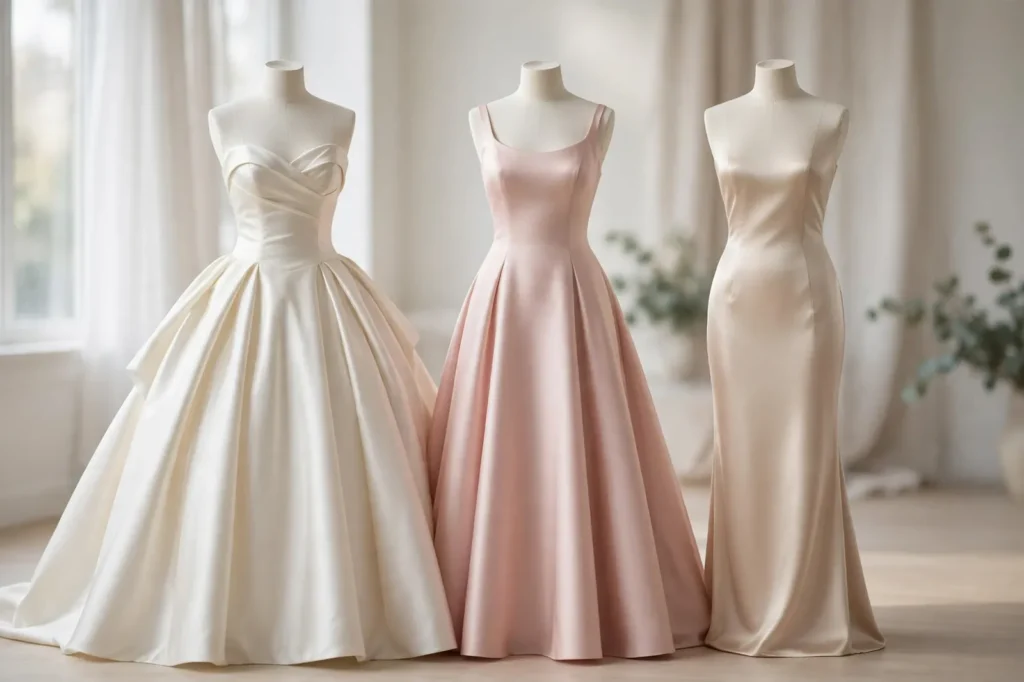
- Ball gown. Wikipedia describes the ball gown as an evening gown with a long, full skirt, and lists satin, silk, taffeta and velvet as the most common fabrics. Use a heavy satin, because a light one will collapse under the volume of the skirt.
- A-line. An A-line garment is fitted at the hips and widens gradually to the hem, forming the shape of the letter A, and Wikipedia notes that a popular wedding dress style fits above and around the hips and flares gently. It is forgiving: mid-weight to heavy satin both work, with heavier cloth giving a cleaner line.
- Sheath. Wikipedia describes the sheath dress as close-fitting and straight-lined, usually with no waist seam. A fluid satin such as charmeuse skims the body, but it shows every seam and undergarment line, so the fit and any lining matter more than anything else.
- Bias-cut slip gown. Cutting satin on the diagonal grain makes it stretch and cling, so light charmeuse falls in long fluid lines. It looks effortless on the right body and unforgiving on the wrong fit.
Remember that the satin face shows light as bands. A full skirt in heavy satin throws wide, quiet highlights, while a slim fluid gown throws small, busy ones. Neither is better. They are different moods, so look at the gown in daylight as well as under shop lights.
Silk, polyester or acetate: which fibre should a satin wedding dress be?
Silk satin feels softest and breathes best, polyester satin is the toughest and cheapest, and acetate satin has a silky drape but the most fragile care. The University of Georgia Cooperative Extension’s Understand Your Fibers guide supports the facts below.
| Fibre | Strengths | Weaknesses | Cleaning |
|---|---|---|---|
| Silk satin | Soft hand, strong when dry, absorbent | Loses strength when wet, takes up body oils and grease, can yellow with high iron heat | Dry cleaning preferred |
| Polyester satin | Strong, wrinkle resistant, holds a heat-set shape | Melts if too hot, absorbs body oils and odour, breathes less | Low iron with steam; check the label for washing |
| Acetate satin | Silky drape and gloss at a modest price | Loses strength when wet, melts at low heat, weak abrasion resistance, alcohol and acetone destroy it | Dry cleaning preferred |
The weather and the length of the day matter more than most brides expect. Polyester satin is the least breathable of the three, so a long summer wedding in a heavy polyester ball gown can be uncomfortable. Silk satin is the better choice for warmth management but costs more and needs more careful treatment. Acetate can be a good value for a gown worn once and cleaned professionally, but it is the fibre where spilled drinks and nail polish remover do the most damage. A fibre-by-fibre stain guide explains why you should not improvise on the day, and the safest rule is to blot and hand the gown to a cleaner.
Read the fibre content label, not the product name. A gown sold as satin tells you only the weave. The label tells you the fibre, and the care follows from it.
White, ivory or champagne: which satin colour should you choose?
Choose the shade by trying it against your skin in daylight, because white, ivory and champagne read very differently once they are lit and photographed. White is neutral to cool, ivory is warm and slightly yellow, and champagne is warmer again with a gold or pink cast. Wikipedia lists ivory, eggshell and ecru among the shades of wedding white.

- White. Crisp and bright, and the most demanding against warm skin tones and in harsh light. See our white satin guide for how to test white against ivory.
- Ivory. Softer and more forgiving, and the choice that most often looks expensive in photographs.
- Champagne. A pale gold. It flatters many skin tones and hides small marks, but it can look like a different colour in cold daylight.
- Blush. A pink-beige. It reads as a soft colour and not as a statement, and it is popular for modern gowns.
Do not compare a swatch with a gown across the room. Satin changes colour with the fold and the light, so the same cloth can look cream at one fold and white at the next. Ask to take a swatch to the venue, or to see the gown in natural light by a window.
Does a satin wedding dress have to be white?
No. White is the dominant Western bridal colour, but it is not a rule, and satin takes colour well. Wikipedia notes that white has been dominant since the middle of the twentieth century, and also records other traditions: red for Kurdish first-time brides and in Indian sari traditions, and black in Finland and other Nordic countries before the Victorian era. Modern brides choose blush, champagne, lavender, sky blue and many other shades.
Colour behaves differently in satin because the floats reflect light in bands. A pale shade looks soft and luminous, and a saturated shade shows a wide range from highlight to shadow. These five gowns show the effect on the same kind of mannequin and lighting.


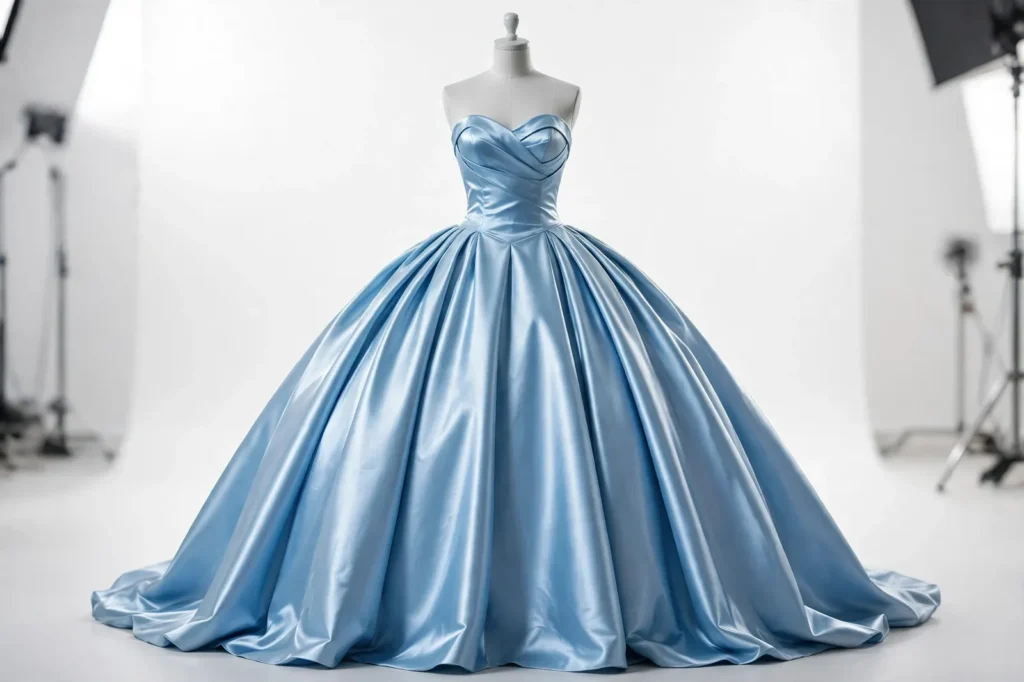


- Ivory and shiny ivory. The classic. Warm, flattering and forgiving in photographs.
- Blush pink. Soft and romantic. It reads as a neutral in most light and suits a full ball gown.
- Champagne. A pale gold that suits slim, fluid cuts.
- Lavender and sky blue. Pastel colours that read as a deliberate choice. Check how they look in daylight, because pastels can change tone.
- Test the dye. Strong colours can bleed or crock when new, so ask for a swatch and check the care label.
The white satin guide linked above covers the white and ivory decision in detail, and the Satin Color Library shows how 22 shades behave in light.
Which satin dress should bridesmaids and wedding guests wear?
Choose a colour that suits the wedding and the season, and avoid white, ivory and champagne unless the couple has said otherwise, because those shades are usually reserved for the bride. This is a social convention, not a rule of fabric. Satin works well for bridesmaids and guests because it photographs richly, and it is easier to wear in short and midi lengths than in a full gown.


- Deep colours. Burgundy, emerald and royal blue suit autumn and winter evening weddings and hide small marks well.
- Warm metallics. Gold satin catches candlelight, but a pale gold can look close to champagne, so check with the couple.
- Bright colours. Scarlet red works for a confident daytime or evening look. Satin makes red look more saturated, so a smaller cut keeps it balanced.
- Fit and shape. A flared skirt in mid-weight satin gives movement. A draped or ruched bodice hides the creases that satin shows.
- Season. Satin is cool at first touch, so it needs a wrap or a jacket in winter. Our guide to satin dresses gives more on fit and layering.
What should you inspect in a satin wedding gown before you buy?
Inspect the seams, the lining, the hem and the closures, because satin shows every flaw and hides none. A well-made satin gown has flat, even seams, smooth finishing on the inside and a structure that does the support, not the cloth alone. These checks take five minutes in a fitting room.

- Seams. Look for straight, flat seams with no puckering. Satin puckers easily, and the puckers cannot always be pressed out.
- Lining. A smooth lining stops the satin from clinging and from showing what sits beneath. Check that it hangs separately.
- Interior structure. Boning, a corset back or a built-in cup should carry the fit, not the satin. Satin has no stretch to hide poor fit.
- Hem. A clean, even hem that hangs straight. Heavy satin shows a wavy hem immediately.
- Pin and needle marks. Hold the cloth to the light and look for small holes. Satin keeps them.
- Snags. Run a hand over the surface. Long floats catch on rings and rough nails, and a snag near the front is hard to hide.
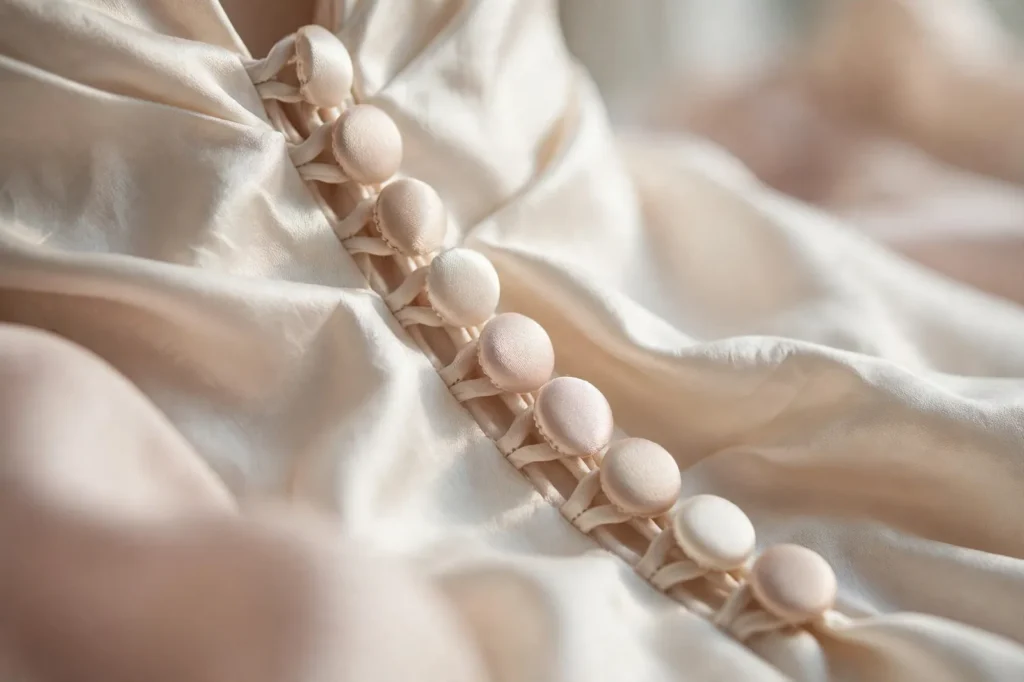
Closures matter too. Many satin gowns close with a row of fabric-covered buttons and loops down the back, which looks beautiful and takes patience to fasten. If you choose that style, practise the buttoning before the day, and ask whether the loops are reinforced.
How do you look after a satin wedding dress on the day?
Treat the gown gently, avoid improvised stain removal, and plan for the cleaner. A satin gown is easy to mark and hard to repair, and most day-of damage is oil, makeup, perspiration and spilled drinks. The easiest way to keep the cloth safe is to keep it away from heat and solvents and to assign one person the job of caring for it.
- Steam, do not iron. A garment steamer held at a distance relaxes creases without pressing the face. If a gown must be pressed, use the lowest setting with a press cloth and test on a hidden seam.
- Keep solvents away. Nail polish remover contains acetone, and acetone dissolves acetate. Spray perfume and hairspray before you put the gown on, not after.
- Blot spills, never rub. Dab with a clean white cloth and keep the stain for the cleaner.
- Carry a small kit. A white cloth, a fine safety pin, a spare button and a few extra loops cost almost nothing.
- Sit carefully. A heavy satin skirt creases in the lap. Stand and shake it out when you can.
How do you clean and store a satin wedding dress after the wedding?
Have the gown professionally cleaned soon after the wedding, then store it clean in an archival box with unbuffered acid-free tissue. That is the advice of Museum Textile Services, a textile conservation firm in Andover, Massachusetts, in its guide How to Archive Your Wedding Gown. The steps below follow it, with the Minnetrista collections guide where noted.

- Clean it first. Museum Textile Services says all gowns should be cleaned before long-term storage, and the sooner the better, because sweat, champagne and dirt are easier to remove early. Oily and sweaty soils dissolve in dry cleaning solvent, while sugar-based stains such as alcohol dissolve in water and detergent, so a good cleaner uses both with low-agitation machines.
- Choose the right box. Use an archival box. The firm prefers polypropylene, which is strong, water resistant and pH neutral, and warns that cardboard is prone to moisture and pests and acidifies over time.
- Choose the right tissue. Use unbuffered acid-free tissue. The Minnetrista guide, published by the Indiana Historical Society, explains that most tissue turns acidic and brittle with age and that buffered paper, while acceptable for cotton or linen, can be harmful to silk or wool, so neutral unbuffered tissue is recommended for general textile storage.
- Line and pad. Line the box with about 1.25 yards of washed, pressed, unbleached muslin. Lay the gown face down and place rolled tissue “snakes” inside the sleeves and in each fold so no sharp crease forms.
- Avoid the common mistakes. Do not use plastic forms, coloured tissue, shiny boxes or boxes with clear windows. They can break down and release volatile organic compounds that the gown absorbs, and coloured paper can transfer dye in humid conditions.
- Store it well. Keep the box on the main floor of the house, on a closet shelf or under a bed, never in an attic or basement. Check it once a year in spring or summer for pests or water damage.
Two points deserve emphasis. First, be wary of one-price-fits-all preservation offers and of warnings never to open the box. Museum Textile Services calls both red flags, because every gown needs its own assessment. Second, if the gown is old, fragile or heavily beaded, ask a textile conservator. The Minnetrista guide also suggests hanging heavier garments on padded hangers and boxing lightweight ones, so a heavy beaded gown may need a different approach from a light slip. Our own guide to how to store satin covers everyday satin storage.
What should you ask a bridal shop about a satin gown?
Ask for facts you can verify. A good shop will answer these questions quickly, and vague answers tell you something too.
- What is the fibre content, in percentages, and is the lining the same fibre?
- What is the weight of the satin in grams per square metre?
- How is the gown meant to be cleaned, and what does the care label say?
- Can I see the gown in natural daylight?
- What alterations are possible, and who does them? Satin shows needle marks, so the tailor should have experience with it.
- Is there a swatch I can take away to test and to match accessories?
- What is the policy on returns for sample gowns that have been tried on?
Frequently asked questions
Is satin a good fabric for a wedding dress?
Yes, for structure and light. Heavy satin holds full skirts and trains, and mid-weight satin gives body at a lower price. Light satin suits fluid, close-fitting gowns, and it shows every seam.
What is the best satin for a ball gown wedding dress?
Duchess satin or a heavy bridal satin. Wikipedia describes duchesse satin as soft, heavy and glossy, and it is the satin most often used for full gowns.
Is satin or silk better for a wedding dress?
Silk satin breathes better and feels softer. Polyester satin is cheaper, stronger and holds its shape. Many gowns sold as satin are polyester, so check the label.
Does satin wrinkle in a wedding dress?
Yes. All satin creases, though heavy satin holds shape better than light. Steam creases away from a distance and avoid a hot iron.
Is ivory or white satin better for a wedding dress?
Neither is better. White is neutral to cool and ivory is warm and softer. Try both against your skin in daylight before choosing.
Can you wash a satin wedding dress at home?
Not usually. Silk and acetate satin are normally dry cleaned, and a wedding gown carries stains from sweat, oil and drinks that need professional treatment. Follow the care label.
How should you store a satin wedding dress?
Have it cleaned first, then store it in an archival box with unbuffered acid-free tissue and an undyed muslin lining, on the main floor of the house. Avoid plastic forms, coloured tissue, attics and basements.
How long does a satin wedding dress last?
With professional cleaning and good storage, a well-made satin gown can last for decades. Museum Textile Services says the aim is a gown that looks the same in thirty years as on the wedding day.
Where to go next
If you are still comparing fabrics, the Satin Database sets out satin types, weights and fibres in tables, and the Satin Glossary defines every term used here. The Satin Visual Library shows the fabrics side by side, and our guide to fashion by satin type matches satin to garments.


