


Satin Ballet Shoes: Why Satin, How Pointe Shoes Are Built and How to Care for Them
What are satin ballet shoes?
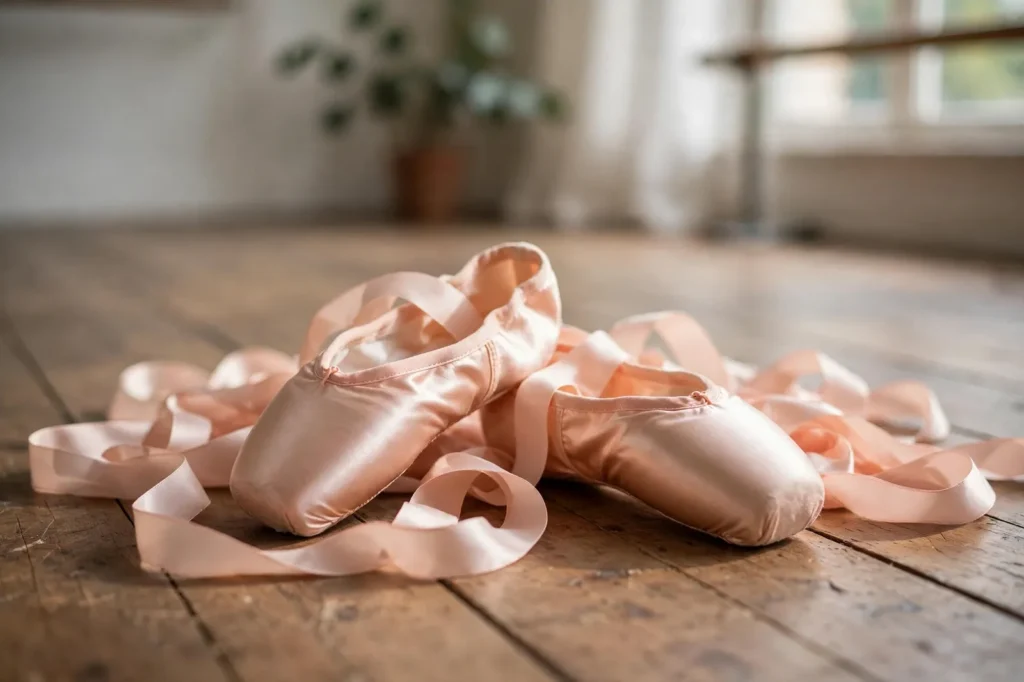
Satin ballet shoes are dance shoes covered in satin, the glossy cloth that gives a ballet shoe its familiar pink sheen. The term covers two different kinds of shoe: soft ballet slippers with a thin, flexible sole, and pointe shoes, which have a hardened toe box and a shank so a dancer can balance on the tips of the toes. Satin is the most common outer fabric on pointe shoes, and it is often used on soft slippers for performances.
This guide explains why dancers wear satin, how a satin pointe shoe is built, how satin compares with canvas and leather, how ribbons and elastic are attached, how long a pair lasts, and how to look after one. It is written for dancers, parents and costume makers. It does not replace a fitting: pointe shoes should always be chosen with a teacher or a trained fitter. For the cloth behind them, see our guide to slipper satin, the stiff satin that takes its name from shoes.
Why are ballet shoes made of satin?
Ballet shoes are made of satin because satin looks right on stage and takes dye evenly, and the tradition goes back almost two centuries. Wikipedia’s article on the pointe shoe notes that the shoes Marie Taglioni wore for La Sylphide were modified satin slippers with leather soles, and that their sides and toes were darned to hold their shape. Satin was already the fabric of the formal slipper, and ballet adapted it.
The same article credits Anna Pavlova with the modern pointe shoe. She added a toughened leather sole and hardened the toe area into a box to support her feet. Late nineteenth-century Italian dancers such as Pierina Legnani had already used shoes with a flat platform at the front, a fabric box for the toes and a stiffer sole. The outer cloth stayed satin because it still looked elegant and matched the long line of a dancer’s leg.
There are practical reasons too. Satin’s smooth face reflects stage light, so the foot reads as a clean, pale line from the audience. It also dyes to a consistent pink, which matches pink tights and skin tones. The cost is wear. Wikipedia’s article on the ballet shoe says satin is often used for performances but wears out very quickly. Satin’s long floats are what make it shine, and they also make it prone to snagging and abrasion. Our guide to how to fix snagged satin explains why.
What is the difference between a satin ballet slipper and a pointe shoe?
A ballet slipper is a soft shoe, and a pointe shoe is a structured one. The slipper has a thin, flexible sole and gives the foot freedom. The pointe shoe has a box around the toes and a stiff shank under the arch so the dancer can rise onto the tips of the toes. Wikipedia notes that female dancers begin class in ballet slippers and may later switch to pointe shoes.
| Feature | Soft ballet slipper | Pointe shoe |
|---|---|---|
| Sole | Thin and flexible, full or split | Leather, with a stiff shank above it |
| Toes | Soft, no box | Hardened box with a flat platform |
| Outer fabric | Leather, canvas or satin | Satin most often, canvas sometimes |
| Fastening | Elastic across the arch, or crossed elastic | Ribbons and elastic, sewn on by the dancer |
| Typical use | Class, rehearsal and performance | Advanced training and performance |
| Satin choice | Often used for performances | The most common outer fabric |
Elastic fastens the shoe in different ways. Wikipedia describes a single band across the arch or two bands crossing in an X at the top of the arch, and it notes that manufacturers sometimes attach one end of each band, leaving the buyer to attach the free ends so the fit can be adjusted.
How is a satin pointe shoe built?
A pointe shoe is built from a satin outer, a stiff box, a shank and a leather sole, and every part matters for balance. The satin is only the visible layer. Underneath it, the box and the shank do the structural work. Wikipedia lists the parts: the box encases the toes, the shank stiffens the sole to support the arch, the platform is the flattened front of the box where the dancer balances, the vamp is the upper section, the throat is the edge above the arch, the drawstring sits in the binding on the throat, and the wings are the sides of the box.

- Box. Traditionally layers of paper, paste and fabric, glued together and shaped. Some newer boxes use plastic and rubber.
- Shank. Made from leather, plastic, cardstock or layers of glue-hardened burlap.
- Outer. Satin is the most common outer fabric, though canvas is also used.
- Sole. A thin piece of leather, attached with adhesive and stitching.
- Drawstring and binding. They let the dancer adjust the fit around the throat.
The structure explains why satin pointe shoes should never be soaked. The box and shank are held together with glue and paste, and Wikipedia notes that heat and humidity can break the glues down faster. A wet satin pointe shoe loses shape in a way that a washed canvas slipper does not.
Satin, canvas or leather: which ballet slipper material is best?
Leather lasts longest, canvas is cheaper and wears out faster, and satin looks best on stage but wears out very quickly. Wikipedia’s article on ballet shoes states all three points. The right choice depends on what the shoe is for.

| Material | Strengths | Weaknesses | Best for |
|---|---|---|---|
| Leather | Long-lasting | Less sheen on stage | Daily class and rehearsal |
| Canvas | Cheaper, holds colour, easy to find | Wears out faster than leather | Beginners and growing children |
| Satin | Glossy, elegant, classic stage look | Wears out very quickly, snags, marks easily | Performances and photographs |
Colour follows custom. Wikipedia notes that women traditionally wear pink and men white or black, and that skin-toned slippers are used in modern ballet and modern dance by both men and women to give the look of barefoot dancing. A school or company may set its own colour, so ask before you buy.
For parents, the practical rule is to buy canvas or leather for classes and satin only for the performance. A child outgrows shoes quickly, and satin that is worn in a studio will look tired by the time it reaches the stage.
How do you sew ribbons and elastic onto satin pointe shoes?
Dancers sew the ribbons and elastic on themselves, and the placement is individual, so the first fitting should happen with a teacher or a trained fitter. Wikipedia notes that some dancers sew the ribbons inside the shoe and others sew them onto the outer satin, and that the loose ends are often briefly flamed to stop them from fraying. The steps below give the general method. They are not a substitute for local advice, because the position depends on the foot.

- Put the shoe on and fold it. With the shoe on your foot, fold the heel forward to find where it creases. Ask your teacher to mark the position of the ribbon on each side.
- Cut the ribbon. Cut the lengths your teacher or fitter recommends. Cut the ends at a slight angle so they hang neatly.
- Thread a strong needle. Use strong thread that matches the satin, doubled, and knot the end firmly.
- Stitch the ribbon to the shoe. Fold the end of the ribbon over once, place it on the marked line and sew it with small, firm stitches through the satin and the lining. Do not pull the thread so tight that the satin puckers.
- Attach the elastic. If your shoe has elastic, attach the free end where it gives a snug fit. Wikipedia notes that manufacturers often attach one end already.
- Seal the ribbon ends. Wikipedia notes that the loose ends are often briefly flamed. If you do this, an adult should do it with care, because satin ribbon is polyester or nylon and melts quickly. A fray sealant is a safer alternative.
- Check the fit. Walk, rise and lower in the shoe, and move the stitches if the ribbon pulls the shoe out of position.

If you are new to sewing satin, our guide to how to sew satin explains why a fine needle and a light hand matter, and our satin ribbon guide covers ribbon widths and edges.
How long do satin pointe shoes last?
A pair of pointe shoes lasts about 10 to 20 hours of wear under moderate use, according to Wikipedia, but the range is wide. Students may get weeks or months from a pair, while professional dancers may wear out a pair in a single performance. The shoe is a consumable, and the cost of replacement is part of every dancer’s budget.

The article lists the factors that decide how long a pair survives: how hard the dancer works, technique, fit, body weight, the construction of the shoe, the shank material, how the shoe was broken in, the performance surface, foot strength, and the environment. Heat and humidity break down the glues faster.
There are two different kinds of wear, and they matter in different ways.
- A dead shoe. The shank is weakened or the box is softened, so the shoe no longer supports the foot. This is a performance problem, and the shoe should be retired for pointe work.
- Worn satin. The outer fabric is scuffed, grey or frayed. Wikipedia says this affects appearance but not performance, so a worn but supportive shoe can still be used for class.
How do you care for satin ballet shoes?
Let satin ballet shoes dry out after every use, keep them away from heat and damp, and never machine wash them. Satin pointe shoes are held together with glues and paste, and moisture and heat weaken them. These habits are general good practice, based on the construction and the effect of humidity described above.
- Air them out. Take the shoes out of the bag after class and let them dry in a ventilated space away from direct heat.
- Give them time to dry. Humidity weakens the glues, so a pair that dries fully between uses is better protected.
- Spot clean only. Dab a mark with a clean damp cloth. Do not rub, because satin marks and scuffs easily. Our guide to cleaning satin shoes covers marks and water spots.
- Avoid heat. Do not dry them on a radiator or in a hot car. Satin made of polyester or acetate melts or distorts, and the glue weakens.
- Store them clean and dry. A breathable bag is better than a sealed plastic one. See our guide to how to store satin.
- Replace them on time. A dead shank cannot be repaired, so ask your teacher to check worn pairs.
Nylon and polyester satin handle moisture differently from silk. The University of Georgia Cooperative Extension’s Understand Your Fibers guide notes that polyester melts if too hot and nylon melts and fuses with heat, so keep heat away from both.
How do you choose satin ballet shoes?
Choose the shoe for the job, then choose the fabric. For a child or a beginner, a leather or canvas soft slipper is the sensible first shoe. For a performance, a satin slipper gives the classic look. For pointe work, only buy shoes after a teacher says the dancer is ready and a trained fitter has checked the fit.
| Situation | Choose | Why |
|---|---|---|
| Beginner or child in weekly classes | Leather or canvas slipper | Lasts, costs less and handles daily use |
| School performance or recital | Satin slipper in the school colour | Matches the stage look |
| Advanced student starting pointe | Pointe shoe chosen with a teacher and fitter | The fit and the shank strength are personal |
| Adult returning to ballet | Soft slipper first, pointe only on a teacher’s advice | Dancers begin class in soft slippers |
| Costume or photograph | Satin pointe shoes or slippers | Best sheen and the classic colour |
If you are buying online, check the fabric, the sole, the size chart and the return policy. Ask your teacher for brand and size recommendations. They have seen many feet and many shoes.
What mistakes do people make with satin ballet shoes?
- Buying pointe shoes too early or without a fitting. A poor fit hurts and wears out the shoe faster. Ask a teacher first.
- Wearing satin slippers for daily class. They wear out very quickly. Use canvas or leather for training.
- Sewing ribbons in the wrong place. The position matters for support. Ask for marks before you stitch.
- Drying shoes on a radiator. Heat melts synthetic satin and weakens glue.
- Washing pointe shoes. Water and detergent soften the box and shank.
- Keeping dead shoes. A shoe that no longer supports the foot should not be used for pointe work.
How have ballet shoes changed over time?
Ballet shoes have moved from heeled court shoes to the structured satin pointe shoe in roughly three centuries, and each step explains something about the shoe you see today. Wikipedia’s articles on the ballet shoe and the pointe shoe give the main steps.
- 1682. Women began dancing ballet, about twenty years after Louis XIV ordered the founding of the Royal Academy of Dance, and early women’s ballet shoes had heels.
- 1730s. Marie Camargo of the Paris Opéra Ballet was the first to wear a flat, heel-less shoe.
- After the French Revolution. Heels were dropped from standard ballet shoes and replaced by the flat shoe used today.
- 1796. Charles Didelot’s “flying machine” helped dancers rise onto their toes.
- Taglioni’s era. Marie Taglioni’s shoes for La Sylphide were modified satin slippers with leather soles, with the sides and toes darned to hold their shape.
- Late nineteenth century. Italian dancers such as Pierina Legnani wore shoes with a flat platform, a fabric box for the toes and a stiffer sole.
- Pavlova. Anna Pavlova is credited with the modern pointe shoe, with toughened leather soles and a hardened toe box.
Satin runs through the whole story. It was the fabric of the formal slipper that Taglioni’s shoes were modified from, and it stayed on the outside as the structure underneath became stronger. The satin is now a thin skin over a very engineered shoe.
How do dancers break in satin pointe shoes?
Dancers break in pointe shoes by working them gradually, usually through relevés, so the box and shank flex in the places the dancer’s foot needs. Wikipedia says breaking in is usually done by performing relevés so the box and shank flex naturally, and that some dancers use manual methods or apply glue or shellac to stiffen the shoe. The method is personal, and the safe starting point is to ask your teacher.
- Let class do the work. Most dancers rely on normal barre work to soften the shoe over several sessions.
- Follow your teacher’s advice on manual methods. Bending or pressing a shoe by hand changes how it supports the foot.
- Be careful with glue and shellac. They stiffen a box that is going soft, but they cannot restore a dead shank.
- Mind the satin. Hard handling scuffs and pulls the floats, so be gentle with the outer fabric.
- Watch for dead shoes. When the shank or box has softened too far, the shoe has done its job.
How do you pack a dance bag to protect satin shoes?
Pack satin shoes so they stay dry, separate and free of rough items. A dance bag carries tights, hair pins, water and often a damp towel, and each of those can mark or soften a satin shoe. A little planning keeps the fabric clean and extends the life of the pair.
- Use a breathable shoe bag or a mesh pocket, not a sealed plastic bag, so damp shoes can dry.
- Keep shoes away from hair pins, clips and zips that can snag satin.
- Do not store shoes next to a wet towel or a water bottle that might leak.
- Take the shoes out of the bag when you get home and let them air.
- Pack a spare set of ribbons and a small sewing kit for quick fixes before a performance.
Frequently asked questions
Why are pointe shoes made of satin?
Satin is the traditional outer fabric. It looks elegant on stage, dyes evenly to the familiar pink, and has been used since early satin slippers, as in the shoes Marie Taglioni wore for La Sylphide.
Are all ballet shoes satin?
No. Soft ballet slippers come in leather, canvas or satin, and satin is mostly used for performances. Pointe shoes use satin most often, with canvas as an alternative.
How long do satin pointe shoes last?
About 10 to 20 hours of wear under moderate use, according to Wikipedia. Students may get weeks or months, and professionals may wear out a pair in one performance.
Can you wash satin ballet shoes?
No. The box and shank are held together with glue and paste, and water and heat weaken them. Spot clean marks with a barely damp cloth and let the shoes dry in the air.
What colour should ballet shoes be?
Women traditionally wear pink, and men traditionally wear white or black. Skin-toned slippers are used in modern dance. Your school may set its own colour.
Do you sew ribbons on pointe shoes yourself?
Yes. Dancers usually sew on their own ribbons and elastic, and the position should be checked by a teacher or fitter. Some dancers sew ribbons inside the shoe and others on the outer satin.
Is satin or canvas better for ballet slippers?
Canvas is cheaper and wears out faster than leather, and satin wears out very quickly but looks best on stage. Use canvas or leather for training and satin for performances.
When can a child start pointe work?
That is for the teacher to decide. Dancers begin class in soft slippers and may switch to pointe shoes later, and a trained fitter should check any pair.
Where to go next
For the cloth, read about satin weave, floats and drape in the Satin Glossary, and compare satin with other fabrics in the Satin Database. The Satin Visual Library shows satin close up.


