


What Is Duchess Satin and Why Dressmakers Reach for It
Duchess satin is a heavy, firm satin that holds a sculpted shape instead of falling close to the body. It has a smooth, glossy face and a duller back, and it keeps pleats, full skirts, and crisp folds in place. That body is the whole point of the cloth, and it is why dressmakers reach for it when a design needs structure.
What is duchess satin?
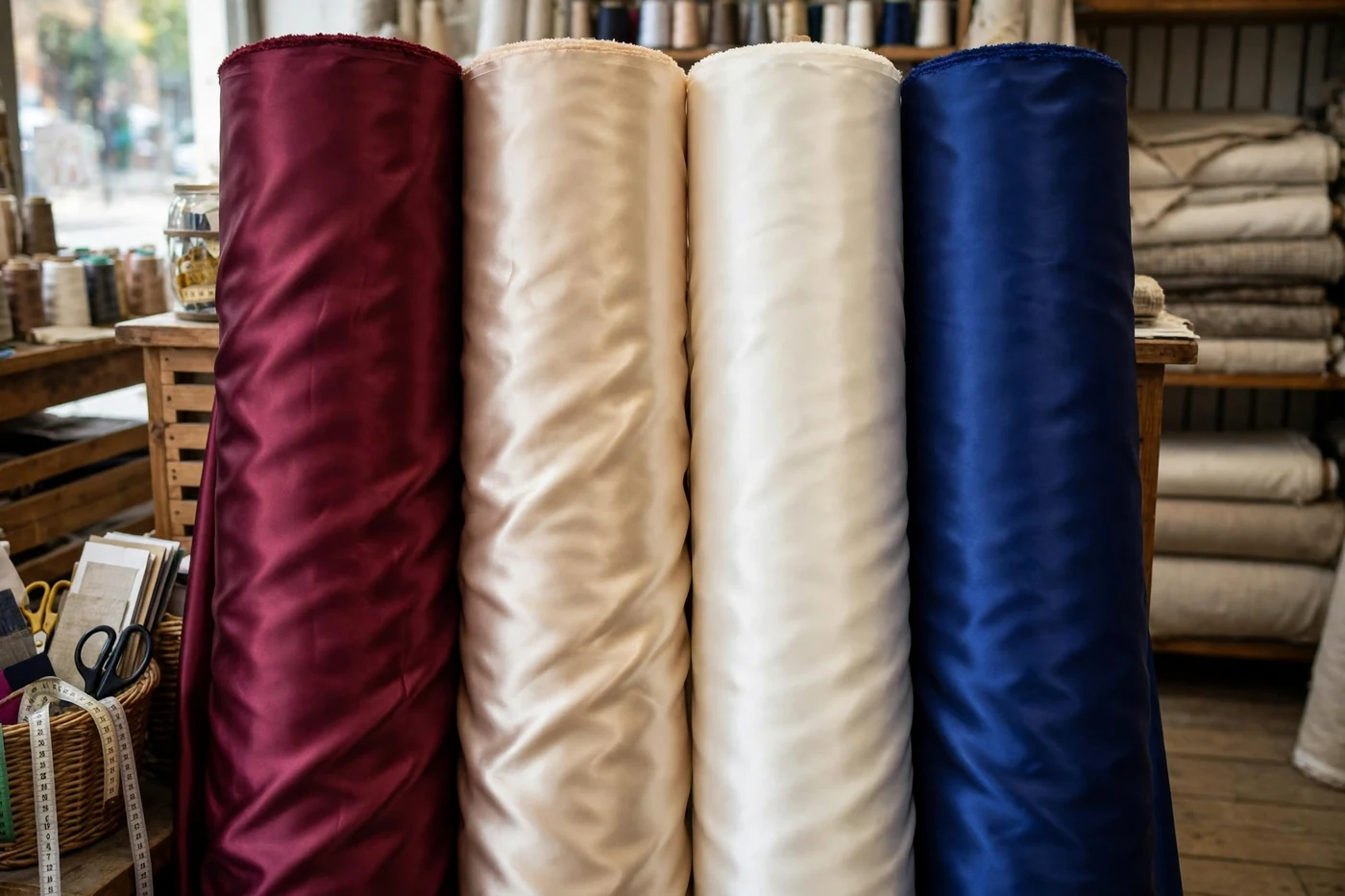
Duchess satin is a heavyweight satin weave cloth with a firm hand, a smooth glossy face, and enough body to hold a shape on its own. It sits at the structured end of the satin family, far from the fluid drape of a light charmeuse. When you pick it up, it feels dense, it resists flopping, and it falls in broad, clean folds.
The name can mislead. Duchess satin is a type of cloth construction, not a fiber name and not a brand. You can find it made from silk, from polyester, or from a blend, and the fiber changes the price, the care, and the feel, while the weave gives the cloth its shared character. Spelling varies too. You will see duchess satin and duchesse satin in shops and pattern books, and they point to the same family of heavy satin cloth.
History helps explain why the name stuck to formal wear. The National Museum of Australia describes a cream duchess satin dress worn for a wedding in 1898, embroidered with pearls, glass beads, and rhinestones in a leaf design. That dress, with its fitted bodice, full sleeves, and long train, shows the cloth doing exactly what it still does today: holding a formal shape while carrying decoration without collapsing. The Metropolitan Museum of Art also records a later couture use, where Sarah Burton described an Alexander McQueen coat in duchess satin that carried an enormous volume of fabric yet still appeared light. Those two examples, a century apart, point to the same strength. Duchess satin can carry volume and still look composed.
For a buyer, the short test is shape. Hold a length up, let it fall, and watch what happens. A light satin will slide and cling. Duchess satin will form broad folds, hold a curve, and spring back a little when you press it. If a shop sample flops like a scarf, it may be a fine satin, but it is probably not the duchess weight you wanted for a structured gown.

How does the weave create that firm hand?
A satin weave creates its shine by letting long yarns float on the surface before they lock into the cloth, and duchess satin uses that idea with a dense, heavy build. The Museum of Fine Arts, Boston, explains the basic satin weave in its CAMEO reference: each weft strand floats over 3 to 12 warp strands then under a single strand, and those floating threads reflect light to produce the satin sheen. You can read that full reference through the Museum of Fine Arts, Boston, satin weave entry.
In a warp faced satin, the lengthwise yarns dominate the face, so light meets long, unbroken yarns and reflects in a smooth sheet. That is why the face looks glossy while the back looks flat and dull. In duchess satin, the yarns are packed close, the cloth is thick, and the floats sit on a firm base. The result is a face that shines without looking thin, and a back that gives seams and linings something solid to grip.
Density matters as much as the weave pattern. Two cloths can share a satin weave and feel nothing alike if one is woven loose and light and the other is woven tight and heavy. Duchess satin belongs to the second group. The tight build limits how much the cloth stretches on the bias, helps it keep a pressed edge, and lets a skirt hold air under it without a heavy petticoat doing all the work. It also means the cloth can feel stiff in the hand when you first unroll it. That stiffness softens a little with handling and pressing, but it should never vanish. If it does, check the label and the weight again.
Which fibers are used for duchess satin?
Silk duchess satin is the classic version, and it still sets the standard for hand and depth of shine. Silk gives a warm, deep glow rather than a hard plastic shine, and it breathes better than most synthetics in a long evening gown. It also costs more, needs gentler care, and can mark with water if you press it badly. For a one off gown that will be worn for hours and kept as a keepsake, many makers still choose silk first.
Polyester duchess satin is the workhorse version, and it is the one most shops stock in the widest color range. It holds a shape well, resists creasing better than silk in many cases, and usually costs far less. The trade off is feel. Some polyester versions look a little too bright under shop lights, and they can feel warmer to wear. Quality varies a lot here, so judge the bolt in front of you rather than the fiber name on the ticket. A well made polyester duchess can beat a poor silk one for a structured dress that needs to survive a long night.
Blends sit between those poles. A silk blend can soften the hand of polyester while keeping some of its toughness, and an acetate blend can add drape in some constructions. The label tells you the mix, but it does not tell you the weight or the weave density, so treat fiber as one clue among several. Always ask for the fiber content in writing when you buy online, and check it against the care label when the parcel arrives.

How heavy is duchess satin, and how does it feel?
Duchess satin feels heavy in the hand, firm across the fold, and smooth on the face with a matte back that grips a little when you rub it. It falls in wide folds rather than narrow ripples, and it holds a pressed crease longer than a light satin. When you run a hand over it, the face feels cool and slick, while the back feels drier and less polished.
Weight is best judged by comparison, not by a single number on a ticket. Hold duchess satin next to a light charmeuse and the difference is plain at once. The charmeuse slides through your fingers and pools. The duchess cloth stands up a little, keeps its fold, and needs a firmer push to bend. That comparison helps more than any chart, because mills and shops measure and describe weight in different ways, and a number alone will not tell you how a cloth behaves in a skirt.
What is duchess satin best used for?
Bridal gowns are the classic home for duchess satin, and for good reason. A bridal skirt needs to hold a shape for hours, carry lace, beading, or applique, and still photograph well from every angle. Duchess satin does all three. It supports a full skirt without collapsing, it gives beading a stable base, and its glossy face catches light in a way that reads well in photos. The 1898 wedding dress held by the National Museum of Australia shows that same logic at work in an earlier era, with a cream duchess satin gown carrying embroidery, a fitted bodice, and a long train. You can see that museum account through the National Museum of Australia wedding dress page.
Evening wear comes next. Cocktail dresses with a sculpted bodice, full skirts, and clean lines all benefit from a cloth that holds its shape. Duchess satin also works for structured jackets, formal trousers with a sharp crease, and occasion dresses where the silhouette matters more than fluid movement. The Met account of the McQueen coat shows the same idea in couture form: a coat in duchess satin that carried a large volume of fabric and still looked light. That balance of volume and control is hard to get from a lighter cloth, and it is why designers keep returning to duchess satin for statement pieces. The Met account is on the Metropolitan Museum of Art McQueen ensemble page.
There are places where duchess satin is a poor pick, and naming them saves money. It is too firm for a bias cut dress that needs to flow, too heavy for a summer blouse that needs to breathe, and too structured for a scarf that should drape soft around the neck. It also adds bulk at seams, so a design with many small gathers or tiny pleats will fight the cloth. Use duchess satin where shape is the design. Use a lighter satin where movement is the design.

How do you sew duchess satin without puckers?
Sewing duchess satin rewards slow, careful work, and most puckers come from speed, a dull needle, or a press that is too hot. Start with a fresh, fine needle made for woven fabric, and test it on a scrap from the same bolt. A needle that is even slightly blunt will push yarns aside and leave a visible track on the glossy face, and that track will not press out. Use a short to medium stitch length on your test piece, and check both sides before you sew a real seam.
Pin within the seam allowance where you can, and use fine pins placed at a shallow angle to the seam line. Thick pins leave holes that show on satin, and holes near a seam edge can grow when the cloth is pressed. If you work with a pattern that needs many pins, place them, sew, and remove them as you go rather than sewing over them. A magnetic pin dish helps here, since a dropped pin on a satin work surface can snag the cloth when you slide it.
Pressing is where duchess satin either looks costly or cheap. Press on the wrong side with a pressing cloth, use a low to medium heat setting that suits the fiber on the label, and lift the iron rather than sliding it. Sliding can stretch the cloth on the bias and create a shine mark on the face. For seams that need to lie flat, press them open on a tailor ham or a seam roll, and let the piece cool before you move it. A seam that looks flat while hot can spring back as it cools, so patience at this step pays off.

How should you care for and store it?
Care starts with the label, and that rule matters more for duchess satin than for most cloths because fiber changes the answer. Silk duchess often needs professional cleaning, while many polyester versions can be washed with care at home. If the label is missing, as it often is on a shop cut length, treat the piece as the more delicate fiber in the mix and test any cleaning method on a hidden scrap first. A single bad wash can dull the face or set a crease that will not press out.
For washing at home, use cool water, a gentle cycle or hand washing, and a mild detergent made for delicate fabric. Do not wring the cloth, since twisting can break surface yarns and leave a permanent twist mark on the face. Roll the piece in a clean towel to press out water, then lay it flat or hang it on a padded hanger to dry away from direct sun. Sun can fade color unevenly on satin, and a glossy face shows fading sooner than a matte cloth.
Stains need quick, calm action. Blot, do not rub, since rubbing can break surface yarns and spread the stain into the weave. Use a clean white cloth, work from the outside of the stain inward, and test any spot cleaner on a hidden area first. For a valuable gown, take it to a cleaner and point out the stain rather than trying a home remedy you found online. A cleaner can judge fiber and dye, and that judgment is worth more than a quick fix that sets the stain for good. For everyday washing guidance, see our guide to washing satin, and for construction help, see our guide to sewing satin.
How can you identify real duchess satin when buying?
Start with the hand test in the shop, and do it before you look at the price ticket. Pick up the bolt, fold a length double, and press the fold. Duchess satin should feel dense and firm, hold the fold for a moment, and spring back a little when you let go. It should fall in broad folds when you drape it over your arm, and the face should shine in a smooth sheet rather than a patchy sparkle. A cloth that feels thin, slides like water, or collapses at once is probably a lighter satin, even if the ticket says duchess.
Check the back next. Turn the cloth over and look at the reverse. A true satin weave cloth will show a duller, flatter back, while the face stays glossy. That contrast is a useful clue, and it also helps you plan seams and linings, since the back will grip a lining better than the face will. If both sides look equally glossy and thin, ask the seller what weave and weight you are looking at, and ask for a written fiber content before you pay.
Watch for naming traps in online listings. Some sellers use duchess as a style word for any shiny satin, and some use it for a polyester satin that is lighter than a true duchess weight. Others confuse duchess satin with charmeuse, crepe back satin, or taffeta, all of which have their own weave and hand. Charmeuse is lighter and more fluid, as our satin versus charmeuse comparison shows. Crepe back satin has a crepe reverse and a different drape, and taffeta has a crisp, rustling hand that duchess satin does not share. If a listing gives no fiber, no weight, and no weave detail, treat it as a warning sign and ask for those details before you order.
| Cloth | Hand and fall | Best use | Watch out for |
|---|---|---|---|
| Charmeuse | Light, fluid, close drape | Bias dresses, blouses, soft scarves | Too little body for a sculpted shape |
| Crepe back satin | Smooth face, textured back | Dresses that need a matte option | Back texture can show at edges |
| Taffeta | Crisp, rustling, holds shape | Full skirts, structured jackets | Rustle and creasing, less soft hand |
Frequently asked questions
Is duchess satin the same as regular satin?
No. Regular satin is a broad family name for a weave, and it covers cloths from light and fluid to heavy and firm. Duchess satin is the heavy, structured member of that family, with a firm hand and a shape holding fall. If you need structure, duchess satin fits. If you need fluid drape, a lighter satin fits better.
Is duchess satin always silk?
No. Silk is the classic fiber, but many duchess satins today are polyester or a blend. Fiber changes price, care, and feel, while the heavy satin weave gives the cloth its shared body. Check the label for fiber content before you buy, and do not assume silk from the name alone.
Is duchess satin good for wedding dresses?
Yes, for structured wedding dresses. It holds a full skirt, supports beading and applique, and photographs well. For a soft, flowing wedding dress that moves with the body, a lighter satin or a crepe may suit the design better. Match the cloth to the silhouette you want.
Can you wash duchess satin at home?
It depends on the fiber and the label. Many polyester versions can be washed gently at home, while silk versions often need professional cleaning. Always follow the care label, test on a scrap first, and avoid wringing, high heat, and direct sun while drying.
Does duchess satin crease easily?
Less than a light satin, but it can still crease at hard folds and tight seams. Press from the wrong side with a pressing cloth, let seams cool before moving them, and roll lengths for storage rather than folding them hard. A good press usually restores a clean look.
How is duchess satin different from charmeuse?
Duchess satin is heavier, firmer, and holds a shape, while charmeuse is lighter, softer, and drapes close to the body. Charmeuse suits bias cuts and soft dresses. Duchess satin suits sculpted bodices and full skirts. Our satin versus charmeuse page sets out that contrast in full, and our satin versus silk page helps if fiber choice is your main question.
Is duchess satin hard to sew for a beginner?
It is workable for a careful beginner, but it rewards testing. Use a fresh fine needle, test stitch length and pressing on a scrap, pin inside seam allowances, and press with a cloth. A toile for a fitted bodice helps a lot, and a simple design with few gathers will be easier than a complex one.
Where to go next
Duchess satin earns its place when a design needs shape, and it disappoints when a design needs soft movement. Keep that single test in mind, and most buying and sewing choices get simpler. Feel the bolt, check the back, test a swatch, and match the cloth to the silhouette before you cut.
If you want to place duchess satin in the wider family, read our satin versus crepe comparison for a softer contrast, and our satin texture guide for how hand and shine change across satin types. For care after the project, keep the washing and sewing guides linked above close to the worktable, and keep a labeled swatch with each finished garment so future cleaning starts from facts, not guesses.


