


Satin Durag: The Complete Guide
# Satin Durag: The Complete Guide
Quick answer: A satin durag is a close-fitting head covering with long ties that compresses hair flat to train waves, protect braids and locs, and cut friction while you sleep. Almost every "silky" durag sold today is polyester satin, not silk. That is not a dealbreaker: polyester satin compresses well, costs a fraction of real silk, and lasts longer. But you should know what you are buying, because sellers rarely say it plainly.
Type "satin durag" into any search bar and you get a wall of product listings, a few thin affiliate listicles, and one brand blog post from about six years ago. Nobody with actual textile knowledge has written the real guide. So here it is: what a durag does, why the label lies, how the materials compare, and how to tie and wash one.
What Is a Durag, Exactly?

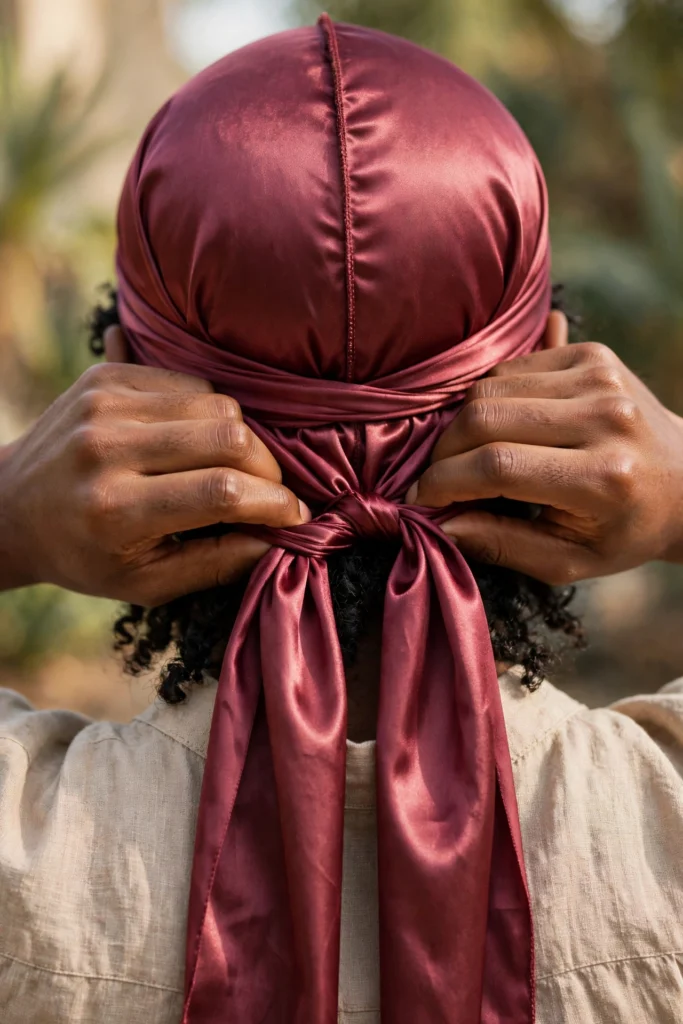
A durag is a close-fitting cloth cap with two long tails and a flap at the back. Center it, cross the tails behind, wrap forward, tie off. The flap covers your nape. Takes about a minute once you have done it a few times. Spellings vary (do-rag, du-rag, doo rag), but "durag" is the standard now.
Its job is compression. After brushing, the durag presses hair flat against your scalp and holds it there. Tails dial the tightness; the cap spreads pressure evenly. The longer you keep it on, the more your curl pattern "remembers" the trained direction. For the wider picture of satin in menswear, see our men’s satin fashion guide.
Why does that matter? Coarse, tightly curled hair has strong curl memory. Brush it into waves and walk away, and the curls spring back toward their natural pattern within hours. A durag interrupts that. It is the difference between brushing for nothing and brushing for progress. For more detail, read our guide to satin hijabs.
The Lie on the Label: Why Most "Silky" Durags Aren't Silk
Short answer: "Silky" is a look, not a fiber. Brands call products silky, silk, or satin silk because the fabric shines like silk. WaveGod Durags, a durag brand, puts it bluntly: 99% of the "silky durags" you see are made from satin. And satin is a weave, not a fiber. What those durags are is almost always polyester woven in a satin weave: polyester satin.
This is the single most useful thing to understand before you buy. Satin is a weave, not a fiber. Silk is a fiber that can be woven into satin (that is silk satin), but satin can also be woven from polyester, nylon, or acetate. When a $9.99 listing says "silky durag," it means "shiny like silk." It does not mean silk.
Does that make polyester satin bad? No. It makes it mislabeled. Polyester satin is smooth, it compresses well, it costs almost nothing, and it survives years of nightly use. The problem is only the deception, because it hides the real tradeoffs: polyester satin holds more heat than silk and breathes less. You can live with all of that. You just deserve to choose it with open eyes.
The 30-second label decoder
Read the listing before the reviews:
Price is the fastest lie detector. A genuine 100% mulberry silk durag sells for around $45 to $50. If the "silk durag" costs $8, $12, or $20, it is polyester satin. No one sells real silk at polyester prices.
Wording is the second. Honest listings say "100% mulberry silk" or "100% silk." Dishonest ones say "silky," "satin silk," or "silk-like." One seller calls its "silk-blend" durag "specially woven with polyester," which tells you everything. If the word "silk" appears without "100%" in front of it, assume polyester.
The burn test settles arguments. Snip a thread from an inside seam and touch it with a flame. Real silk smells like burning hair, shrinks from the flame, and leaves a crushable black ash. Polyester satin smells like burning plastic, melts, and hardens into a little bead.
Our full silk satin guide goes deeper on what real silk satin is and how to spot fakes across all products, not just durags.
Silk vs Satin vs Velvet Durag: The Honest Comparison
Short answer: Velvet grips hardest and trains waves fastest, but it runs hot and needs a smooth lining. Real silk treats your hair best and breathes, but it grips less and costs five times more. Polyester satin sits in the middle on almost everything, costs pocket change, and is the right default for most people.
Every durag seller ranks their own material first. Here is the version with no product to push.
| Real silk durag | Polyester satin durag | Velvet durag | |
|---|---|---|---|
| What it is | Silk fiber, usually satin weave | Polyester fiber, satin weave | Polyester pile, often satin-lined inside |
| Compression/grip | Medium; slippery, less hold | Medium; the balanced default | High; pile grips hair and stays put |
| Friction on hair | Lowest | Low | Low inside (if lined); higher if unlined |
| Moisture | Keeps product on your hair, breathes | Decent; slightly more absorbent than silk | Can pull moisture on long wear without product |
| Heat | Coolest, most breathable | Middle; warmer than silk | Hottest; traps heat |
| Durability | Delicate; snags and thins | Tough; survives years of nightly use | Pile crushes over time; attracts lint |
| Care | Hand wash, baby it | Hand wash cold, easy | Cold wash, never mix with lint-shedders |
| Price | ~$45-50+ | $5-15 | $12-30 |
| Best for | Hair health first, sensitive scalps | Most wavers, daily drivers | Wolfing, cold weather, max lay-down |
Three things the table hides. First, the inside matters more than the outside. The interior touches your hair, not the exterior. A velvet durag with a rough polyester lining creates friction and steals moisture all night; the good ones use a smooth satin lining inside. No lining description on the listing? Assume the worst.
Second, "silk" durags at $10 to $25 are polyester satin in costume. Buyers pay the silk premium and get satin performance. Want real silk? Pay the real price to a seller who writes "100% mulberry silk" plainly.
Third, plain non-satin polyester durags sit at the bottom of the market: cheap, nearly indestructible, moisture-pulling, higher friction. Gym bag material, not overnight material.
The buying verdict: if you own one durag, make it polyester satin. Fragile hair, sensitive scalp, or money to spare, get real silk. Wolfing or winter, add a lined velvet for the heavy sessions. Most serious wavers end up with two: satin for daily wear, velvet for training.

How to Choose a Satin Durag That Actually Works
Short answer: Long wide tails (30 inches or more), a smooth interior, a centered seam, and honest labeling. Skip anything that will not tell you what it is made of.
Tails: long and wide. Tail length is not decoration. Longer tails give you more wrap, which means a tighter, more adjustable tie that survives sleep. Look for 30 inches minimum. Wide tails spread pressure across your forehead instead of concentrating it in a thin line, which means fewer crease marks in your wave pattern. Thin, short tails come loose by 3 a.m.
Interior: smooth, always. Run your finger along the inside before you commit, or read the listing carefully online. You want a slick satin or silk-smooth interior. This matters doubly for velvet durags, where the plush outside should never be the surface touching your hair.
Seam: centered, worn outside. The center seam should run straight from forehead to nape. An off-center seam presses unevenly and draws a line across your pattern. Wear the stitching on the outside of the cap so the seam ridge never imprints on your hair.
Lined vs unlined. Double-layer durags combine two jobs: grip outside, glide inside. The velvet-outside, satin-inside durag is the classic example. Unlined single-layer satin is lighter, cooler, and cheaper, and for most people it is plenty.
Rotation. Buy at least two. You will wash one while you wear the other, and rotating spreads the wear across seams. A decent satin durag lasts months of nightly use; a good one lasts years. The cheap thin ones tear at the front seam within weeks because the stitching is loose and the fabric too light for nightly tension.

How to Tie a Durag for Waves

Short answer: Center the cap, cross the tails flat behind your head, wrap forward, tie a single knot at the back, tuck the flap. Snug, not strangling: the point is even pressure, not force.
Do this after brushing, while your hair is laid in the pattern direction. The durag locks in whatever the brush just did.
- Center the cap. Place the durag on your head with the center seam running from the middle of your forehead straight back to your nape. The front edge should sit just above your eyebrows, covering the full hairline. Stitching faces out.
- Double the forehead (optional, recommended). Pull the front edge down over your eyes, then fold it back up to just above your eyebrows. This doubles the fabric across your forehead and adds compression where waves need it most.
- Cross the tails behind. Pull both tails straight back and cross them at the nape. Keep them flat. Twisted tails dig in and draw lines across your pattern.
- Wrap forward. Bring both tails forward along the sides, flat against the fabric.
- Tie at the back. Cross the tails once more and tie a single knot or bow at the back of your head. Check the tension: one finger should fit between the fabric and your forehead. If it does not fit, it is too tight. If the durag slides when you shake your head, it is too loose.
- Tuck the flap. Fold the back flap down and tuck it under the tied tails. An untucked flap rides up during sleep and takes your compression with it.
- Smooth it down. Press out wrinkles with your hands. Wear it at least 30 minutes after brushing; overnight is where the real training happens.
Nighttime is non-negotiable for serious wavers: tossing without a durag trains forks into your pattern. A satin bonnet is the looser alternative for nights off from compression.
5 Mistakes That Ruin Waves (and One That Ruins Hairlines)
Short answer: Tying too tight is the big one. It causes headaches tonight and traction alopecia over months. Everything else on this list just costs you wave progress.
Tying it like a tourniquet. This is the mistake sellers will never warn you about. A durag tied too tight pulls constantly on the hairline. Do it nightly for months and you get traction alopecia: thinning and recession along the edges that does not always reverse. Headaches and deep forehead marks are your early warning system. If you wake up with grooves across your forehead, loosen up. Compression should feel like a firm hug, not a vise.
Twisting the tails. Tails rolled into ropes concentrate tension into thin lines that press dents into your wave pattern. Keep tails flat and wide.
Setting the front edge too far back. If the cap starts behind your hairline, the hairline gets zero compression and zero protection. Front edge just above the eyebrows, every time.
Skipping the brush session. A durag preserves what brushing creates. It does not create anything on its own. Tying down unbrushed hair just locks in chaos.
Wearing velvet in summer heat. Velvet's grip is wonderful in winter and miserable in July. It traps heat against your scalp, you sweat, the sweat sits under the fabric, and your hair pays. Match the material to the season: satin or silk when it is hot, velvet when it is not.
How to Wash a Satin Durag So It Lasts
Short answer: Hand wash cold with mild detergent, press the water out (never wring), and air dry away from heat. Wringing breaks the long floating yarns that make satin smooth.
Polyester satin is tougher than silk satin, but the weave is still the weave. The long floating yarns that give satin its gloss are exactly what wringing and hot dryers destroy.
- Fill a basin with cool water and a small squirt of mild detergent. Skip bleach and fabric softener; both attack the fibers and dull the finish.
- Submerge and swish gently. Let it soak a few minutes, then agitate softly. Do not scrub or twist. The dirt is mostly product buildup and scalp oil, and it releases easily.
- Rinse thoroughly in clean cool water until no soap remains. Residue left in the fabric stiffens it and irritates scalps.
- Press, don't wring. Lift the durag out, fold it, and press the water out between your palms or against the basin. Wringing twists the weave and snaps yarns.
- Air dry flat or hanging, away from direct sun and radiators. Heat fades color and can permanently dull the satin face.
- Low iron only if you must, with a pressing cloth between iron and fabric. Many durags never need ironing if you smooth them flat while damp.
Rotate at least two durags so each one rests between wears. When loose threads appear, trim them with scissors. Never pull them; one pulled thread can run across the cap. Our full how to wash satin guide covers the per-fiber details.

Beyond Waves: Braids, Locs, and Daytime Wear
Short answer: Durags are not only for waves. They protect braids, cornrows, twists, and locs from frizz and friction, and work as a daytime moisture seal. Same tying; the goal changes from training to preserving.
Braids, cornrows, and locs. Fresh braids frizz fastest at the edges; a satin durag at night cuts the pillow friction that causes it. Do not tie drum-tight over braids, since the style's weight plus hard compression stresses roots. Locs catch on everything, and a durag keeps them contained while slowing the lint buildup that dulls mature locs. Satin beats velvet here: locs are heavy, and you want low friction without the heat.
Wolfing and wash days. Growing your hair out between cuts makes waves harder to lay down, which is when the durag earns its keep. After a wash, once hair is damp-dry and brushed into pattern, tying down sets the style as it finishes drying.
Daytime. After a brushing session, an hour under the durag banks the progress. During workouts, it keeps sweat off the hairline. Under a helmet, it is a friction barrier. Rule of thumb: if you are not brushing, tie down.
A Short Note on Where the Durag Comes From
The durag is rooted in Black hair culture, and any honest guide should say so plainly. Its ancestors are the headwraps enslaved African Americans wore in the 19th century. It resurfaced through the Harlem Renaissance, the 1930s conk era, and the Black Power movement before taking its modern form in the late 1970s. Hip-hop made it an icon in the 1990s. Today it is both a serious hair tool and a fashion statement worn worldwide.
That history is worth knowing, and worth respecting. The durag earned its place through function first. Everything in this guide treats it that way.
Satin Durag FAQs
Are satin durags good for waves?
Yes. Satin balances the three things waves need: enough compression to lay hair down, low friction to avoid breakage, and decent moisture retention. Most wavers start with polyester satin and never need anything else.
Silk vs satin durag: which is better?
Real silk is kinder to hair: less friction, better breathability, superior moisture behavior. Polyester satin wins on price and durability, and compresses just as well. The catch is that most "silk" durags under $25 are polyester satin with silk branding, so compare honest silk at $45+ against honest satin at $10.
How do I know if my "silky" durag is real silk?
Check price and wording. Real 100% mulberry silk durags cost around $45 to $50 and say so explicitly. Listings that say "silky" or "satin silk" at $8 to $20 are polyester satin. The burn test is definitive: silk smells like burning hair and leaves crushable ash; polyester melts and smells like plastic.
Can you sleep in a durag every night?
Yes, that is the intended use. Two rules keep it safe: keep tension snug rather than tight, and wash the durag regularly so buildup does not sit against your scalp. If your scalp feels irritated, loosen up and take a night off.
Do durags cause hair loss?
A durag tied correctly does not cause hair loss. A durag tied too tight, every night, can cause traction alopecia: gradual thinning along the hairline from constant pulling. Forehead grooves and headaches are warnings. Loosen the tie and widen the tails, and the risk drops to near zero.
Velvet vs satin durag: which should I choose?
Velvet for maximum compression: wolfing phases, cold weather, stubborn patterns. Satin for everything else: daily wear, hot weather, sensitive scalps, beginners. Many wavers own both and switch by season. If the velvet durag is unlined, check that the interior is smooth.
Can you wear a durag with braids or locs?
Yes. Durags protect braids, cornrows, twists, and locs from overnight friction and frizz. Tie it snug rather than tight over braided styles to avoid stressing the roots.
—
Why trust this guide: Satin Universe sells nothing and takes no commission on durags, so there is no incentive to rank any material first. The textile science is real, the prices are observed, and the warnings are the things sellers leave out. If you spot an error, we want to hear about it.
Related reading: why satin helps hair, the satin bonnet guide, what polyester satin really is, how satin weave works.


