


Satin Gloves: Lengths, History, How to Wear Them and How to Care for Them
What are satin gloves?
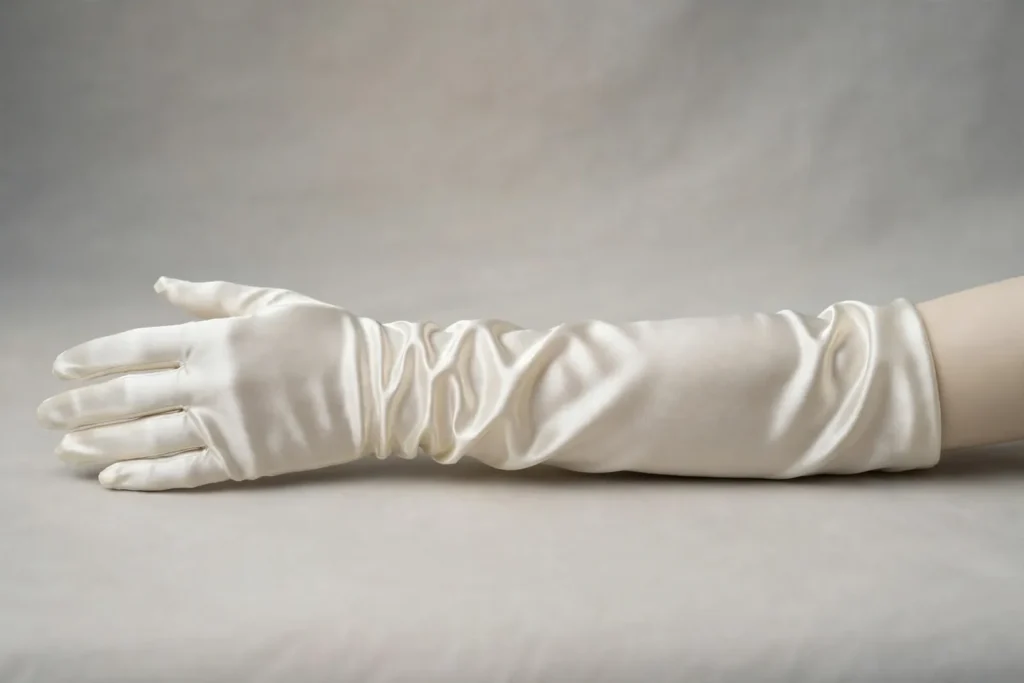
Satin gloves are formal gloves made from satin, the smooth, glossy cloth that gives them a luminous finish. They are worn for ball gowns, weddings, proms and other very dressy occasions, and the long versions are known as opera or evening gloves. Satin and stretch satin are popular glove fabrics, according to Wikipedia’s article on the evening glove, and satin gloves are widely mass-produced.
This guide explains where satin gloves come from, how the lengths are named, how satin compares with leather and lace, when to wear them and in which colour, and how to put them on, store them and clean them. Satin is a weave and not a fibre, so a satin glove can be silk, polyester or another filament, and the fibre decides the care. For the gown they usually accompany, see our guide to satin wedding dresses.

Where do satin gloves come from?
Gloves have a very long history, and formal long gloves for women have appeared and disappeared with sleeve fashions for roughly four centuries. Wikipedia’s article on the glove traces gloves back to ancient Egyptian tomb art, and says that in the thirteenth century ladies began to wear linen or silk gloves as fashion ornaments, sometimes reaching to the elbow.
- 1500s. Elizabeth I popularised richly embroidered and jewelled gloves.
- 1600s. Women in Western countries wore elbow-length gloves from this century, according to the evening glove article.
- 1700s. When short sleeves came into fashion, women began wearing long gloves reaching halfway up the forearm, and above-elbow styles followed in the late 1700s.
- About 1800 to 1825. Long gloves were widely popular in the Regency and Napoleonic era.
- Early and mid-Victorian period. Popularity declined.
- 1870s. Buttoned kid, silk or velvet gloves were worn with evening or dinner dress.
- Late 1800s to World War I. Long gloves peaked again. Wikipedia credits Sarah Bernhardt and Lillian Russell with reviving them.
- 1940s to early 1960s. Popularity was highest, with later revivals, including in haute couture in the late 2000s.
Gloves were once considered mandatory for upper-class men and women, and a well-dressed woman at a public event was rarely without them. That expectation has faded, but the tradition still shapes where satin gloves appear today.
How long should satin gloves be?
Satin gloves come in three women’s lengths: wrist, elbow and opera. Wikipedia describes them as wrist (also called matinee), elbow, and opera or full length, which usually reaches the biceps and sometimes the full arm. Gloves are also described by button length, which Wikipedia defines as the distance in inches from the base of the thumb to the cuff.

| Length | Where it ends | Best with | Notes |
|---|---|---|---|
| Wrist (matinee) | At the wrist | Short sleeves, cocktail dresses, daytime events | Easiest to wear and to take off; shows the least satin |
| Elbow | At or just above the elbow | Short-sleeved or sleeveless dresses, formal day events | A balanced length that suits most formal dress |
| Opera (full length) | To the biceps, sometimes the full arm | Strapless and sleeveless ball gowns, bridal gowns | The classic evening glove; needs a good fit to stay up |

Choose the length from the dress. A strapless or sleeveless gown suits an opera glove, which fills the space between the neckline and the wrist. A dress with short sleeves suits an elbow glove. A dress with sleeves that reach the elbow suits a wrist glove, because anything longer bunches under the sleeve.
Why are gloves made of satin?
Gloves are made of satin because it looks elegant, takes colour evenly and is far cheaper than kidskin. Wikipedia lists custom kidskin as the most expensive material for evening gloves, with softer cowhide, patent leather and suede as cheaper options, and says satin and stretch satin are popular, including mass-produced versions. Lace is also popular for bridal and formal gowns, and exotic leathers such as python and stingray exist.
| Material | Strengths | Weaknesses |
|---|---|---|
| Satin | Glossy, smooth, widely available, takes colour well | Snags, marks and creases easily; polyester is not breathable |
| Stretch satin | Gives a close fit and is easier to pull on | Elastane makes it less formal in feel and heat sensitive |
| Kidskin | Soft, formal, traditional, the most expensive | Needs specialist care and can mark in damp |
| Lace | Delicate and decorative, popular for bridal wear | Fragile and less opaque |
| Leather and suede | Durable, warm | Less formal for a ball or a bride |
Many satin gloves are stretch satin, which has elastane in it. Our guide to stretch satin explains how the stretch works and how it affects care. A non-stretch satin glove needs a more exact fit.
When do you wear satin gloves?
Wear satin gloves at very formal events: balls, weddings, proms, debutante and quinceañera celebrations, and formal dances. Wikipedia says opera gloves accompany bridal, prom, debutante and quinceañera gowns and very formal ballroom dances, and that performers such as can-can and burlesque dancers also wear them. Its article on the ball gown notes that most ball gowns are traditionally worn with long white gloves.
- Ball gowns. Long white gloves are the traditional partner. See Wikipedia’s article on the ball gown.
- Weddings. A bride may wear opera gloves with a strapless gown, and some women wear gloves with dressy outfits at weddings.
- Proms, quinceañeras, cotillions and confirmations. Wikipedia says long white gloves are common for teenage girls at these events.
- Debutante balls. White opera gloves are still mandatory for female debutantes at the Vienna Opera Ball, according to the evening glove article.
- Stage and costume. Dancers and performers wear satin gloves for the line and the shine.
Customs on eating, drinking and removing gloves vary. We found no authoritative rulebook, so ask the host or the event organiser if you are unsure. As a rule of thumb, long gloves are easier to manage at a dance than at a seated dinner, so plan for the setting.
Which colour should satin gloves be?
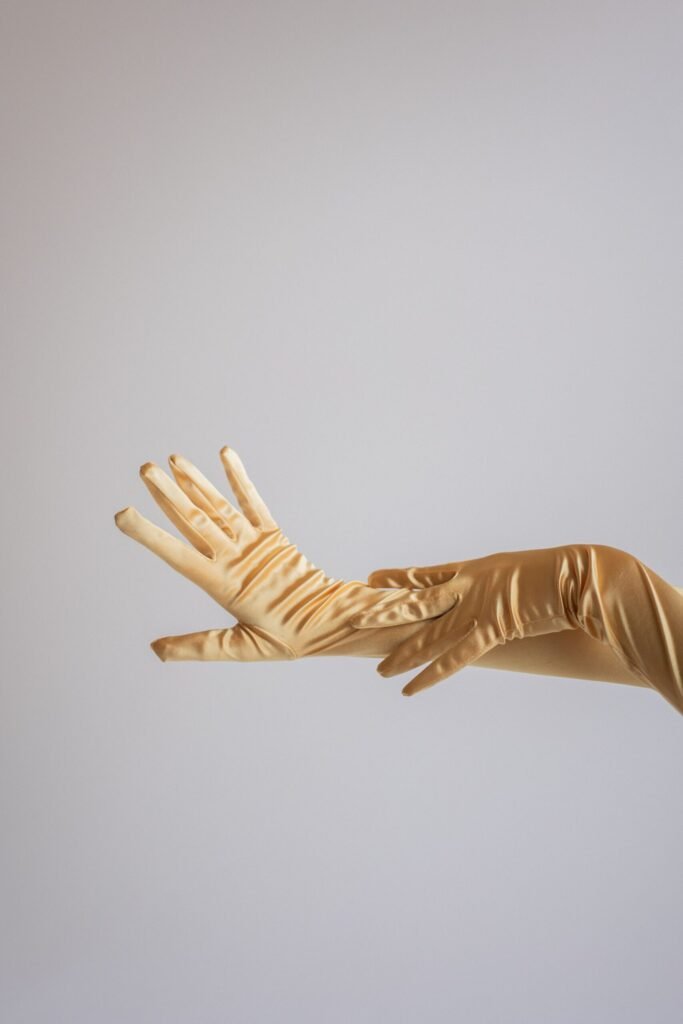
White is the traditional colour for formal long gloves, and ivory, champagne, black and gold are common alternatives. At the Vienna Opera Ball white is mandatory for debutantes, and long white gloves are the usual choice for prom and quinceañera. For a wedding, match the gloves to the gown rather than the veil, and test the two together in daylight, because white, ivory and champagne satin read very differently.
- White. The classic. Crisp against a white, ivory or deep-coloured gown.
- Ivory. Warmer and softer, and the match for an ivory gown.
- Champagne and gold. A softer metallic note for evening wear.
- Black. Dramatic, and a good choice for a dark gown or a stage costume.
- Pastels and deep colours. A deliberate fashion choice. Match the gloves to the dress colour or choose a neutral.
The Satin Color Library shows how 22 satin shades behave in light, which helps when you are matching a glove to a dress.
How do you choose the right size and fit?
Choose by the maker’s size chart, because glove sizing varies and Wikipedia gives no standard figures. Measure your hand around the knuckles, and your arm for the length you want, and compare both with the chart. If you are between sizes, choose the smaller size in stretch satin and the larger in non-stretch satin.
- Measure the hand. Use a flexible tape around the widest part of the palm, below the knuckles, with your hand flat.
- Measure the arm length. From the base of the thumb to the point where the glove should end. This is the button length that Wikipedia describes.
- Check the upper arm. For an opera glove, measure around the upper arm where the glove ends, so it does not slide down.
- Compare with the chart. Use the maker’s chart for the hand and the arm.
- Check the fingers. Glove fingers should reach the tips without wrinkling.
- Try before the day. A glove that is too tight tears at the seams, and one that is too loose slides and wrinkles.
How do you put on and take off satin gloves?
Put on satin gloves slowly, one finger at a time, with clean, dry hands and no rings. Rings and bracelets snag the floats, and a hasty pull can split a seam. Remove all jewellery first, as the Canadian Conservation Institute’s guidance on caring for textiles advises.
- Remove rings, watches and bracelets, which can snag threads.
- Make sure your hands are clean and dry. Skin oils and moisture mark satin.
- Gather the glove in your hand and slide it over your fingers first, easing each finger in.
- Pull the glove up over the hand, then up the arm, smoothing it as you go.
- Never tug at the fingertips or the top edge. Smooth the cloth towards the elbow.
- To remove, grip the glove at the wrist and peel it down inside out, finger by finger.
If a glove is tight, a little cornflour on the hands can help it slide on, but test it first on a spare glove because powder can mark dark satin. Avoid hand cream, which leaves marks that are hard to remove.
How do you care for satin gloves?
Care for satin gloves by keeping them clean, dry, flat and out of the sun, and by treating stains early. Check the label first. The University of Georgia Cooperative Extension’s Understand Your Fibers page gives the fibre rules: silk loses strength when wet and prefers dry cleaning, polyester melts if it is too hot, and acetate loses strength when wet and melts at low heat.
- Wash only if the label allows. Hand wash polyester satin in cool water with mild detergent, squeeze gently and never wring. See how to wash satin for a fibre-by-fibre method.
- Dry flat away from heat and direct sun.
- Spot clean carefully. Blot marks with a clean white cloth and avoid rubbing.
- Press gently with a cloth and low heat, if at all.
- Watch the snags. If a thread pulls, see our guide to fixing snagged satin.
How do you store satin gloves?
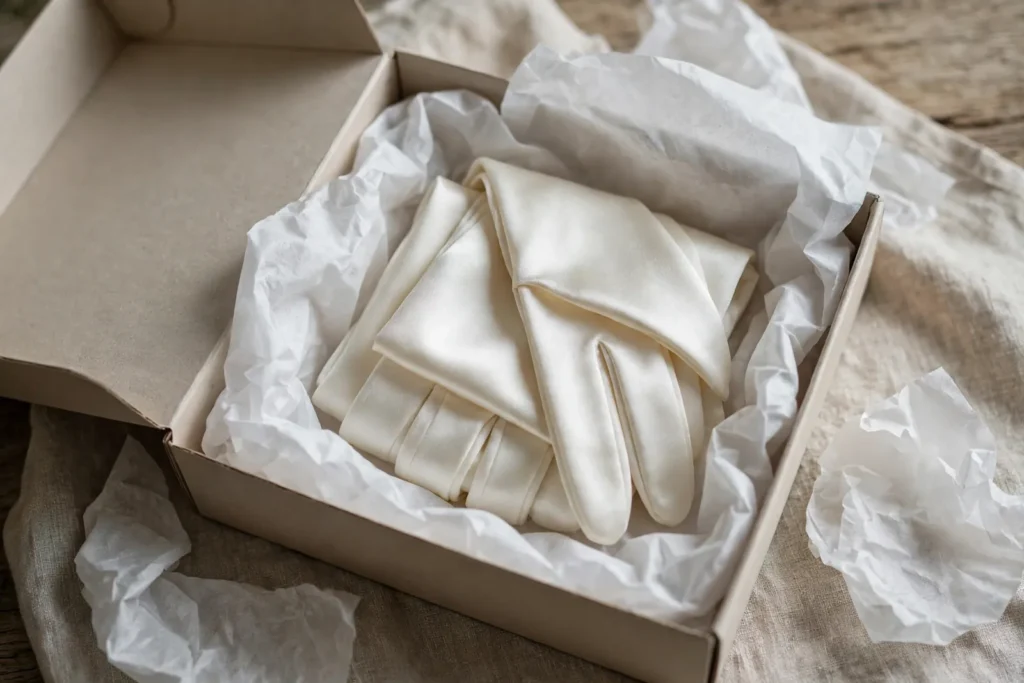
Store satin gloves flat in an acid-free box lined with tissue or muslin, in a cool, dark, dry place. The CCI’s guidance says flat storage is generally best for textiles, in acid-free boxes lined with unbleached muslin, without folding, and warns against ordinary paper, wood, dry-cleaner plastic bags, mothballs and cedar chests, which can release harmful vapours or trap moisture. It also says to keep textiles out of direct sunlight, which causes fading and brittleness.
- Clean and dry the gloves before you store them.
- Lay them flat in an acid-free box, with tissue between the layers if you stack them.
- Avoid hanging by the fingers, which stretches the cloth.
- Keep them away from perfume, hairspray and nail polish remover. Acetone destroys acetate, and alcohol can harm some fibres.
- Take them out occasionally to check for pests or creases.
If you are storing a gown and gloves together, our guide to satin dresses and the storage advice in the wedding guide apply to both.
What mistakes do people make with satin gloves?
| Mistake | What goes wrong | Do this instead |
|---|---|---|
| Wearing rings or bracelets | Snags the floats and splits seams | Take jewellery off, or wear it over the gloves only if the gloves allow |
| Choosing a length that does not suit the dress | Bunches at the sleeve or slides down | Match length to the sleeve and neckline |
| Pulling on tight gloves | Splits seams and stretches the cloth | Ease the glove on slowly, finger by finger |
| Wearing hand cream or perfume | Marks the satin | Apply after dressing, and keep gloves clear |
| Hot ironing | Melts polyester and scorches silk | Use the lowest heat and a press cloth |
| Storing in plastic | Traps moisture and yellows the cloth | Use an acid-free box with tissue or muslin |
How do you style satin gloves with a dress?
Style satin gloves by letting one element lead. If the dress is the star, keep the gloves plain and matching in tone. If the gloves are the statement, keep the rest simple. Satin is glossy, so several shiny pieces together can compete, and a matte element such as a crepe skirt, a linen wrap or lace gives the eye somewhere to rest.
- With a strapless ball gown. Opera gloves fill the space between the neckline and the wrist. This is the classic pairing that Wikipedia describes for ball gowns.
- With a sleeved dress. Choose a wrist or elbow glove that ends below the sleeve, so the cloth does not bunch.
- With jewellery. Wear bracelets and rings over the gloves only if the gloves are firm and the jewellery is smooth. Otherwise skip them, because they catch the floats.
- With a clutch and shoes. One shared shade, such as ivory or champagne, ties the outfit together. Our guide to satin clutches covers matching.
- With a wrap or jacket. A fur-free shawl or a tailored jacket keeps the look grounded and protects the gloves from the cold.
- With bridal wear. A bride may match the gloves to the gown, or to the veil if the two differ slightly. Test them together in daylight.
What makes one pair of satin gloves better than another?
A good satin glove has smooth, flat seams, an even sheen, a fit that follows the hand and a finish that does not fray or snag. Price is a rough guide only, because mass-produced stretch satin gloves can be well made and some expensive pairs are not. Look at the construction before you look at the label.
| Check | What to look for | Warning sign |
|---|---|---|
| Seams | Flat, even stitching along the fingers and the thumb | Puckering, twisted seams or loose threads |
| Fingertips | Rounded, with the seam lying neatly inside | Pointed or twisted tips that pull the cloth |
| Cloth | Smooth floats and an even sheen | Fuzz, pulls or a patchy shine |
| Fit at the wrist | Snug without squeezing | A loose cuff that wrinkles or slides |
| Top edge | Neatly finished, with a hem that lies flat | A raw or rolled edge that frays |
| Length | Matches the dress and the arm | A glove that stops mid-forearm when you wanted the elbow |
| Fibre label | Clearly stated in percentages | No fibre information at all |
If you can try the gloves on before you buy, do so. Bend and flex the hand, raise the arm and check that the glove stays in place and the seams do not pull.
Can you eat and drink while wearing satin gloves?
You can, but satin marks easily, so take care. Wikipedia’s article on evening gloves does not give any rule about eating or removing gloves, so there is no authoritative etiquette to quote. The practical advice is simple: protect the cloth, because satin shows grease, wine and lipstick, and the marks are hard to remove.
- Hold a napkin in the gloved hand when you eat or drink.
- Avoid greasy finger food and dark drinks that can stain pale satin.
- If you take the gloves off for a meal, peel them down inside out from the wrist, and lay them flat on your lap, not on the table.
- Blot any spill with a clean white cloth and do not rub. Our guide to washing satin explains why.
- Keep a spare pair in your bag if the event is long.
Are satin gloves used for costume and dance?
Yes. Wikipedia says performers such as can-can and burlesque dancers wear opera gloves, and satin is a popular choice because it looks bright on stage and costs less than kidskin. For performance, choose a stretch satin that moves with the hand, and expect it to wear faster than a pair worn for an occasional evening.
- Costume wear. Reinforce the seams at the thumb and the fingers if you will be moving a lot.
- Washing. Stage gloves collect makeup and perspiration, so clean them after each use according to the label.
- Spares. Keep a spare pair for dress rehearsal and the show.
- Sun and heat. Do not leave gloves in a hot car, because polyester can distort and dye can fade.
Frequently asked questions
What are satin gloves used for?
They are worn for formal occasions such as balls, weddings, proms and debutante events, and by performers. Long versions are called opera or evening gloves.
How long are opera gloves?
Opera or full-length gloves usually reach the biceps and sometimes the full arm, according to Wikipedia. Elbow and wrist lengths are shorter.
Do you wear gloves at a wedding?
Some brides wear opera gloves with a strapless gown, and some women wear gloves with dressy outfits at weddings. It is a style choice, not a requirement.
What colour gloves go with a ball gown?
Long white gloves are the traditional choice, and they are mandatory for debutantes at the Vienna Opera Ball. Ivory, champagne and black are common alternatives.
Are satin gloves stretchy?
Many are made from stretch satin, which has elastane in it, so they give and fit closely. Non-stretch satin needs an exact fit.
Can you wash satin gloves?
Sometimes. Polyester satin gloves may be hand washed in cool water if the label allows, and silk satin gloves are best dry cleaned. Never wring.
How do you stop satin gloves from slipping?
Choose the right size and length, and for opera gloves check the upper arm measurement. A slightly snug fit stays up better than a loose one.
How do you store satin gloves?
Clean them and lay them flat in an acid-free box with tissue or muslin, in a cool, dark, dry place, away from sunlight and plastic.
Where to go next
If you are dressing for a formal event, the Satin Database compares satin types and fibres, and the Satin Glossary defines terms such as float and sateen. Our guide to satin scarves covers another formal accessory, and the Satin Visual Library shows satin close up.


