


Satin Curtains: Fibre, Lining, Sun Fading and How to Hang and Clean Them
Are satin curtains a good idea?
Satin curtains are a good idea if you line them, choose polyester or a good silk, and keep them out of strong direct sun. They give a window a smooth, luminous look, and the weight of a lined satin curtain falls in deep, even folds. They are a poor idea unlined on a sun-facing window, where light fades the dye and weakens the fibre. This guide explains which fibre to choose, why lining matters, how sunlight affects satin, which headings and hardware suit it, and how to clean it.
Satin is a weave and not a fibre, so satin curtains can be polyester, silk, acetate or nylon, and the fibre decides how they behave at a window. The facts come from Wikipedia’s article on curtains, the Canadian Conservation Institute’s note on textiles and the environment, and the University of Georgia Cooperative Extension’s fibre guide. For the heaviest option, see our guide to heavyweight satin.

What do curtains actually do?
Curtains block light and drafts, give privacy and shape the look of a room. Wikipedia describes a curtain as cloth or other material that blocks or obscures light, drafts or, in a shower curtain, water. It notes that heavier fabrics insulate, that a small gap between the curtain and the window reduces drafts, and that curtains block light to aid sleep and set the mood of a room.
Wikipedia also describes a lined curtain as an uncoated face fabric backed by a separate coated lining, which gives maximum light absorption and insulation. That detail is central to satin curtains. The satin is the beautiful layer, and the lining does the practical work of blocking light, adding weight and protecting the face from the sun.
- Light control. A satin face reflects light, so it does not block it. A lining or a blackout layer does the blocking.
- Insulation. Heavier curtains insulate better, and a lining adds weight.
- Privacy. Sheer curtains screen the room from outside, and lined satin curtains close it off completely.
- Look. Satin catches window light, so the folds show a gleam that changes through the day.
Which fibre should satin curtains be made from?
Polyester satin is the practical choice for most windows, silk satin is the luxury choice that must be lined, and acetate and nylon satin carry more risk. The University of Georgia Cooperative Extension’s Understand Your Fibers guide supports the facts in the table.
| Fibre | Strengths at a window | Weaknesses | Our view |
|---|---|---|---|
| Polyester satin | Strong, wrinkle resistant, affordable; see polyester satin | Melts if too hot; absorbs body oils and odours | Best all-round choice, especially lined |
| Silk satin | Soft, rich drape; see silk satin | Loses strength when wet; UGA says heavily weighted silk is not a good choice for draperies unless lined | Choose only if lined and kept out of strong sun |
| Acetate satin | Silky drape; Wikipedia lists draperies among its uses | Loses strength when wet, melts at low heat, poor abrasion resistance | Fine for occasional rooms; see acetate satin |
| Nylon satin | Very strong | UGA says strong sunlight damages nylon and that it is a poor choice for sheer curtains | Avoid for sunny windows |
The table shows why polyester wins in most homes: it tolerates cleaning, resists wrinkles and costs less to replace. Silk is beautiful but fragile in a sunny window, and the guidance that heavily weighted silk needs lining applies to satin silks too.
How does sunlight affect satin curtains?
Sunlight fades dye and weakens fibre, and the damage is permanent. The Canadian Conservation Institute’s Note 13/1, Textiles and the Environment, says light fades dyes and weakens fibres, that light damage is cumulative and irreversible, and that the total dose is roughly brightness multiplied by hours of exposure, so halving either one halves the damage.

That rule gives you practical levers. You cannot move the sun, but you can reduce the dose in several ways.
- Line the curtain. A lining takes the sun, so the face fabric sees less light. Wikipedia describes a lined curtain as a face fabric backed by a separate lining.
- Close the curtains only when needed. Hours of exposure count, so an open curtain that sees less direct light lasts longer than one in constant sun.
- Add a UV film or a blind. The CCI says UV-absorbing window films can cut UV without dimming visible light, but their performance should be checked.
- Choose pale or very stable colours. Deep, saturated dyes show fading more.
- Rotate or swap panels. Moving a curtain to a shadier window shares the load.
- Keep an eye on heat. The CCI notes that decay roughly doubles for every 5 degrees Celsius rise in temperature.
The same note covers humidity, which matters for curtains in bathrooms and bedrooms. Damp above about 70 percent relative humidity is the condition to avoid, because mould can form in months at 70 percent and in days at 90 percent, and low humidity makes fibres brittle.
Why should satin curtains be lined?
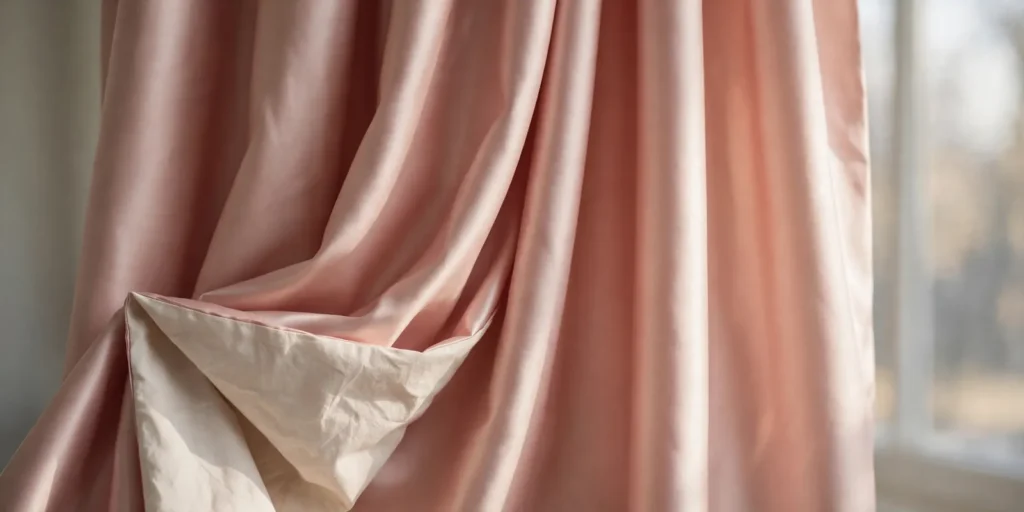
Line satin curtains because the lining protects the face from sunlight, adds weight and body, improves insulation and makes the curtain hang better. Without a lining, satin can look thin, show the window frame through it and fade quickly. A lining is the single most useful upgrade.
| Lining type | What it does | Good for |
|---|---|---|
| Cotton or cotton-polyester lining | Adds body, shields the satin from light, and gives a clean back | Most rooms |
| Blackout lining | A coated layer that blocks light. Wikipedia describes blackout fabric as rubber-coated | Bedrooms, nurseries and shift workers |
| Heavier or thermal lining | Adds weight and insulation | Cold rooms and draughty windows |
| No lining | Light passes through and the satin fades faster | Sheer decorative use only |
A lined curtain also hangs more evenly, because the lining weight pulls the folds down and keeps them tidy. If you are buying ready-made curtains, check that the lining is stitched in neat, loose seams so the satin does not pucker.
Which heading style suits satin curtains?
Heading styles that make regular, deep folds suit satin best, because the gloss shows each fold clearly. Wikipedia lists the main styles: pinch pleat, pencil pleat, eyelet, tab top, rod pocket, flat panel and grommet. Each shows satin differently.

| Heading | Look | Notes for satin |
|---|---|---|
| Pinch pleat | Tailored, evenly spaced pleats | Very formal; the pleats show as clean vertical highlights |
| Pencil pleat | Narrow, gathered pleats | Soft, full folds; needs a track or hooks |
| Eyelet or grommet | Metal rings through the cloth | Casual, wide folds; metal edges can snag satin, so check they are smooth |
| Tab top | Loops over a pole | Relaxed look; the tabs take strain, so reinforce them |
| Rod pocket | A channel the pole passes through | Gathered and soft; hard to slide along the pole |
| Flat panel | Clip-on rings hold a flat piece | Minimal; Wikipedia mentions clip-on rings for this style |
Check the hardware as well as the heading. Rings and clips should be smooth, because rough metal snags satin. Our guide to satin drape and shine explains how weight and finish change the fall of the folds.
How do you choose the right weight and fullness?
Choose a medium to heavy satin for a curtain that should drape, and add fullness so the folds are deep. Light satin gives a floating, wrinkled look, and heavy satin gives deep, sculptural folds that hang straight. Heavier cloth also insulates better, as Wikipedia notes, but it needs a stronger rod and brackets.
- Weight. Ask for the weight in grams per square metre and compare it. Our Satin Database has the conversions.
- Fullness. Makers commonly recommend fabric widths of about one and a half to two times the width of the window for fuller headings. Check the maker’s guidance for your heading style.
- Rod strength. Heavy lined satin is heavy. Use strong brackets and fix them into the wall, not just the plaster.
- Length. Sill, apron or floor length each change the look. Satin shows the hem, so measure carefully and hem with a fine, hidden stitch.
- Return and stack. Allow room for the curtain to stack back so it does not cover the glass when open.

Which colour satin curtains should you choose?
Choose a colour that suits the room and the light, and remember that satin changes colour with the angle and the hour. Ivory and champagne look warm and rich in daylight. Pinks and blush look softer in the morning and warmer in the evening. Deep colours such as navy, burgundy and emerald show a wide range from highlight to shadow, and they also show fading sooner.
- Ivory, cream and champagne. Light, warm and forgiving, and the most popular choice.
- Blush and pale pink. Soft and calm, ideal for bedrooms. They can look different at different times of day.
- Grey and silver. Cool and modern. Silver can look metallic against the window.
- Deep colours. Dramatic, but they show dust and fading more, and need lining.
The Satin Color Library shows how 22 shades behave in light. Always test a swatch in the room, at the window, at several times of day.
How do you hang satin curtains?
- Measure the window and the rod position. Place the rod above the window frame and wider than the glass, so the curtains clear it when open.
- Fix strong brackets into the wall at the right height and spacing.
- Attach the heading to the rings, hooks or track according to the style, making sure the pleats are even.
- Hang the curtains and let them settle for a day or two, then adjust the folds by hand.
- Steam out creases with a garment steamer, held a few inches away.
- Train the folds. Arrange the pleats while the curtain hangs, and tie them loosely for a few hours.
Take care when you lift satin curtains, because the lining and the weight can stress the heading. Support the weight with both hands, and never drag the cloth across a rough surface.
How do you clean and care for satin curtains?
Clean satin curtains regularly with gentle methods, and check the label first. Dust lodges in fibres, and the CCI notes that gritty particles can cut them, so regular dusting protects the cloth. Dust and oils can also feed mould and insects, and the note adds that clothes moth and carpet beetle larvae can attack silk, cotton and synthetics if they are soiled.
- Dust often. Use a soft brush or a gentle, low-suction vacuum, working with the grain.
- Check the label. Polyester satin may be washable. Silk and acetate are usually dry cleaned, as UGA notes.
- Wash gently if allowed. Use cool water, a mild detergent and a gentle cycle, and do not wring.
- Dry away from heat. Hang to dry. Polyester melts if too hot.
- Iron only if needed. Use the lowest heat on the wrong side through a cloth. See how to iron satin.
- Avoid damp. Ventilate the room and keep humidity below the level where mould forms.
- Rotate and inspect. Check the folds near the window for fading and thinning.
What mistakes do people make with satin curtains?
| Mistake | What goes wrong | Do this instead |
|---|---|---|
| Hanging unlined satin in a sunny window | Fades the dye and weakens the fibre | Line it, or choose a stable polyester |
| Choosing silk without lining | UGA says heavily weighted silk is not a good choice for draperies unless lined | Line silk or choose polyester |
| Using a weak rod | The rod bows under the weight | Use strong brackets and a stout pole |
| Rough rings and clips | Snag the floats | Use smooth rings and clips |
| Hot ironing | Melts polyester and scorches silk | Steam, or iron low through a cloth |
| Leaving damp curtains in a closed room | Invites mould | Dry well and ventilate |
| Skipping the swatch | The colour looks different at home | Test a swatch at the window |
How do satin curtains compare with other curtain fabrics?
Satin curtains are glossier and more formal than cotton or linen, lighter and cooler than velvet, and less forgiving of sun than polyester voile. Wikipedia’s article on curtains notes that velvet was used in Elizabethan and Jacobean curtains, that silk, nylon marquisette and ninon are used for sheer curtains, that cotton and polyester appear in blended uncoated fabrics, and that loosely woven polyester voile is used for sheers. Satin is not named, so the comparison below is practical, not sourced.
| Fabric | Look | Light control | Care | Best for |
|---|---|---|---|---|
| Satin (lined) | Glossy, formal, deep folds | Good when lined or backed with blackout | Polyester can be washable; silk and acetate usually dry cleaned | Bedrooms, dining rooms, formal rooms |
| Velvet | Rich, matte, heavy | Very good | Often dry cleaned | Cold rooms and formal settings |
| Cotton | Soft, casual, matte | Moderate, better lined | Usually washable | Everyday rooms |
| Polyester voile | Sheer and light | Low, filters light | Easy to wash | Layering behind satin |
| Blackout fabric | Plain, practical | Excellent | Wipe or wash | Bedrooms and nurseries |
The choice depends on the job. Satin brings the gloss and the formal look, and a lining brings the light control and weight. Many rooms use both, with satin on the room side and a lining behind.
Can you layer satin curtains with sheers or blinds?
Yes, and layering is often the best way to protect satin from the sun. A sheer curtain or a blind on the window takes the brightest light, and the satin curtains hang in front or behind as the room-side layer. Wikipedia notes that sheer weaves give basic UV protection, and the Canadian Conservation Institute says that reducing brightness reduces the dose of light damage.
- Sheer plus satin. A polyester voile behind the satin diffuses daylight and protects the face fabric.
- Blind plus satin. A roller or Roman blind handles light control in the day, and the satin curtains dress the window.
- Double rod. A two-layer rod lets you open the satin and keep the sheer.
- Track system. A double track gives a neat result with fewer folds to clash.
- Shade the glass. A UV-absorbing film on the window cuts UV without dimming visible light, as the CCI notes, though its performance should be checked.
How do you measure for satin curtains?
Measure the rail or pole, not the window, and measure the drop from the pole to where the curtain should end. Satin shows its hem, so the length matters, and an error is expensive. Work with a metal tape measure and write down every figure.
- Fix the pole or track first. Place it above the window frame and extend it beyond each side, so the curtains clear the glass when open.
- Measure the width of the pole or track. This is the width the curtains must cover.
- Decide the fullness. Makers commonly recommend about one and a half to two times the width, depending on the heading. Multiply the width by the fullness.
- Measure the drop. From the pole or ring to the sill, the apron or the floor, depending on the length you want.
- Allow for the heading and the hem. Follow the maker’s guidance for each heading style.
- Check the room. Radiators, furniture and window handles can all change the length you can use.
- Order a swatch first. Hold it at the window at different times of day.
How do you stop satin curtains from creasing or looking limp?
Choose a weight with body, line the curtain, and let the folds train in place. Satin creases easily, and a limp curtain usually means the cloth is too light or the lining is too thin. A few habits keep the curtains looking neat.
- Line them. A lining adds weight and keeps the folds falling straight.
- Train the folds. Arrange the pleats by hand each time you hang the curtains, and tie them loosely for a few hours.
- Steam in place. Hold a garment steamer a few inches from the cloth and work downwards.
- Avoid tight tie-backs. They leave a crease. Use a soft, wide tie-back.
- Do not crush them. Never push the curtains into a ball when you open them. Draw them back neatly.
- Dust regularly. The CCI notes that dust lodges in fibres and gritty particles can cut them.
Frequently asked questions
Are satin curtains good for bedrooms?
Yes, if they are lined, ideally with a blackout lining. The satin face looks soft and rich, and the lining blocks light and adds weight.
Do satin curtains fade in the sun?
Yes. The Canadian Conservation Institute says light fades dyes and weakens fibres and that the damage is cumulative and irreversible. Lining and shading reduce it.
What fibre is best for satin curtains?
Polyester satin is the practical choice. Silk satin must be lined, and nylon is damaged by strong sunlight, according to University of Georgia Extension.
Can you wash satin curtains?
Sometimes. Polyester satin may be washable on a gentle cycle in cool water. Silk and acetate satin are usually dry cleaned. Follow the label.
Should satin curtains be lined?
Yes. A lining protects the face from the sun, adds weight and insulation, and makes the curtain hang better.
Which heading is best for satin curtains?
Pinch pleat and pencil pleat give regular, deep folds that show satin’s gloss well. Check that rings and clips are smooth, because rough hardware snags satin.
How do you get creases out of satin curtains?
Hang them and steam from a few inches away, or iron on the lowest heat through a cloth. Do not use a hot iron.
How full should satin curtains be?
Makers commonly recommend about one and a half to two times the window width for fuller headings. Check the guidance for your heading.
Where to go next
If you want to compare satin with other fabrics for the home, see the Satin Database. The Satin Glossary defines terms such as float and drape, and the Satin Visual Library shows satin in folds and in light.