


Satin Bags and Clutches: Types, Fibres, What to Check and How to Care for Them
What is a satin clutch?
A satin clutch is a small evening bag covered in satin, usually without handles, that you hold in your hand or tuck under your arm. It carries the essentials for a formal event: a phone, a card, keys and a lipstick. Satin gives it a smooth, glossy surface that matches a dress or a pair of satin shoes, and the bag is usually lined and stiffened so it keeps its shape.
This guide explains the types of small evening bag, how a satin clutch is built, which fibre to choose, what to look for when you buy, how to match a clutch to a dress and shoes, and how to care for it. It draws on Wikipedia’s article on the handbag, the Canadian Conservation Institute’s guidance on caring for textiles, and fibre guidance from the University of Georgia. For the dress it will accompany, see our guide to satin dresses.
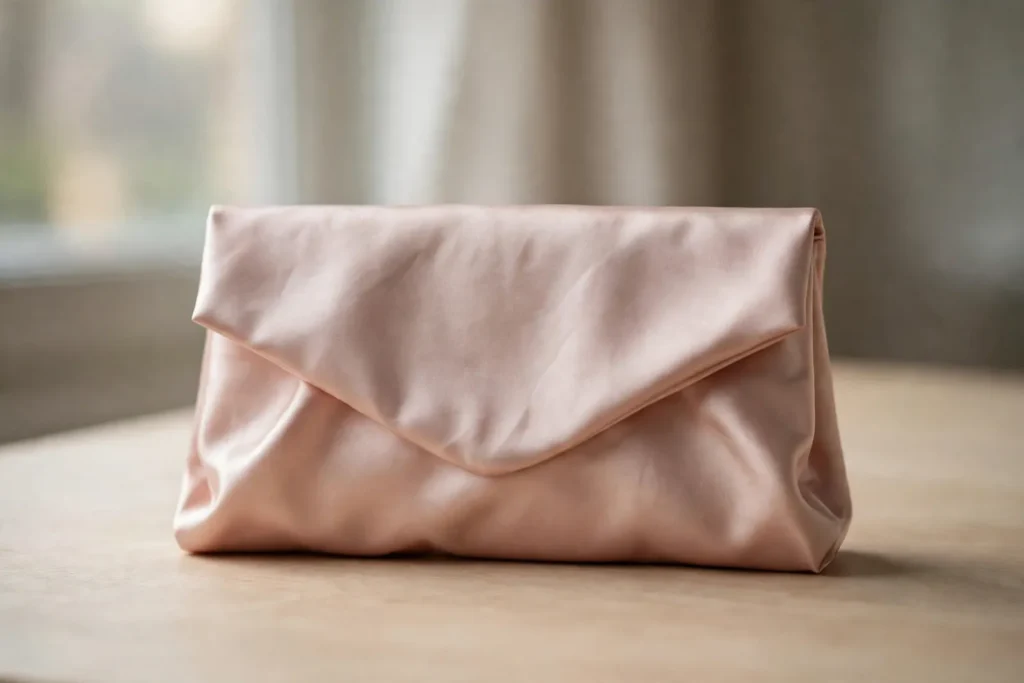
Clutch, minaudière, wristlet or reticule: what is the difference?
They are four kinds of small evening bag, and they differ in rigidity, straps and history. Wikipedia lists all four under the types of handbag. A clutch is a small, firm handbag with a top flap and no handles. A minaudière is a rigid type of clutch with a hinge at the bottom, no handles, straps or feet, often covered in jewels. A wristlet is a small rectangular bag with a short strap that goes around the wrist. A reticule is a small drawstring bag, also called a ridicule or an indispensable.

| Type | Shape | Closure | Satin version |
|---|---|---|---|
| Clutch | Small, firm, often rectangular, with a top flap and no handles | Flap, clasp or magnet | The most common satin evening bag, in envelope and box shapes |
| Minaudière | Rigid, hinged at the bottom, often jewelled | Hinged lid with a clasp | Wikipedia describes a vintage ivory satin minaudière covered with faux pearls and glass bugle beads |
| Wristlet | Small and rectangular with a short wrist strap | Zip or clasp | Satin wristlets suit parties where you need a free hand |
| Reticule | Soft, drawstring pouch | Drawstring | Made from silk and velvet in the early 1800s; a modern satin version is a pouch bag |
Choose by how you will carry it. A clutch needs a hand free for holding, a wristlet loops over the wrist, and a drawstring pouch hangs from the arm. Many satin clutches include a hidden chain strap, so the bag can hang from the shoulder when you need both hands.
Where do satin evening bags come from?
Satin evening bags descend from the reticule, a small fabric bag that appeared in the late eighteenth century. Wikipedia says that in the late 1700s fashion moved to slimmer accessories inspired by ancient Greece and Rome, and reticules were designed so purses would not look bulky. They were made of fine fabrics such as silk and velvet and carried by wrist straps, were popular in France first and then spread to Britain, where they were called indispensables, and were used mainly from 1795 to 1820.
The modern clutch followed. Wikipedia says the modern purse, clutch, pouch or handbag developed in England during the Industrial Revolution. The material that suited a formal dress was the same smooth, glossy cloth that suited a formal shoe, and so the satin clutch became the natural partner of a satin dress.
How is a satin clutch built?
A satin clutch has an outer layer of satin, a stiffener that holds the shape, a lining, and a closure. The satin is only the visible surface, and the quality of the stiffener, the seams and the lining decides how long the bag looks good. Wikipedia divides handbags into soft-body bags and frame bags, in which a metal frame supports the fabric or leather, and says frame bags often close with a kissing lock, two interlocking metal beads on the top of the frame.
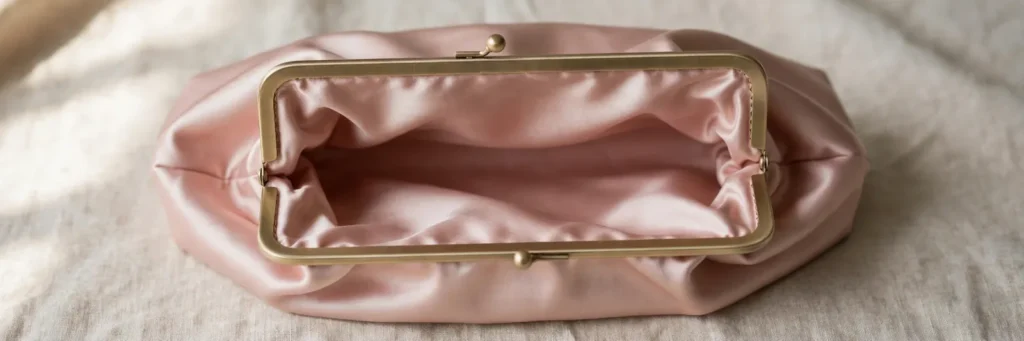
- Outer satin. The glossy face. On a good clutch the satin lies flat with no puckers at the corners.
- Stiffener. A layer of interfacing or board behind the satin that gives the clutch its firm shape. Without it, satin sags.
- Lining. Wikipedia notes that minaudières sometimes have a soft fabric lining. A smooth lining protects the satin from your belongings and makes the inside neat.
- Frame and clasp. A metal frame gives a crisp, structured opening. A clasp, magnet or kissing lock keeps it shut.
- Seams and edges. Neat, even seams and clean edges show careful making. Long floats catch easily, so rough finishing shows quickly.
- Strap or chain. A thin chain tucks inside. Check that the attachment points are reinforced.
Which fibre is best for a satin clutch?
Polyester satin is the sturdiest and most affordable choice, silk satin looks and feels the richest but is delicate, and acetate satin wears at the corners fastest. The University of Georgia Cooperative Extension’s Understand Your Fibers guide supports the facts below. A bag takes more abrasion than a dress, so abrasion resistance matters.
| Fibre | Strengths in a bag | Weaknesses | Care starting point |
|---|---|---|---|
| Polyester satin | Strong, good abrasion resistance, holds colour | Melts if too hot | Spot clean; low heat only |
| Silk satin | Soft, rich, absorbs moisture | Loses strength when wet, takes up body oils and grease | Dry cleaning preferred; avoid water |
| Acetate satin | Silky drape and gloss | Poor abrasion resistance, loses strength when wet, melts at low heat | Keep dry; avoid solvents such as acetone and alcohol |
| Nylon satin | Very strong | Picks up dirt, can grey with age, melts with heat | Wipe clean, keep from heat and sun |
For a bag that you will use more than once or twice a year, polyester satin is the sensible choice. For a bag that matches a silk dress and will see little use, silk is worth the extra care. Our guide to fixing snagged satin explains what to do when a clasp or a ring catches the surface.
What should you check before you buy a satin clutch?
Check the lining, the stiffening, the closure and the seams before you check the price. A satin clutch is a small item, and flaws show quickly because the bag is held in the hand and looked at closely.
| Check | What to look for |
|---|---|
| Fibre label | Polyester, silk or another fibre, stated in percentages |
| Surface | Smooth, flat floats with an even sheen and no pulls or fuzz |
| Corners | Neat, with no puckering or fraying. Corners wear first |
| Stiffener | The bag should hold its shape when empty. Squeeze it gently: it should spring back |
| Lining | Smooth and firmly attached, with no loose threads |
| Clasp or frame | Closes firmly and cleanly, with smooth edges that do not catch the satin |
| Size | Big enough for a phone and cards, but small enough to stay elegant |
| Strap or chain | Strong attachments and a comfortable length, and detachable if you want to carry it by hand |
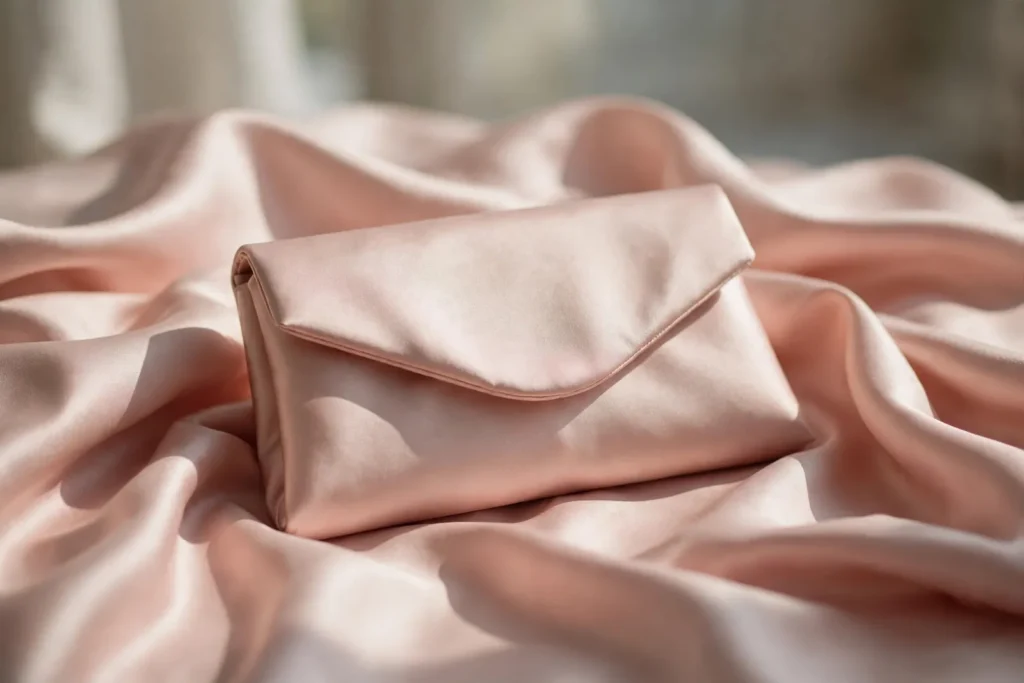
What fits in a satin clutch?
A satin clutch holds a phone, a card or a few notes, keys and a lipstick, and little else. A bag that is too full loses its shape and stresses the seams, and satin shows every bulge. Pack light and choose the size to match.
- Phone. Check the inside dimensions, because large phones do not fit small clutches.
- Cards and a little cash. A slim card holder keeps the shape.
- Keys. Put keys in a small pouch so they do not scratch or snag the lining.
- Lipstick and a compact. Keep makeup in a small case to avoid marks.
- A tissue and a spare pin. Useful for repairs during the evening.
Put anything that could stain, such as lipstick or a pen, in a separate pouch. Marks on a satin lining are hard to remove, and marks on the outer face are worse.
How do you match a satin clutch to a dress and shoes?
Match the colour family and the finish, and treat an exact match as optional. A clutch in the same colour as the dress looks coordinated, a clutch in a neutral such as champagne, ivory or black works with many outfits, and a metallic clutch adds contrast. Satin changes colour with the light, so compare the pieces together in daylight.
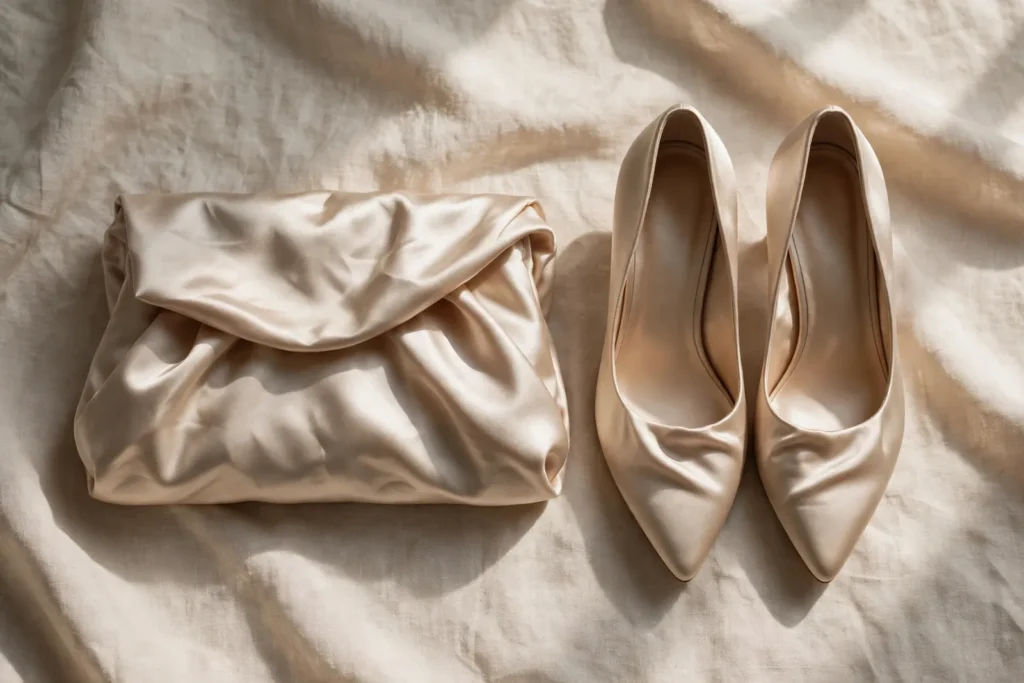
- Match the shoes. A satin clutch beside satin shoes looks deliberate. See our guide to cleaning satin shoes for care of the pair.
- Match the undertone. Warm shades such as ivory and champagne go together, and cool shades such as white and silver go together.
- Choose contrast on purpose. A deep clutch on a pale dress adds a focal point.
- Keep the finish consistent. A glossy satin clutch with a matte crepe dress can look uneven, while a satin clutch with a satin dress echoes the shine.
- Think about the event. A bride might choose ivory to match her gown, and a guest might choose a colour from the wedding palette. Our guide to satin wedding dresses covers colour in more depth.

If you are matching to a dress you already own, take the dress, or a swatch of it, when you shop. Online photos misrepresent satin colour, and a small difference shows as a mismatch under bright light.
How do you care for a satin clutch?
Care for a satin clutch by keeping it clean, dry and shaped, and by protecting it from snags and sun. The Canadian Conservation Institute’s guidance on caring for textiles advises handling textiles gently, removing rings and bracelets that can snag threads, and keeping textiles out of direct sunlight, which causes fading and brittleness.
- Keep it clean. Wipe the surface with a clean, dry cloth after use. Blot marks with a barely damp white cloth and do not rub.
- Do not wash it. The stiffener, glue and frame do not survive a wash. Spot clean only, or take it to a specialist.
- Avoid solvents. Acetone destroys acetate and alcohol can harm some fibres, so keep perfume, hairspray and nail polish remover away from it.
- Avoid snags. Keep the clutch away from rings, rough zips and Velcro.
- Dry it completely if it gets damp, away from heat.
- Protect it from sun. Direct sunlight fades dye, as the CCI notes.
How do you store a satin clutch?
Store a satin clutch stuffed lightly with acid-free tissue, in a breathable cloth bag, in a cool, dark, dry place. The CCI advises against ordinary paper, wood, dry-cleaner plastic bags, mothballs and cedar chests, which can release harmful vapours or trap moisture. Stuffing the bag keeps its shape and stops creases.
- Empty the bag and clean it before storing.
- Fill it loosely with acid-free tissue to hold the shape.
- Wrap it in a soft cotton cloth, or use the dust bag that came with it.
- Store it on a shelf, not under heavy items that crush it.
- Check it occasionally for dust or pests. See our guide to how to store satin for the full method.
Can you make a satin clutch yourself?
Yes, an envelope clutch is a good first project, but satin makes it harder than cotton. You need satin, a firm interfacing or stiffener, a lining and a closure. The process is simple to describe and fussy to do well, because satin slips and shows every stitch.
- Choose the size from your essentials, adding seam allowances.
- Cut the satin, interfacing and lining carefully, single layer, and mark with chalk.
- Attach the interfacing to the wrong side of the satin, testing the heat on a scrap first.
- Sew the outer pieces, using a fine needle and a small stitch, and press gently with a cloth.
- Sew the lining and join it to the outer, turning the bag right side out.
- Close the opening with a hidden slip stitch, and add the clasp.
- Press the finished bag and check the corners.
If you need to repair a seam or a hole while making or using it, our guide to satin repair explains how to do it without leaving a mark.
What mistakes do people make with satin clutches?
| Mistake | What goes wrong | Do this instead |
|---|---|---|
| Overfilling the bag | The seams strain and the shape is lost | Pack light and use a slim organiser |
| Choosing silk for heavy use | Wears at the corners and marks easily | Choose polyester for regular use |
| Carrying it with rings on | Snags the floats | Take care, or choose a bag with a firm frame |
| Washing the bag | Ruins the stiffener and the glue | Spot clean or use a specialist |
| Storing it in plastic | Traps moisture and yellows the cloth | Use a breathable bag and tissue |
| Buying by photo alone | The colour differs from the dress | Compare a swatch in daylight |
Is a satin clutch only for evenings?
A satin clutch is mainly an evening bag, but it works in the day too. Wikipedia describes the clutch as often an evening bag but also used during the day, and notes that some have a shoulder strap and many do not. A satin clutch suits a daytime wedding, a formal lunch or a dressy event, and it looks wrong with a casual outfit because the gloss is formal.
- Evening. The natural home of satin: weddings, balls, dinners and black tie events.
- Daytime formal. A pale satin clutch suits a wedding or a garden party.
- Travel and daily use. Satin is a poor choice, because it snags and marks. Choose leather or canvas.
- Costume and stage. A satin clutch is a good prop and photographs well.
How do you carry and hold a satin clutch?
Hold a satin clutch with a light, clean hand, tuck it under the arm when you need a hand free, and use a hidden strap for longer stretches. Satin picks up marks from skin oils, lotion and makeup, so handle it with dry, clean hands and put it down on a clean surface.
- Carry it by the body, not the flap, so the closure is not strained.
- Tuck it under the arm with the opening against your body, so nothing falls out and the surface is protected.
- Use a detachable chain strap if the bag has one, and check the attachment points before a long evening.
- Put it on a chair or a table, never the floor, which is dirty and abrasive.
- Keep it away from jewellery that can catch the floats, such as rings with stones.
How do you clean the inside of a satin clutch?
Clean the inside gently, without soaking it, because the stiffener and the glue do not like water. A lining collects lipstick, powder and crumbs, and these show up on a pale lining. Empty the bag, shake it out and wipe the lining with a barely damp white cloth.
- Empty the bag and open it fully.
- Shake out loose dust and crumbs over a bin.
- Blot marks with a clean white cloth, lightly dampened with water, working from the outside of the mark inwards.
- Do not use acetone or alcohol-based wipes. Acetone destroys acetate, and alcohol can harm some fibres.
- Let the bag dry open in the air, away from heat and sun.
- Take stubborn marks to a specialist. Do not rub, because rubbing spreads the mark and ruins the finish.
Which satin clutch colours are most useful?
Neutral colours give the most use, and a single good neutral can serve many outfits. Champagne, ivory, blush and black are the usual choices, and each works with a different range of dresses. A deep or bright colour is a good second bag for a particular outfit.
| Colour | Works with | Notes |
|---|---|---|
| Champagne | Ivory, gold, blush, black, navy | Warm and adaptable; hides marks better than white |
| Ivory | Ivory and cream gowns, pastels | Soft and classic; shows marks and oils |
| Blush pink | Pastels, grey, black | Soft and pretty; can look pale in bright light |
| Black | Almost everything | Practical; shows dust and lint |
| Gold or silver satin | Evening wear in a matching metal | Eye-catching; use as the single shiny accessory |
| Deep colours | A dress in a matching shade | Rich but less versatile |
The Satin Color Library shows how these shades behave in light, which helps when you are matching a clutch to a dress.
Frequently asked questions
What is a satin clutch?
A small evening bag covered in satin, usually with no handles. It carries essentials for a formal event and matches a dress or shoes.
What is the difference between a clutch and a minaudière?
A clutch is a small, firm handbag with a top flap and no handles. A minaudière is a rigid clutch with a hinge at the bottom, often jewelled, according to Wikipedia.
Can you wash a satin clutch?
No. The stiffener, glue and frame do not survive washing. Spot clean with a barely damp cloth, or ask a specialist.
Which fibre is best for a satin clutch?
Polyester satin is strongest and most affordable. Silk satin looks richest but is delicate. Acetate wears quickly at the corners.
What fits in a satin clutch?
A phone, a card or a few notes, keys and a lipstick. Check the inside dimensions for a large phone.
How do you keep a satin clutch from snagging?
Keep it away from rings, rough zips and Velcro. If a thread pulls, work it back gently rather than cutting it.
How do you store a satin clutch?
Stuff it lightly with acid-free tissue, wrap it in a breathable cloth bag and keep it in a cool, dark, dry place.
Should a clutch match your shoes?
It can, and a matching pair looks deliberate. A neutral clutch in ivory, champagne or black also works with most outfits.
Where to go next
To go further on the cloth, see the Satin Database, which compares fibres and weights, and the Satin Glossary for terms such as float and selvage. Our guide to satin gloves covers another formal accessory, and the Satin Visual Library shows satin close up.


