


Satin Dress Necklines: Which Neckline Suits Which Satin and How It Should Fit
What is a neckline, and why does it matter in satin?
A neckline is the shape of the edge of a garment around the neck and chest, and in satin it decides how the cloth sits, folds and catches the light. Satin is smooth, glossy and unforgiving, so a neckline shows every seam, ridge and crease. A neckline that works in a matte cotton can look wrong in satin, and a good one makes the cloth look luminous.
This guide sets out the main necklines, using the definitions on Wikipedia’s neckline article, and explains how each behaves in satin, which satin suits which neckline, and how to choose and fit one. It is written for anyone choosing a satin dress, a wedding gown or a bridesmaid dress. For the whole garment, see our guide to satin dresses.

What are the main satin dress necklines?
The eight most useful necklines for satin are the sweetheart, boat, halter, off-the-shoulder, square, V-neck, scoop and one-shoulder. Each has a different line, and each asks something different of the cloth. The diagram shows the shapes, and the table says what Wikipedia says about each and how it behaves in satin.

| Neckline | What it is (Wikipedia) | In satin |
|---|---|---|
| Sweetheart | A curved, concave-down bottom edge, usually doubly scalloped, like the top of a heart. The strapless version is common in wedding dresses | Needs structure so the curves stay crisp; heavy satin holds the shape best |
| Boat (bateau) | A high, wide, slightly curved neckline that passes the collarbones and sits on both shoulders | Clean and calm; the wide line shows the gloss across the shoulders |
| Halter | A V or scoop front with straps that tie behind the neck or meet at the nape; hides cleavage and exposes the collarbone and back | The neck strap carries the weight, so it needs to be strong and smooth |
| Off the shoulder | Lower than a boat neck, below the shoulders and collarbone, passing over the arms | Slippery satin can slide, so it needs elastic, boning or a firm structure |
| Square | Three linear edges with the bottom meeting the sides at right angles | Crisp lines suit structured satin; used in wedding dresses since at least the 1800s |
| V-neck | Two diagonal lines from the shoulders meeting on the chest | Elongates the line; fluid satin falls cleanly from the point |
| Scoop (U-neck) | A curved U-shape with the arms resting on the shoulders; depth varies from high to plunging | Soft and easy; works in light and mid-weight satin |
| One shoulder | An asymmetrical neckline running diagonally from one shoulder to under the other arm | Dramatic; the diagonal shows the gloss, but the single strap must be firm |
The table is the short version. The sections below go through each neckline with a satin buyer in mind.
How does a sweetheart neckline work in satin?
A sweetheart neckline works best in a structured satin, because the scalloped curves need support to stay crisp. Wikipedia describes the sweetheart as a curved, concave-down edge, usually doubly scalloped like the top of a heart, and says the strapless version is common in wedding dresses. In satin, the bodice behind the neckline needs boning or a stiff lining, or the curves collapse and the edge wrinkles.

- Best satin. Duchess or a heavy bridal satin, which hold the curve. See our guide to duchess satin.
- Watch. Gaping at the centre of each curve, and wrinkles where the cup meets the edge.
- Fit. The edge should lie flat against the body without pulling or gapping.
- Good for. Wedding gowns, prom dresses and formal gowns.
How does a boat neckline work in satin?
A boat neckline suits satin because it is simple and shows the gloss without fuss. Wikipedia describes it as a high, wide, slightly curved neckline that passes the collarbones and sits on both shoulders. The line is calm, and in satin it creates a wide band of light across the shoulders, which looks elegant on structured cloth.
- Best satin. Mid-weight to heavy satin, or crepe-back satin with the matte side outward, which reduces glare.
- Watch. The neckline can slide off the shoulders if the cloth is slippery and the fit is loose. A stay tape along the edge keeps it in place.
- Good for. Day-to-evening dresses, wedding guest outfits and modest formal wear.
How does a halter neckline work in satin?
A halter neckline in satin shows the shoulders and back and puts the weight on the neck, so the strap must be firm and smooth. Wikipedia describes the halter as a V or scoop front with straps that tie behind the neck or wrap and meet at the nape, hiding cleavage and exposing the collarbone and back. It notes that Jeanne Lanvin’s Cyclone dress had a halter neckline.
- Best satin. Light to mid-weight satin, such as charmeuse, which falls fluidly from the neck.
- Watch. A heavy skirt pulling on a thin strap. Lined, reinforced straps or a firm bodice share the load.
- Good for. Evening dresses, summer weddings and bridesmaid dresses.
How does an off-the-shoulder neckline work in satin?
An off-the-shoulder neckline is the hardest to wear in satin because the smooth cloth slips. Wikipedia describes it as lower than a boat neck, below the shoulders and collarbone, passing over the arms. It was popular in the Regency and Victorian eras, Charles Frederick Worth designed many such bodices, and Brigitte Bardot revived the style in the 1960s. A satin version needs a structure that holds it in place.
- Best satin. Structured satin with a firm lining and boning, or elastic stitched into the edge.
- Watch. Slipping when you lift your arms, and a visible line where the edge presses into the skin.
- Good for. Ball gowns, wedding gowns and formal evening dresses. Wikipedia notes that most ball gowns are traditionally off-the-shoulder with a low neckline, in its article on the ball gown.
How do square, V, scoop and one-shoulder necklines work in satin?
Each of these four has a clear line that satin shows well, and each asks for a different kind of cloth. Square necklines are crisp, V-necks are long and fluid, scoops are soft, and one-shoulder lines are diagonal and dramatic.
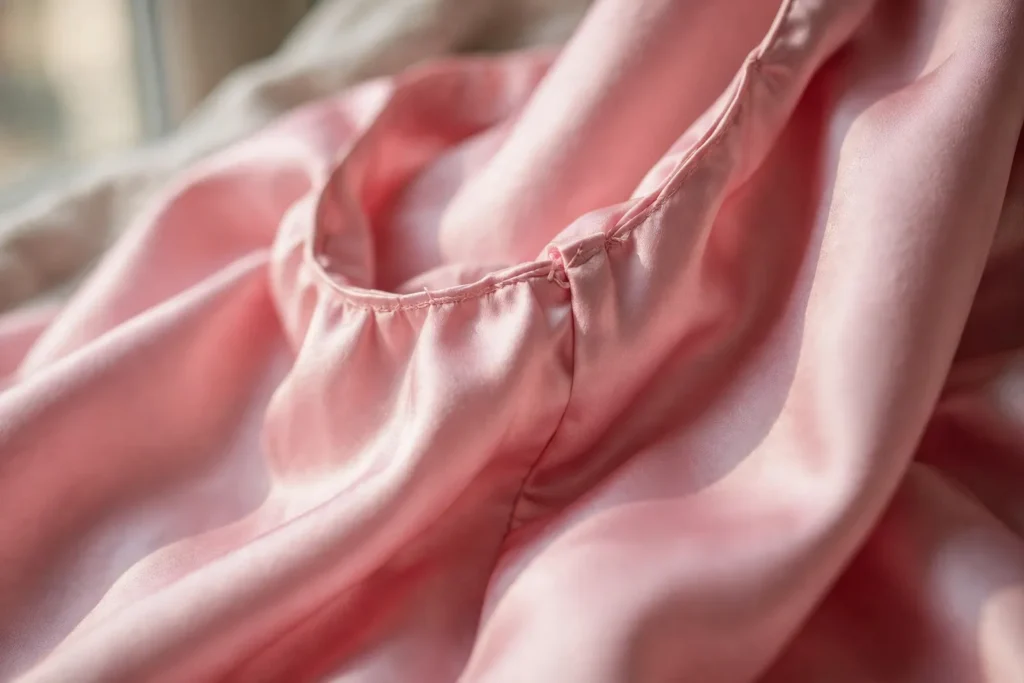
- Square. Three straight edges that meet at right angles. Wikipedia says it has been used in wedding dresses since at least the 1800s and was popular in the 1870s. Satin shows the straight lines sharply, so the sewing must be exact.
- V-neck. Two diagonal lines from the shoulders meeting on the chest. In satin the diagonal catches the light, and a fluid satin falls cleanly. Watch for gaping at the centre.
- Scoop. A curved U-shape. Easy and flattering, and in light satin it drapes softly. The depth can range from high to plunging, as Wikipedia notes.
- One shoulder. An asymmetrical line from one shoulder to under the other arm. In satin it gleams along the diagonal, and the single strap carries the weight, so it must be firm.
What about cowl, illusion and other necklines?
Cowl, illusion, keyhole, surplice and portrait necklines are less common but well suited to satin. A cowl neckline is a draped fold of fabric at the front, which fluid satin does beautifully. Wikipedia notes the term “cowl” only in a gallery caption and a fabric treatment, so we describe it here from the garment, not from its definition: a neckline that falls in soft, loose folds.
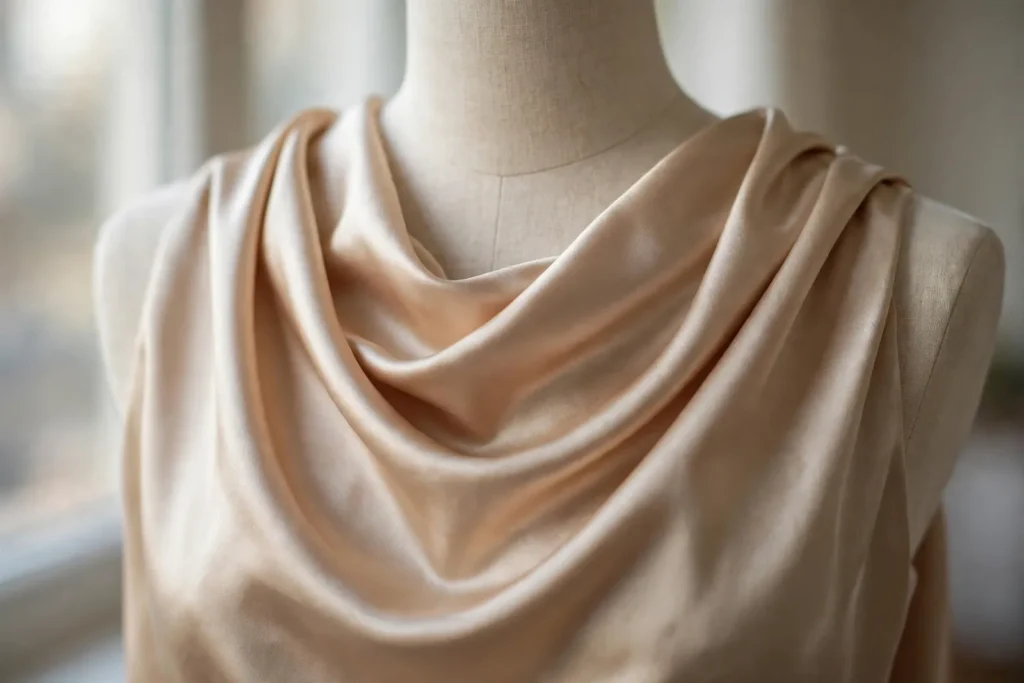
- Cowl. Soft, draped folds at the front. It needs a fluid satin cut on the bias, and a heavy satin will not fall in soft folds. Our guide to satin drape and shine explains what controls the fall.
- Illusion. Wikipedia describes a low, usually strapless neckline with sheer fabric or lace above it, creating a second, higher neckline, with tulle or organza as typical sheers. Pairing satin with sheer fabric is common in bridal wear, and our comparison of satin vs organza shows how the two differ.
- Keyhole. A hole at the centre, usually just below the collarbones. A small opening that is easy to get wrong in satin, because the edge must be finished neatly.
- Surplice. Fabric wraps to form a V in the front, like a bathrobe overlap. It suits fluid satin that wraps and drapes.
- Portrait. A V-neck whose edges sit at the points of the shoulders, with the straps set higher than in an off-the-shoulder style.
- Plunging. A deep V, U or square neckline. It needs careful construction and a firm tape along the edge so it does not shift.
Which satin suits which neckline?
Match the weight of the satin to the shape of the neckline. Structured necklines such as sweetheart, square and off-the-shoulder need a heavier satin, and fluid necklines such as cowl, V and halter need a lighter one. Using the wrong weight is the most common reason a satin neckline looks wrong.
| Satin | Weight and character | Necklines that suit it | Necklines to avoid |
|---|---|---|---|
| Duchess satin | Heavy, structured, glossy | Sweetheart, boat, off the shoulder, square | Cowl and surplice, which need fluidity |
| Bridal satin | Mid weight to heavy | Sweetheart, square, boat | Very deep plunging necklines |
| Charmeuse | Light, fluid, glossy face | Cowl, V, halter, surplice, scoop | Sweetheart without a structured lining |
| Crepe-back satin | Satin face, matte crepe back | Boat, square, scoop | Anything that shows a lot of the reverse |
| Stretch satin | Gives and recovers | Scoop, V, one shoulder | Strapless off-the-shoulder without boning |
The weights of satins are covered in our Satin Database. The principle is simple: heavier satin holds a shape, lighter satin falls in folds.
Which neckline suits which occasion?
Choose the neckline for the setting, the season and how you will move. A sweetheart or off-the-shoulder suits a formal wedding or ball, a boat or square suits a more modest event, and a halter or one-shoulder suits a summer party. The table gives a starting point. It is a guide to the style, not a rule.
| Occasion | Necklines that often work | Notes |
|---|---|---|
| Wedding gown | Sweetheart, off the shoulder, square, V | Wikipedia notes sweetheart and square are common in wedding dresses. See satin wedding dresses |
| Bridesmaid or guest | Boat, halter, scoop, one shoulder | Choose a neckline you can move in for a long day |
| Prom | Sweetheart, halter, V, one shoulder | Stay-up structure matters for dancing |
| Black tie | Off the shoulder, V, boat, halter | Satin shows best in a clean, confident line |
| Cocktail | Scoop, V, square, halter | A softer satin works well |
| Daytime event | Boat, square, scoop | Cover and comfort come first |
How should a satin neckline fit?
A satin neckline should lie flat against the body without gaping, pulling or sliding, and it should stay put when you move. Satin does not forgive a poor fit, because the glossy surface shows every gap and wrinkle. Check the fit sitting, standing and with your arms raised.
- Stand straight in the dress and look at the neckline in a mirror. It should lie flat against the body.
- Raise your arms. The neckline should not slip or drag the dress out of place.
- Sit down. Check that the edge does not gape or roll.
- Bend forward. A neckline that gapes badly is hard to wear.
- Move as you will on the day. Walk, turn and raise a glass.
- Check the edge. It should be smooth, with no puckers and no visible stitches.
If the neckline gapes or slips, a tailor can add stay tape, elastic, a silicone grip or a small dart. Do not ask for heavy alterations without care, because satin shows needle holes and pressing marks. Use a tailor who has worked with satin before, and press only with a cloth. The University of Georgia Cooperative Extension’s Understand Your Fibers page notes that polyester melts if too hot and that silk can yellow at high iron temperatures.
Can you trim a satin neckline?
Yes, and necklines are a common place for decoration. Wikipedia notes that necklines can be trimmed with jewels, scallops, picots or ruffles, and that gauzy tulle or lace overlays can create illusion necklines. Satin is a good base for decoration because it shows beads and embroidery clearly, but heavy trim needs a firm structure behind it.
- Beading and jewels. Add weight, so the neckline needs a stiffer lining.
- Scalloped or picot edges. Fine finishing that suits light satin.
- Ruffles. Add volume and movement; they work best in a soft satin.
- Lace or tulle overlays. Create an illusion neckline and add texture.
- Piping. A fine line of contrast or matching satin emphasises the shape.

What mistakes do people make with satin necklines?
| Mistake | What goes wrong | Do this instead |
|---|---|---|
| Choosing a structured neckline in light satin | The curves collapse and wrinkle | Choose a heavier satin or add structure |
| Choosing a cowl in heavy satin | The folds are stiff and bulky | Choose a fluid, light satin |
| Skipping stay tape | The neckline stretches or slips | Add stay tape along the edge |
| Wearing an off-the-shoulder without structure | It slides down | Choose boning or elastic |
| Ignoring the lighting | The neckline looks different in photographs | Check the dress in daylight |
| Pressing hot | Melts polyester and scorches silk | Use a cloth and low heat |
How have satin necklines changed over time?
Several of the necklines in this guide have long histories, and Wikipedia gives enough detail to show how fashion keeps returning to them. Knowing the history helps you see why a neckline carries a particular mood, such as romance, formality or glamour.
- Off the shoulder. Popular in the Regency and Victorian eras, in the early to mid-nineteenth century. Charles Frederick Worth designed many off-the-shoulder bodices, and Brigitte Bardot revived the style in the 1960s.
- Square. Used in wedding dresses since at least the 1800s and popular for dresses in general in the 1870s.
- Halter. Jeanne Lanvin’s Cyclone dress had a halter neckline, which Wikipedia cites as an early example.
- Sweetheart. Its strapless version is common in wedding dresses today.
- Illusion. A modern construction that layers sheer tulle, organza or lace above a low neckline.
Satin has been a favourite fabric for each of these shapes because the gloss follows the line of the neckline and makes it read clearly from across a room.
Which neckline is easiest to wear and to move in?
Boat, scoop, square and V necklines are generally the easiest to wear, because they sit on the shoulders and do not depend on structure to stay in place. Strapless, off-the-shoulder and halter necklines look dramatic but ask more of the fit, because there is less cloth holding them up. Choose by how long you will wear the dress and how much you will move.
| Activity | Easier necklines | Harder necklines | Why |
|---|---|---|---|
| Dancing | Scoop, V, square, boat | Strapless, off the shoulder | The dress must stay put while you move and raise your arms |
| Sitting for a long dinner | Boat, square, scoop | Plunging, halter | A neckline that gapes or digs in becomes tiring |
| Travelling in the dress | Boat, scoop, V | Sweetheart, off the shoulder | Structured edges crease and slip in a car or on a plane |
| Photographs | Any, but check the gloss | Very low plunging lines | Satin shines under flash and shows every wrinkle |
| Cold weather | Boat, square, one shoulder with a wrap | Strapless without a wrap | Satin is cool to the touch and offers little warmth |
How do you pair a satin neckline with jewellery and hair?
Let the neckline frame the jewellery, and keep one focus. A satin neckline already has gloss and line, so too much jewellery competes. Match the metal and the scale to the shape, and think about where the eye travels.
- Sweetheart. A simple pendant or a short necklace follows the curve. Avoid a heavy collar that hides the shape.
- Boat neck. Choose earrings and a bracelet. A necklace usually clashes with the straight line.
- Halter. Wear statement earrings and an updo that shows the neck and shoulders. A necklace is usually unnecessary.
- Off the shoulder. A delicate chain or a choker suits the bare collarbone. Hair up shows the line.
- V-neck. A pendant that follows the V repeats the line.
- Cowl. Skip the necklace. The drape is the decoration.
- One shoulder. A single bold earring or a cuff balances the asymmetry.
Be careful with clasps and chains. Fine chains can snag satin, and hair clips and pins can pull the floats, so put jewellery on before the dress and check for catches.
Frequently asked questions
What is the most popular neckline for a satin wedding dress?
Sweetheart and square necklines are common in wedding dresses, according to Wikipedia. Off-the-shoulder and V-necks are also popular.
Which neckline suits satin best?
It depends on the satin. Structured satin suits sweetheart, boat and off-the-shoulder, and fluid satin suits cowl, V and halter.
What is a sweetheart neckline?
A curved, concave-down edge, usually doubly scalloped like the top of a heart. The strapless version is common in wedding dresses.
What is a boat neckline?
A high, wide, slightly curved neckline that passes the collarbones and sits on both shoulders.
What is a halter neckline?
A V or scoop front with straps that tie behind the neck or meet at the nape, exposing the collarbone and back.
Does satin slip off the shoulders?
It can, because the cloth is smooth. Off-the-shoulder styles need boning, elastic or a firm structure to stay in place.
What is a cowl neckline?
A neckline that falls in soft, draped folds at the front. It needs a light, fluid satin.
How do you stop a satin neckline from gaping?
Ask a tailor to add stay tape, a small dart or silicone grip, and check the fit sitting and with arms raised.
Where to go next
For the types of satin that suit each shape, see our guide to fashion by satin type. The Satin Glossary defines terms such as bias and drape, and the Satin Visual Library shows satin garments on mannequins.


