


Satin Dyeing and Finishing: How Colour and Gloss Are Made
What happens to satin after it is woven?
Woven satin goes through preparation, dyeing and finishing before it is the fabric you buy. The cloth that comes off the loom, called greige, is usually dull, stiff and undyed, and it still carries the oils, sizing or natural gums that helped the yarn survive weaving. Wet processing cleans it, colours it and sets it, and finishing then gives it the hand and the gloss that make it satin. Colour and shine are decided in different steps, which is why a fabric can be well dyed and badly finished, or the reverse.
This guide follows the main steps in order, explains the differences between silk and polyester satin, and shows how each step shows up in the fabric you hold: fastness, shine, feel and weight. For the earlier story of fibre, yarn and weaving, see our guide to how satin is made. The flow chart is a simplified original diagram, and mills change the order and the number of steps to suit the fibre and the product.

Why is satin prepared before it is dyed?
Dye cannot reach the fibre evenly through oils, sizes and gums, so the cloth is cleaned first. For many fabrics that means removing warp sizing, which protects yarn on the loom, and scouring away oils and dirt. For silk there is one more step, degumming, which removes the natural gum that holds the silk filaments together.
The silk-dyeing site Wormspit describes degumming as the process of removing the sericin, or silk gum, from silk. Sericin acts as a protective layer, so it is usually left on until the silk is ready to dye, and some fabric is degummed after weaving to protect the yarn from abrasion on the loom. Removing it improves the silk’s sheen, colour, hand and texture, and typical silks lose roughly 15 to 25 percent of their original mass in the process (Wormspit, Degumming silk). That weight loss is one reason a silk’s final momme can differ from what the raw cloth weighed.
- Desizing and scouring. These remove sizes, oils and dirt so dye can penetrate evenly. The exact method depends on the fibre and on what was applied during weaving.
- Degumming (silk). This strips sericin, softening the silk and raising its sheen.
- Bleaching (if needed). White and pale shades need a clean, even base, so some fabrics are bleached first.
- Rinsing. Residues left in the cloth can cause uneven dyeing or later staining.
How is silk satin dyed?
Silk is a protein fibre, so it is dyed with dye classes suited to protein fibres, in a bath at a controlled temperature and acidity. After degumming, the fabric takes up the dye evenly, which is why preparation matters so much. The result is the soft, deep colour silk is known for.
Because silk is dyed at lower temperatures than polyester, it is gentler on the fibre, but silk is also more sensitive to light, perspiration and harsh washing, so its dyed colour needs careful care. We describe the general logic and do not give a recipe, because dye choice, temperature and chemicals vary by mill and by shade, and we do not have an authoritative source for silk dye recipes. If you want to dye silk at home, our guide to dyeing satin covers what is realistic. For more detail, read our guide to satin vs rayon. We cover this in depth in our guide to satin colors.

How is polyester satin dyed?
Polyester satin is dyed with disperse dyes at high temperature, and the dye that stays on the surface is then washed off. Polyester is hydrophobic and tightly packed, so ordinary dyes cannot enter it. Disperse dyes are fine particles that dissolve into the fibre when it is heated. In the conventional process, shown in a review by Jozi and Izadan of the Isfahan University of Technology, the fabric is dyed at 130 degrees Celsius for 60 minutes in a buffered bath, and part of the dye penetrates the fibre while part stays on the surface (Jozi and Izadan, Journal of Studies on Color World, 2022).
That surface dye causes trouble. The review says deposits of disperse dye on dyed polyester are an important problem, because these dyes deteriorate the wash, rubbing and sublimation fastness and the brightness of the dyed fibres, especially deep-dyed ones. So the surface dye has to be cleared. Conventionally this is done by reduction clearing, using sodium dithionite, a reductant, and sodium hydroxide, an alkali. The same review notes that this process also removes surface oligomers and auxiliaries such as carriers, and that, unfortunately, it is not environmentally friendly, which is why researchers are studying alternatives.
- Dyeing. The fabric is heated with disperse dyes, commonly around 130 degrees Celsius under pressure, so the dye can move into the fibre.
- Clearing. A reducing wash removes surface dye so the colour rubs and washes out less.
- Rinsing and neutralising. This removes chemicals and leaves the fabric ready for finishing.
For the black and green cases, where heavy dye loads make fastness harder, see our guides to polyester satin and the colour guides on this site.
What does finishing do to satin?
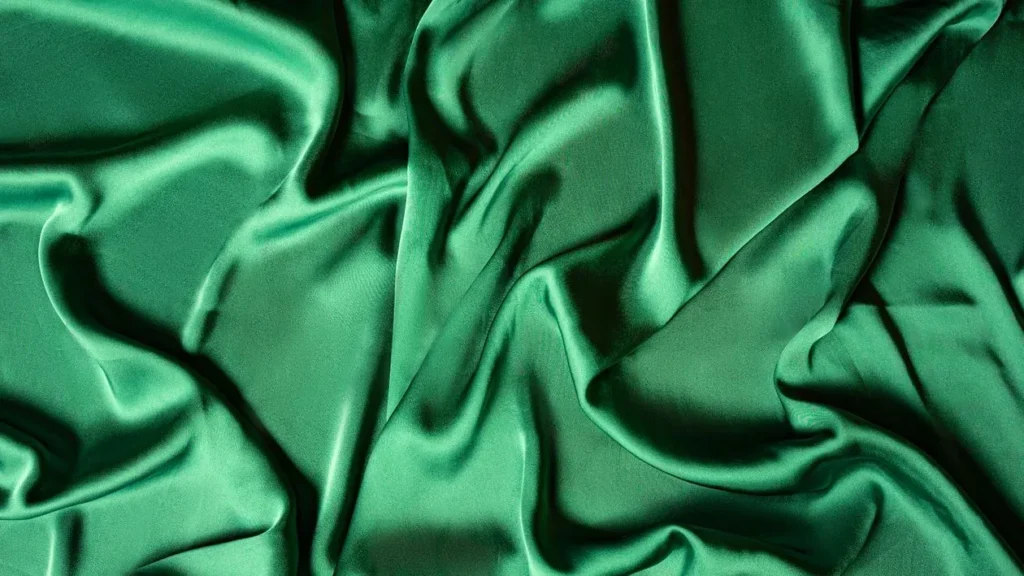
Finishing sets the feel and the shine. After dyeing, satin is softened, stabilised and often pressed. Softening makes the hand supple, heat setting helps synthetic fabrics keep their shape, and calendering presses the surface for gloss. Different finishes can give the same dyed fabric a crisp, papery feel or a soft, fluid one.
Calendering is the best-known gloss finish. Wikipedia describes it as a process in which, for textiles, fabric is passed between calender rollers at high temperatures and pressures, and says treated fabrics are glossier and smoother, though they can “feel thin, glossy and papery” (Wikipedia, Calendering). The pressing flattens the floats so they reflect light together, which raises shine, but the same flattening can make the cloth firmer and less supple.
- Softening. Adds a smoother, more fluid hand.
- Heat setting (synthetics). Fixes the fabric’s shape and size, so it resists wrinkling and shrinking.
- Calendering. Presses the surface to raise gloss and smoothness.
- Stiffening or resin finishes. Add body and crispness, and may wear off with washing.
- Special finishes. Embossing, moire effects and others change the look of the surface.
Mechanical effects such as pressing can soften with washing and heat, and chemical finishes can wash out gradually, which is a general pattern, not a rule for every fabric. That is why a satin can lose some of its gloss or its crispness after repeated cleaning. Our satin finish guide covers the main finishes in more detail.

How do dyeing and finishing decide colour fastness?
Fastness depends on how well the dye is fixed and how clean the surface is. Colourfastness is the resistance of a dyed or printed textile to fading or bleeding. The Belgian textile research centre Centexbel describes it as “an important demand” that “refers to the resistance of colour to fade or bleed”, and lists water, light, rubbing, washing and perspiration among the influences tested (Centexbel, colour fastness according to the ISO 105 series).
| Test area | What it checks | What usually causes poor results |
|---|---|---|
| Washing | Does the colour fade or stain other items in the wash? | Surface dye left on polyester, or poorly fixed dye on silk |
| Rubbing (crocking) | Does colour transfer to a rubbing cloth, wet or dry? | Heavy dye loads in dark shades, and incomplete clearing |
| Light | Does the colour fade in sunlight? | Dye choice and shade depth |
| Perspiration | Does the colour change or stain with sweat? | Dye sensitivity to acid or alkali, and fibre type |
| Water spotting | Does a drop of water leave a mark? | Some silk dyes and finishes, and uneven drying |
Deeper shades generally carry more dye, so they are where fastness problems show first. That is why deep greens, blacks and reds deserve a closer look. Our guide to satin and sustainability also touches on the water and chemical load of dyeing.
What goes wrong in dyeing and finishing?
Most defects come from uneven dyeing, unfinished clearing or over-pressing. They show up in the cloth in recognisable ways, and knowing them helps you judge a fabric.
- Shade variation. Different dye batches or uneven dyeing give pieces that do not quite match. Glossy fabric exaggerates it.
- Crocking. Colour rubs off on skin, clothes or sheets, usually from surface dye that was not cleared.
- Bleeding. Dye runs in the wash and stains other items, often in the first wash.
- Streaks and patches. Uneven calendering or dyeing leaves bands of different shine or colour.
- Hard, papery hand. Over-pressing or heavy finish can leave satin thin and stiff.
- Fading at folds. Light exposure on exposed areas fades colour while folded areas keep it.

What do the process words on a label or listing mean?
Words about dyeing and finishing hint at how the fabric was made, but they are not standardised, so ask when a claim matters. These are the common ones and their usual meaning.
| Term | Usual meaning | What to check |
|---|---|---|
| Piece-dyed | The woven cloth was dyed as a whole | Even colour across the roll, and matching between pieces |
| Yarn-dyed | The yarn was dyed before weaving | Often used for stripes and checks, and colour is built into the weave |
| Calendered or pressed | The cloth was pressed between heated rollers | Gloss may soften with washing and heat |
| Washed or sand-washed satin | The cloth was softened by washing or abrasion | Less gloss and a softer hand |
| Heat-set | Synthetic cloth stabilised with heat | Better shape retention, and watch your iron temperature |
| Colourfast or fast dyes | Marketing for low fading or bleeding | Ask for the test, or do a damp-cloth rub test at home |
Is satin dyeing and finishing sustainable?
Dyeing and finishing use water, energy and chemicals, and parts of the standard process are not environmentally friendly. The Isfahan review says plainly that conventional reduction clearing is not environment friendly, and describes research into alternative clearing methods, each with its own advantages and disadvantages. Silk adds the water and chemicals used in degumming. How much this matters depends on the mill, the treatment of wastewater and the fibre.
As a buyer, you can reduce the impact by buying fewer, longer-lasting pieces, washing at low temperatures, and asking brands about their wastewater and chemical management. Our guide to silk satin covers the fibre choice, and the sustainability guide above covers the wider picture.
Can you dye or finish satin at home?
You can re-dye some satins at home, but you cannot reproduce the industrial process, and polyester is the hardest. Mills dye polyester at around 130 degrees Celsius under pressure with disperse dyes, which a kitchen cannot do safely, and clearing uses chemicals that are not for household use. Home dye products work best on silk and some blends, and they give different results from factory dyeing.
- Check the fibre label before you buy dye, because polyester needs different dye from silk.
- Test on a hidden seam first, and expect uneven results on a satin with a finish.
- Do not use industrial reducing agents or high-pressure methods at home.
- Expect to lose some gloss and handle after dyeing, because heat and water can change the finish.
What should you ask a seller about dyeing and finishing?
Most sellers will not volunteer process details, but a few direct questions show whether they know their product. You do not need technical language, only clear questions and a willingness to read the answers.
- What is the fibre content, and is the satin dyed as cloth (piece-dyed) or as yarn?
- Has the colour been tested for rubbing, washing and light fastness, and can you see the result?
- Is the gloss a pressed or calendered finish, and how does it behave in the wash?
- Will every piece in an order come from one dye lot, so that they match?
- What does the care label say, and is the fabric safe to wash at home?
A seller who answers these plainly is usually working with a real mill. Vague answers or a refusal to say are a reason to buy a swatch first and test it yourself.
Why should you trust this guide?
We do not sell fabric or dyes and earn nothing from any brand named here. The polyester dyeing and clearing material comes from an open-access review by researchers at Isfahan University of Technology, the silk degumming material from the Wormspit guide, the calendering material from Wikipedia, and the colourfastness material from Centexbel. Mills vary their processes and publish few details, so this guide describes the general sequence and does not give recipes. The diagram is our own simplification. We did not visit a mill or test fabrics for this guide.
Frequently asked questions
What is the difference between dyeing and finishing?
Dyeing gives the fabric its colour. Finishing changes how it feels and looks after dyeing, for example by softening it, stabilising it or pressing it for gloss. They are separate steps with different effects.
Why is polyester dyed at such a high temperature?
Polyester is tightly packed and does not take dye easily. Heat opens the fibre so disperse dyes can move in, and the conventional process runs around 130 degrees Celsius. When the fibre cools the dye is held inside.
What is reduction clearing?
It is a wash that removes dye left on the surface of polyester after dyeing, so the colour does not rub or wash off. The conventional version uses sodium dithionite and sodium hydroxide, and researchers are looking for greener alternatives.
Why does silk lose weight when it is degummed?
Degumming removes sericin, the gum that coats the silk filaments. Wormspit says typical silks lose roughly 15 to 25 percent of their mass, which also improves sheen, colour, hand and texture.
Does calendering make satin shinier?
Yes, usually. Pressing the cloth between heated rollers flattens the surface so it reflects light more evenly, and the fabric becomes glossier and smoother, though it can feel thinner and more papery.
Why does my satin lose shine after washing?
Some of the gloss may come from a mechanical or chemical finish that wears away with washing, heat and friction. Wash cool, avoid fabric softener, and follow the care label.
Why does dark satin stain other clothes?
Deep shades carry more dye, and any dye that was not fixed or cleared can transfer. Wash dark satin alone in cool water, and check with a damp white cloth on a hidden seam.
Can finishing change how satin drapes?
Yes. Softening improves drape and heavy finishes reduce it, and pressing can make cloth firmer. See our guide to drape and shine for how the pieces connect.
Final word
Colour and shine are made in different steps of the same long process. Preparation cleans the cloth, dyeing sets the colour, clearing and fixing make it hold, and finishing sets the feel and the gloss. Read the label, test fastness when it matters, and care for the fabric so you keep what the mill built into it.


