


Satin Glossary: 81 Terms Explained from Acetate to Yarn-Dyed
What is a satin glossary and how do you use it?
A satin glossary is a plain-language dictionary of the words you meet when you buy, sew, wash or compare satin. This one defines 81 terms, from acetate to yarn-dyed, in the order a reader is likely to need them. Each entry gives a short answer first, then points to the full guide when the topic is bigger than a definition.
The most useful idea to carry through all of it is that satin is a weave and not a fibre. A satin can be silk, polyester, nylon, acetate or rayon, and the weave is what produces the smooth, glossy face. Most buying mistakes come from mixing up the weave, the fibre, the weight and the finish, so those four groups run through the glossary. Start with our guide to what satin is if you want the full picture first.
Which satin terms matter most before you buy?
Six terms do most of the work. Learn these and you can read almost any product listing.
- Weave tells you whether it is true satin or sateen. See satin vs sateen.
- Fibre content tells you whether it is silk, polyester or another fibre. The label is the only reliable source.
- Momme and GSM tell you how heavy it is. See our momme guide and GSM guide.
- Float explains the shine and the snagging. See satin floats.
- Drape and hand tell you how it hangs and feels. See satin drape and shine.
- Colourfastness tells you whether the colour will last. See dyeing and finishing.

The satin glossary from A to Z
Terms are listed alphabetically. Where a bigger guide exists, the entry links to it.
Satin terms starting with A
Acetate
A man-made fibre made from cellulose, common in satin linings and occasion wear. It takes a glossy finish well but is sensitive to heat, so press it on a low setting and follow the care label. Read more: Satin vs Silk: The Honest Guide.
Acid dye
A dye used in an acidic bath on silk and nylon. It is why silk satin and nylon satin can take deep, bright colours that polyester cannot. Read more: Satin Dyeing and Finishing: How Colour and Gloss Are Made.
Antique satin
A heavier satin with slub yarns that give an irregular, textured surface and a subdued shine. Popular for drapes, evening wear and bridal wear. Read more: Antique Satin: What It Is, How It Differs and How to Use It.
Satin terms starting with B
Back (of fabric)
The wrong side. On warp-faced satin the back is usually duller than the face, and on crepe-back satin it is a deliberate matte crepe. Read more: Crepe Satin Guide: The Fabric With Two Faces.
Bias
The direction at 45 degrees to the warp and weft threads of a woven fabric. Cloth cut on the bias stretches and clings, which is why bias-cut satin slip dresses fall so fluidly. Read more: Satin Dress: The Complete Guide.
Bridal satin
A medium to heavy satin made for wedding gowns, with enough body to hold a shape and a lustre that photographs well. Read more: Bridal Satin: The Complete Guide.
Brocade
A figured fabric woven on a Jacquard loom, with a raised pattern. Satin is often the ground cloth, so the pattern appears to float on a glossy surface.
Satin terms starting with C
Calendering
A finishing step that passes cloth between heated rollers to smooth it and raise its sheen. It can flatten and polish satin, and some calendered effects wear off with washing. Read more: Satin Dyeing and Finishing: How Colour and Gloss Are Made.
Charmeuse
A lightweight, fluid satin with a glossy face and a dull back, made for slips, blouses, lingerie and linings. Read more: Charmeuse Satin: The Complete Guide.
Colourfastness
How well a dye resists fading, running or rubbing off under washing, light, sweat and friction. Labs test it with the ISO 105 series of methods. Read more: Satin Dyeing and Finishing: How Colour and Gloss Are Made.
Counter number
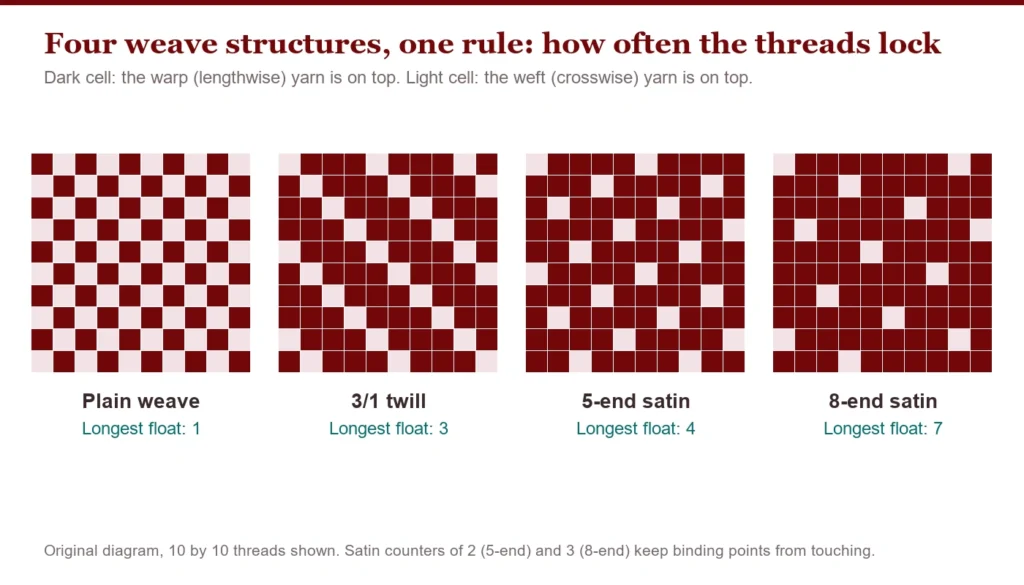
In a satin weave, the fixed step between the points where a thread passes over and under the crossing threads. A five-end satin commonly uses a counter of 2 or 3, which spreads the interlacing points so no diagonal line forms. Read more: What Is Satin Weave? The Complete Guide.
Crepe-back satin
A two-faced fabric with a glossy satin face and a matte, pebbly crepe reverse. Both sides can be used. Read more: Crepe Satin Guide: The Fabric With Two Faces.
Crocking
Colour transferring from a fabric onto another surface by rubbing. Dark and saturated satins are the usual offenders. Read more: Green Satin: The Complete Guide to Shades, Care and Colour Fastness.
Cupro
A cellulose fibre regenerated from cotton linter and often used for linings. It feels silky and breathes better than polyester. Read more: Satin vs Silk: The Honest Guide.
Satin terms starting with D
Degumming
Removing sericin, the gum that coats raw silk, by boiling in soap or alkali. It can remove roughly 15 to 25 percent of the fibre mass and is what turns stiff raw silk into soft, lustrous silk. Read more: Satin Dyeing and Finishing: How Colour and Gloss Are Made.
Denier
A unit of yarn fineness, defined as grams per 9,000 metres. A lower denier means a finer thread and generally a softer, lighter satin.
Disperse dye
The dye class used for polyester. It enters the fibre at high temperature, about 130 degrees Celsius, and the dyed fabric usually needs reduction clearing afterwards. Read more: Satin Dyeing and Finishing: How Colour and Gloss Are Made.
Drape
How a fabric hangs and folds under its own weight. Fluid satins fall in soft, rounded folds while heavy satins hold wide, sculptural ones. Read more: Satin Drape and Shine: What Controls Them and How to Judge Them.
Drape coefficient
A number from a standard test that expresses how much a circular fabric sample spreads when it hangs. A lower coefficient means a more fluid fabric. Read more: Satin Drape and Shine: What Controls Them and How to Judge Them.
Duchess satin
A heavy, stiff, highly lustrous satin used for ball gowns and wedding dresses. Read more: Duchess Satin: The Complete Guide.
Durag
A head covering, often in satin, worn to protect hair and keep waves in place. Read more: Satin Durag: The Complete Guide.
Dye lot
A batch of fabric dyed together. Two lots of the same named colour can differ slightly, so buy all the yardage for one project from one lot. Read more: Satin Fabric by the Yard: The Complete Buying Guide.

Satin terms starting with E
Elastane
The generic name for spandex and Lycra type fibres. A small share of it gives stretch satin its give. Read more: Stretch Satin: The Complete Guide.
End
A single warp thread. Fabric density is often quoted as ends per inch (EPI). Read more: What Is Satin Weave? The Complete Guide.
Satin terms starting with F
Face (of fabric)
The right side, the one meant to be seen. On warp-faced satin the face is the side where the floats lie. Read more: What Is Satin Weave? The Complete Guide.
Faille
A soft ribbed fabric with fine crosswise ribs, heavier and drier in look than satin. It is a cousin of grosgrain. Read more: Peau de Soie: What It Is and Why Every Definition Differs.
Fibre content
The percentage of each fibre in a fabric. In the United States the Textile Fiber Products Identification Act requires it on garment labels, which is why the label is the most reliable way to tell silk satin from polyester satin. Read more: Silk Satin: What It Really Is (vs Polyester Satin).
Filament
A fibre of very long, continuous length. Silk is the only common natural filament, and polyester and nylon are made as filaments for satin. Read more: How Is Satin Made? The Honest Guide.
Finishing
Any process after weaving that improves the look, performance or feel of cloth, such as calendering, softening or heat setting. Read more: Satin Dyeing and Finishing: How Colour and Gloss Are Made.
Float
A stretch of yarn that passes over several crossing yarns without interlacing. Long floats are what make satin smooth, shiny and prone to snagging. Read more: Satin Floats Explained: Why Satin Shines and Snags.
Satin terms starting with G
Grain
The direction of the threads in woven cloth. The lengthwise grain runs with the warp and the crosswise grain with the weft. Read more: How to Sew Satin: The Complete Guide.
Greige
Cloth as it comes off the loom, before scouring, dyeing or finishing. It is also used as a colour name for a grey beige. Read more: Satin Dyeing and Finishing: How Colour and Gloss Are Made.
Grosgrain
A heavy ribbon or fabric with pronounced crosswise ribs, used for the facings and trim on tuxedo lapels. Read more: Satin Suits and Tuxedos: Where Satin Belongs on Formalwear.
GSM
Grams per square metre, the standard measure of fabric weight. Light linings and scarves sit at the low end, and heavy duchess types sit well above blouse and pajama weights. Read more: GSM in Satin: What Fabric Weight Means and How to Measure It.
Satin terms starting with H
Hand
How a fabric feels to the touch: smooth, crisp, soft, dry or slippery. Mills also call it handle.
Heat setting
Using heat to fix the shape of synthetic fabric so it resists wrinkling and keeps its pleats. It is also why a too hot iron can ruin polyester satin permanently. Read more: How to Iron Satin: The Complete Guide.
Satin terms starting with I
Interlacing
The crossing of warp and weft threads. Satin has few interlacing points, and each is hidden between long floats.
Satin terms starting with J
Jacquard
A loom attachment that controls each warp thread individually, and the figured cloth it weaves, such as damask and brocade.
Satin terms starting with L
Lining
A layer of fabric sewn inside a garment to hide seams and let it slide over the body. Satin and charmeuse are common choices because they are smooth. Read more: Satin Blazers and Jackets: Bombers, Souvenir Jackets and Evening Jackets.
Loom
The machine that weaves cloth by interlacing the warp and weft. Read more: How Is Satin Made? The Honest Guide.
Lustre
The way a surface reflects light. Satin's lustre comes from long floats that lie flat and act as small mirrors. Read more: Satin Drape and Shine: What Controls Them and How to Judge Them.
Satin terms starting with M
Mercerising
A treatment, applied mainly to cotton, that swells the fibre and gives it a lustrous look. It is how some cotton sateens get their gloss.
Microfibre
A very fine synthetic fibre, usually polyester or nylon, finer than one denier. Microfibre cloth can imitate satin but has a different structure. Read more: Satin vs Microfiber: The Honest Guide.
Momme
The Japanese unit of silk weight. One momme equals about 4.34 grams per square metre, so 19 momme is about 82.5 GSM and 25 momme about 108.5 GSM. Read more: Momme Explained: What Silk Weight Means and What to Buy.

Satin terms starting with N
Nap
The raised surface of a pile fabric such as velvet. Nap has a direction, and cutting against it changes the shade. Satin has no nap. Read more: Satin vs Velvet: The Honest Guide.
Nylon satin
Satin woven from nylon filament. It is strong and takes acid dye like silk, and it is common in lingerie and ribbons. Read more: Types of Satin: The Complete Guide.
Satin terms starting with P
Peau de soie
A French name meaning skin of silk, used for a medium to heavy, softly lustred, finely ribbed cloth. Sources disagree on its exact weave. Read more: Peau de Soie: What It Is and Why Every Definition Differs.
Pick
A single weft thread. Fabric density is also quoted as picks per inch (PPI).
Piece dyeing
Dyeing fabric after it has been woven, in one length. Most satin is dyed this way, which is why it can be matched to a colour late in production. Read more: Satin Dyeing and Finishing: How Colour and Gloss Are Made.
Pilling
Small balls of fibre on a fabric surface caused by friction. Filament satin pills less than spun fabrics but can still fuzz at seams.
Plain weave
The simplest weave, where each weft thread passes alternately over and under each warp thread. It is firm and flat with no shine. Read more: What Is Satin Weave? The Complete Guide.
Polyester satin
Satin woven from polyester filament. It is the most common and affordable type, and it holds colour and resists wrinkles well. Read more: Polyester Satin: The Complete Guide.
Satin terms starting with R
Rayon
A cellulose fibre made by dissolving wood pulp. Also called viscose, it drapes well but is weak when wet. Read more: Satin vs Silk: The Honest Guide.
Reduction clearing
A wash with a reducing agent that strips loose disperse dye from dyed polyester, which improves colourfastness. Read more: Satin Dyeing and Finishing: How Colour and Gloss Are Made.
Satin terms starting with S
Sateen
A weft-faced version of the satin weave, usually in cotton, with short staple yarns. It is softer and less lustrous than true satin. Read more: Satin vs Sateen: What’s the Real Difference?.
Satin weave
A weave in which each yarn floats over four or more crossing yarns before it interlaces. It creates the smooth, glossy face. The fibre is not part of the definition. Read more: What Is Satin Weave? The Complete Guide.
Selvage
The woven edges of a fabric that run parallel to the warp and keep it from fraying. Read more: How to Sew Satin: The Complete Guide.
Sericin
The protein gum that holds silk filaments together in the cocoon. It is removed in degumming. Read more: Satin Dyeing and Finishing: How Colour and Gloss Are Made.
Shantung
A silk fabric with a slightly nubby texture from uneven weft yarns. It is related to dupioni. Read more: Peau de Soie: What It Is and Why Every Definition Differs.
Silk satin
Satin woven from silk filament. It is soft and breathes well, and it needs careful washing. Read more: Silk Satin: What It Really Is (vs Polyester Satin).
Sizing
A temporary coating, often starch or a polymer, applied to warp yarns so they survive weaving. It is washed out in finishing. Read more: How Is Satin Made? The Honest Guide.
Slipper satin
A stiff, firm satin originally used for dancing and evening shoes, now also for linings and bridal accessories. Read more: Slipper Satin: The Complete Guide.
Slub
A thick, irregular lump in a yarn. Slubs create the textured look of antique satin and shantung. Read more: Antique Satin: What It Is, How It Differs and How to Use It.
Snag
A pulled thread loop on a fabric surface. Satin snags easily because its floats are long and loose. Read more: How to Fix Snagged Satin.
Spandex
Another name for elastane. It stretches several times its length and snaps back. Read more: Stretch Satin: The Complete Guide.
Staple
A fibre of limited length, such as cotton or wool, that must be spun into yarn. It is the opposite of a filament. Read more: Satin vs Sateen: What’s the Real Difference?.
Stretch satin
Satin woven with elastane to give two-way or four-way stretch. Read more: Stretch Satin: The Complete Guide.
Sukajan
A Japanese souvenir jacket in satin or rayon with embroidery, a descendant of American bomber and baseball jackets. Read more: Satin Blazers and Jackets: Bombers, Souvenir Jackets and Evening Jackets.

Satin terms starting with T
Taffeta
A crisp, finely woven fabric that makes a rustling sound. It is often confused with satin but has a plain weave. Read more: Satin vs Chiffon: The Honest Guide.
Tex
A unit of yarn fineness, defined as grams per 1,000 metres. It is the metric alternative to denier.
Thread count
The number of warp threads per inch plus the number of weft threads. It is a poor quality guide for satin, because weave and fibre matter as much. Read more: Satin Bedding: The Complete Buying Guide.
Twill
A weave that makes a diagonal rib, as in denim. It is stronger than satin but has less shine. Read more: What Is Satin Weave? The Complete Guide.
Twist
The turns put into a yarn when it is spun. Satin filament yarns are low in twist, which keeps floats flat and reflective. Read more: How Is Satin Made? The Honest Guide.
Satin terms starting with V
Velvet
A cut pile fabric with a soft nap. It is often compared with satin for evening wear. Read more: Satin vs Velvet: The Honest Guide.
Viscose
The European name for rayon. Read more: Satin vs Silk: The Honest Guide.
Satin terms starting with W
Warp
The lengthwise threads held under tension on the loom. In warp-faced satin they form the surface.
Warp-faced
A fabric in which warp threads cover the surface. Most true satin is warp-faced, and sateen is weft-faced.
Weave
The pattern in which warp and weft threads interlace. Plain, twill and satin are the three basic weaves. Read more: What Is Satin Weave? The Complete Guide.
Weft
The thread that passes back and forth across the warp. Also called filling.
Satin terms starting with Y
Yarn
A continuous strand of fibres twisted or laid together for weaving. Filament yarn is smooth, and spun yarn is fuzzy.
Yarn-dyed
Fabric woven from yarns that were dyed before weaving. It gives patterns such as stripes and shot colours. Read more: Satin Dyeing and Finishing: How Colour and Gloss Are Made.
How do weave, fibre, weight and finish fit together?
Use this table as a cheat sheet. It groups the glossary into the four decisions that shape every satin.
| Decision | Terms to know | What it controls |
|---|---|---|
| Weave | Satin weave, sateen, float, counter number, warp-faced | Shine, smoothness, snag risk |
| Fibre | Silk, polyester, nylon, acetate, rayon, cupro, elastane | Feel, breathability, care, price |
| Weight | Momme, GSM, denier, thread count | Drape, opacity, durability |
| Finish | Calendering, degumming, heat setting, sizing, dye class | Gloss, colour, wrinkle behaviour |
For the standards behind these terms, the glossary of textile manufacturing on Wikipedia is a useful general reference. For labels in the United States, the Federal Trade Commission explains the fibre content rules, and its Care Labeling Rule page explains what a care label must tell you.
Frequently asked questions
What is the difference between satin and sateen?
Satin is warp-faced and usually made from filament yarns, so it is glossy. Sateen is weft-faced and usually made from spun cotton, so it is softer and less shiny.
What does momme mean?
Momme is a unit of silk weight. One momme is about 4.34 grams per square metre, so 19 momme is about 82.5 GSM.
What is a float in weaving?
A float is a stretch of yarn that passes over several crossing yarns without interlacing. Long floats make satin shiny and easy to snag.
Is satin a fibre?
No. Satin is a weave. It can be woven from silk, polyester, nylon, acetate or rayon.
What is charmeuse?
Charmeuse is a lightweight satin with a glossy face and a dull back. It is common in slips, blouses and linings.
What does GSM mean on a label?
GSM means grams per square metre. It tells you the weight of the fabric, which affects drape, opacity and feel.
What is degumming?
Degumming removes sericin, the gum on raw silk. It softens the silk and brings out the lustre.
What is the bias of a fabric?
The bias is the diagonal at 45 degrees to the threads. Fabric stretches and clings along it, which gives bias-cut satin its fluid fall.
Where to go next
If a term here raised a question, the full guides go deeper. Start with types of satin, then how satin is made and fashion by satin type. The numbers behind many of these terms sit together in the Satin Database.