

Gold Satin: The Complete Guide

Gold satin is one of the most mislabeled fabrics in the shop: the word "gold" gets printed on gold-dyed satin, metallic-thread lamé, foil-coated polyester, and brocaded satin alike, four different fabrics with different care.
This guide sorts them out: where the golden look comes from, the four shades compared, lamé and brocade explained, how gold gets into polyester satin, which fiber to buy, and how to care for it.
What is gold satin, exactly?
Gold satin is satin weave dyed a gold shade. It is a color, not a separate fabric, and it contains no actual gold. The shine comes from the weave's long floating yarns working on gold-dyed yarn. Change the dye and you change the color; the weave underneath stays the same.
That distinction matters because sellers use "gold" loosely. A bolt labeled gold satin is usually polyester satin dyed a warm yellow-gold, and that is the honest mainstream product. But the same label sometimes appears on lamé (glitter from metallic yarn), foiled satin (glitter from a surface coating), or brocade (gold from metallic threads woven as a raised pattern). All four look golden on the roll and age like different fabrics.
Gold satin also shows its fiber honestly. On a bright gold, silk looks deep and liquid while polyester looks crisp and mirror-like. Pick the fiber for the job first and the shade second.
Where does the gold look come from if there is no gold in it?
The gold look comes from light physics, not gold. Satin weave floats long yarns across the fabric face, and those unbroken yarns reflect light in a smooth sheet instead of scattering it. Dye those yarns gold and that smooth reflection reads as metallic to your eye, even though no metal is present.
Cornell's textile glossary defines floats as threads passing over clusters of crossing threads in a planned sequence, and satin packs those floats long and uninterrupted. The V&A catalogues an Edo-period kimono ground as "4/1 warp-faced" satin: each warp yarn floats over four weft yarns before diving under one (Kimono, V&A). That unbroken surface is the mirror. Dye it gold and the mirror turns golden.
Finish plays a supporting role, and this is where buyers get fooled. Mills can press extra gloss into satin with calendering, running the cloth through hot rollers that polish the face. A calendered gold looks almost molten in the shop, but some of that polish washes out, so a bargain gold can go dull after two washes. Our satin finish guide explains which finishes last.
Then there is the route that actually involves metal: foil, a thin metallic layer bonded to the fabric face. It is the brightest, cheapest "gold" you can buy, but it cracks at fold lines and peels with washing. If the back looks like plain mustard cloth, you are holding foil, not dye: a costume fabric with a short life.
So the honest map has four territories: dyed gold satin (gold yarn, satin weave, durable shine), foiled satin (metallic coating, brilliant but fragile), lamé (metallic yarn, a different fabric), and brocade (metallic threads as a raised pattern). When a seller just says "gold," ask which of the four you are looking at.

Gold vs champagne vs bronze vs antique gold: what is the real difference?
Gold, champagne, bronze, and antique gold are four distinct shades, but none of the names is regulated, so two sellers can use the same word for different cloth. Gold is the brightest and most yellow. Champagne is pale and soft. Bronze is dark and brown leaning. Antique gold is muted, as if aged.
| Shade | How it looks | Undertone | Best uses |
|---|---|---|---|
| Gold | Bright, high shine, reads metallic | Warm, yellow leaning | Evening gowns, festive outfits, statement decor |
| Champagne | Pale, soft glow, barely golden | Warm, peachy neutral | Bridal, bridesmaid dresses, linings that glow |
| Bronze | Dark, deep, muted shine | Warm, brown leaning | Formal drapery, upholstery, menswear accents |
| Antique gold | Muted, dusty, aged look | Warm, desaturated | Vintage-style garments, cushions, classic interiors |
Gold flatters warm skin tones and photographs with drama, but it is the least forgiving shade: every wrinkle shows as a dark line. Champagne is the easy-wearing member of the family, hiding creases better and pairing with ivory and blush without shouting. Our champagne satin dress guide covers the shade in garment form.
Bronze sits close to brown, which gives it a grounded feel but can read flat in bright light. Antique gold is the sophisticate: its muted surface hides wear and reads expensive rather than flashy, the shade most often chosen for vintage-style pieces and classic interiors, where a bright gold would look cheap.

What is the difference between gold satin, gold lamé, and gold brocade?
These are three different fabrics that all look gold. Gold satin gets its shine from the weave structure working on gold-dyed yarn. Gold lamé gets its shine from metallic threads worked into the cloth. Gold brocade gets its pattern from metallic threads woven as a raised design on a satin ground. Different construction, different care.
Start with lamé, the most confused term. The Met's Costume Institute defines it as "Lamé, a fabric which incorporates metallic threads and is known for its festive brightness, was often used in evening wear of the 1920s, '30s and '40s" (Evening dress, the Met). Note the definition: metallic threads, not satin weave. A lamé can use any weave structure; the shine rides in the yarn itself.
Gold has ridden in yarn for centuries. The V&A holds an Edo-period kimono of white figured satin whose embroidery includes "gold-wrapped thread couched down in fine orange thread" (Kimono, V&A). The Met holds an 18th-century Chinese silk satin "brocaded with metallic thread," where "the centers of the flowers are brocaded in gold thread, strips of gilded paper wrapped around a silk core, for an opulent effect" (Textile with Floral Scroll, the Met). That is brocade: the gold sits only where the pattern is, raised above the satin ground.
Here is the part that decides purchases. Dyed gold satin has no metal in it, so there is nothing metallic to wear off. Lamé and brocade carry their gold in the thread, so the gold surface can wear with handling. Modern mass-market lamé usually uses metallized plastic film instead of real metal: cheaper and glitterier, with the same care problems. Lamé is also stiffer and less breathable than satin, which is why you see it in evening tops and costumes more than in fitted garments.
| Fabric | Where the gold lives | Hand and drape | Care in one line |
|---|---|---|---|
| Gold satin | Dye on the yarn, shine from the weave | Smooth, fluid, breathable by fiber | Wash and press by fiber |
| Gold lamé | Metallic threads through the cloth | Stiffer, less drape, less breathable | Gentle wash or dry clean only |
| Gold brocade | Metallic threads as a raised pattern | Textured, structured, heavier | Dry clean, handle the pattern gently |
| Foiled gold satin | Metallic coating bonded to the face | Like satin until the foil cracks | Spot clean, never iron, short life |
So when a listing says "gold satin" and the glitter looks too intense for the price, check the yarn. Fine metallic ribbons catching the light independently of the weave means lamé or a lamé blend. Gold confined to a raised pattern means brocade.
How does gold get onto polyester satin?
Polyester satin is dyed with disperse dyes, the dye class the industry uses for polyester. A peer-reviewed dyeing review states that disperse dyes are the most often used dyes for coloring PET fabrics. Polyester's dense, water-hating fibers need heat to open up: dyeing runs with carriers below 100 C or at 130 C without them.
This explains why polyester gold holds its color so well: polyester fibers are dense and hydrophobic, so water-based dye chemistry barely wets them, and disperse dyes are built for exactly this problem. A 2024 peer-reviewed review in Polymers notes polyester's glass transition around 80 C, which is why the process needs real heat: with carriers it runs below 100 C at normal pressure, without carriers at 130 C (Disperse dye review, MDPI Polymers). The dye ends up locked inside the fiber rather than painted on top. Silk satin takes a different dye class suited to protein fibers, one reason silk golds read softer and deeper than polyester golds.
Which fibers can gold satin be made from?
Gold satin comes in the same fibers as every other satin, and the fiber matters more than the shade. Polyester dominates with an even, bright gold that holds through washing. Silk gives a softer, deeper gold, while acetate and rayon fill the budget corners. Our types of satin guide maps the whole family.
Polyester gold satin is the workhorse. It takes a level, consistent gold, keeps its brightness in the wash, and costs a fraction of silk. Its shine reads harder and more mirror-like than silk's, which suits the festive brief: if you want gold that reads as GOLD across a ballroom, polyester delivers it. The tradeoff is hand and breathability, and cheap lightweight weaves can look plasticky.
Silk gold satin is the luxury option and it looks it. The gold goes deep and warm rather than brassy, the drape flows like water, and the fabric breathes. It costs several times the polyester price and needs silk's usual gentle care: cool hand wash or dry clean, no wringing. For a wedding outfit or an heirloom dress, silk's quieter gold usually photographs better than polyester's shout.
Acetate gold satin was the classic mid-century formal fabric, and you still meet it in vintage pieces. It has a warm sheen and a crisp hand, but it weakens when wet, so treat it as dry-clean or careful-hand-wash. Rayon gold satin drapes beautifully and dyes well, but it wrinkles readily and loses strength when wet. Both are honest budget choices for garments that will not face hard wear.
Weight matters as much as fiber: lightweight gold charmeuse for bias-cut dresses and scarves, heavy duchess-weight gold for structured gowns and decor.
What is gold satin best used for?
Gold satin works hardest in evening wear, festive and bridal outfits, and decor, anywhere its warm shine can carry the look. It flatters warm skin tones, photographs with drama, and pairs naturally with black, ivory, deep red, and emerald. Keep the cuts simple and let the fabric do the talking.
Evening wear is the natural home: a gold slip dress, a bronze blouse, an antique gold camisole. The caution is fit, since shine shows every pull, so evening pieces need clean construction and a lining matched to the shell's shade family. Our satin dress guide covers the silhouettes that suit a high-shine fabric.
Festive and bridal wear is where gold earns its keep. Gold carries celebratory weight in wedding traditions across South Asia, the Middle East, and parts of Africa and Europe. Brides use it for reception outfits, sashes, shoes, and full gowns in champagne or soft gold. Our bridal satin guide covers fabric choice for wedding garments.
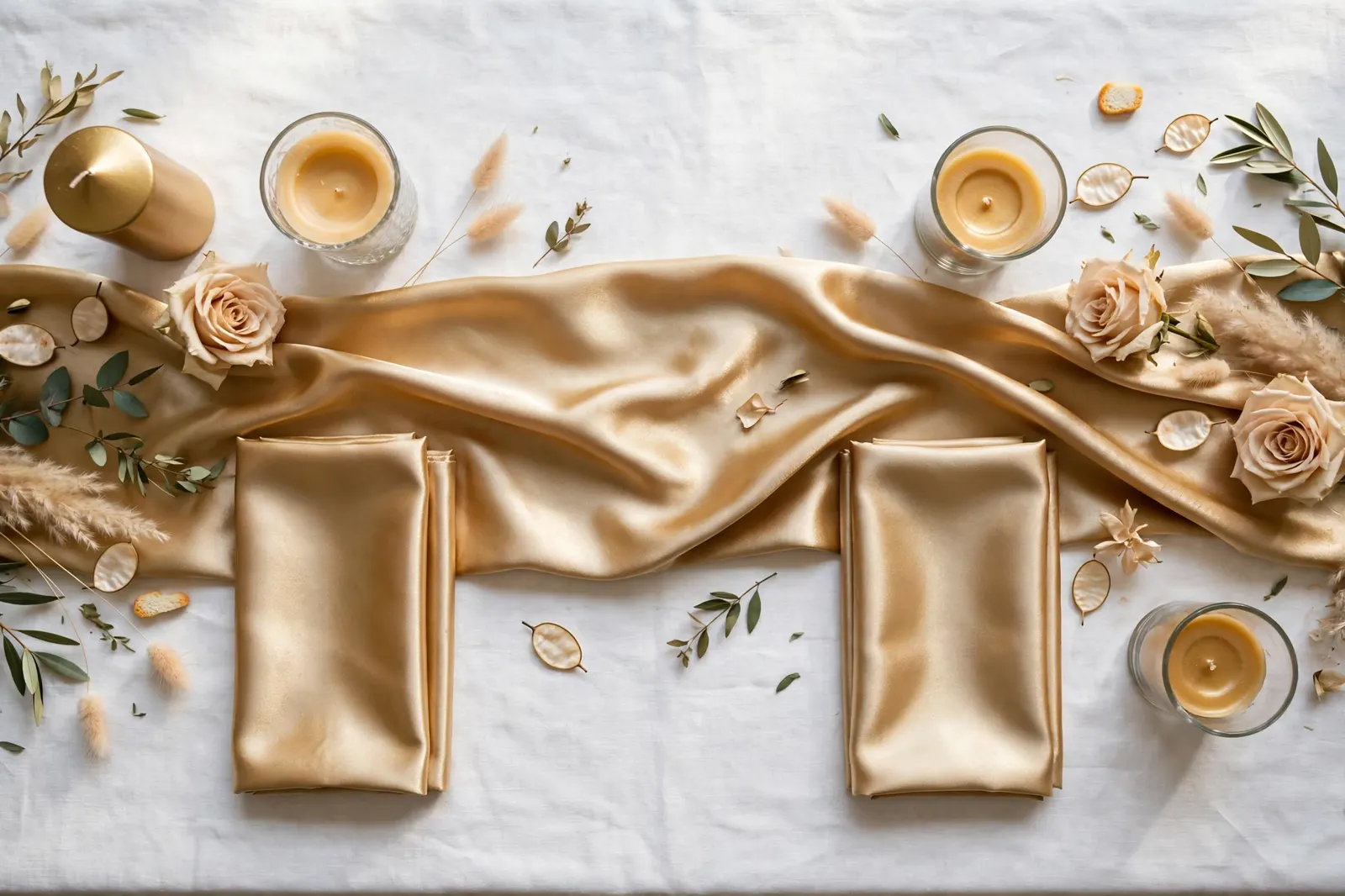
Decor is the third strong use: table runners, cushion covers, and drapery with a warm shimmer in candlelight. For drapery, go heavier, since a lightweight gold hangs limp. Antique gold is safer than bright gold, which can look gaudy in large areas under flat daylight.
One honest limit: gold is a loud color. A full gold outfit at noon can read costume, and bright gold shows abrasion as dull patches. Reserve the brightest golds for evenings, celebrations, and decor.

How do you wash and care for gold satin?
Care for gold satin by fiber, not by color. Cool water, gentle handling, and low heat keep the gold bright and the shine intact. Wash golds with golds only, because dye transfer goes both ways and a dark companion can dull a bright gold in a single load.
Polyester gold satin is the easy one: machine wash cool on gentle, inside out, then line dry in shade or tumble dry low. Skip fabric softener, which coats the floating yarns and dulls the shine. Silk gold satin wants a cool hand wash with a pH-neutral detergent or dry cleaning, no wringing. Acetate and rayon golds want dry cleaning or a very gentle hand wash.
Pressing needs respect. Gold satin marks easily under a hot iron, and polyester gold can develop a permanent sheen patch where the iron sat too long. Press from the wrong side through a press cloth on low heat. Our how to iron satin guide has the per-fiber temperatures.
Clean gold satin before storing it, because invisible body soils oxidize into marks over months, and those show on gold. Store cool, dark, and dry in breathable cotton bags or acid-free boxes, never in plastic. Refold once a year along different lines.
Sunlight is the other care factor. Dyed gold satin contains no metal, so there is nothing to tarnish, but dye molecules break down under ultraviolet light like any dye: darker golds dull, bright golds can turn paler and chalkier. No dye is sunproof, so display and store gold out of direct sun and line dry in shade. One honest note: no published test rates gold satin specifically for light fastness, so anyone selling you a "fade-proof gold" number without a test report is inventing it.
The one gold-specific rule concerns real metallic-thread fabrics, not dyed satin: hand wash only or dry clean anything with metal thread, keep soaks short, and never use chlorine bleach near it. If your "gold satin" turned out to be lamé or brocade on the earlier yarn check, this paragraph is your care label.
What buying traps should you watch for?
Gold satin has six common traps, and every one comes from trusting the name instead of your eyes. Gold on a label can mean gold dye, metallic yarn, a foil coating, or a brocaded pattern: four different fabrics with different care. Look at the cloth, flip it over, and rub it before you buy.
The first trap is the lamé switch. A listing says "gold satin," the price is low, and the glitter is intense. Fine metallic ribbons catching light independently of the weave means lamé or a lamé blend: it needs lamé care and will not drape or sew like satin.
The second trap is the foil coating. Blinding brightness plus a plain mustard back means a metallic layer bonded to the face. Flex the fabric sharply and look for tiny cracks along the crease: if it cracks in the shop, it will crack in your wardrobe.
The third trap is brocade sold as satin. The gold sits in a raised pattern while the ground stays plain, yet the listing still says "gold satin." Pretty fabric, wrong name, and you will press it wrong if you believe the label.
The fourth trap is the disappearing shine. A calendered gold can look molten on the roll and go matte after two washes, because the polish was a finish, not the fiber. Wash a swatch before committing to yardage.
The fifth trap is shade drift between dye lots. Gold is hard to match across production runs, so buy all of one project at once, from one dye lot, and keep the lot number.
The sixth trap is the screen lie. Cameras and monitors shift warm metallics more than most colors: a gold that looks rich bronze on your phone can arrive brassy yellow. Order swatches and look at them in daylight before buying the yardage.

Frequently asked questions
Is gold satin made with real gold?
No. Gold satin is ordinary satin weave dyed a gold shade, and it contains no metal at all. Its shine comes from the weave's long floating yarns reflecting light in a smooth sheet. Fabrics with real metal thread belong to the lamé and brocade families, which need different care.
What is the difference between gold satin and gold lamé?
The shine comes from different places. Gold satin's shine comes from the weave structure working on gold-dyed yarn; gold lamé's shine comes from metallic yarn worked into the cloth, which is how the Met's Costume Institute defines lamé. Lamé is stiffer, drapes less, and needs gentler care.
What is the difference between champagne and gold satin?
Champagne is the paler, softer member of the gold family: a warm, peachy neutral with a gentle glow. Gold is brighter, more yellow, and more reflective. Both are unregulated names, so compare the actual cloth before buying.
Does gold satin tarnish?
Dyed gold satin cannot tarnish because it contains no metal. Its gold is dye, so it can fade in strong sun, but it will never darken or corrode the way exposed metal thread can.
Can you machine wash gold satin?
Polyester gold satin, yes: machine wash cool on gentle, inside out, with golds only, then line dry in shade. Silk, acetate, and rayon gold satins want hand washing or dry cleaning. Never machine wash lamé, brocade, or foiled "gold" fabrics as if they were satin.
Is gold satin a good choice for a wedding outfit?
It is a festive and historic one. Gold carries celebratory weight in wedding traditions across South Asia, the Middle East, and parts of Africa and Europe. Choose silk for a deep, soft gold or polyester for a brighter, budget-friendly one. Gold photographs best in warm evening light.
How can you tell gold satin from gold brocade?
Look at where the gold sits. On gold satin the whole face shines evenly because the shine is the weave itself. On brocade the gold appears only in a raised pattern while the ground stays plain. If the gold is confined to the design, you are holding brocade.


