


Satin Ribbon: Types, Widths, and What Each Is For
A spool of satin ribbon looks simple, but the choice explodes: single-face, double-face, wire edge, grosgrain edge, widths in millimetres and inches, polyester and silk. This guide sorts it out by the job, not by the shelf label.
What is satin ribbon, exactly?
Satin ribbon is a narrow woven ribbon whose face uses a satin weave, so long yarn floats sit on the surface and reflect light as a smooth shine. The ribbon is woven to its width, with finished edges, rather than cut from wider cloth. That woven edge is what keeps it from fraying the moment you cut it.
Satin is a weave, not a fiber, and that fact clears up half the confusion on ribbon labels. The Museum of Fine Arts, Boston CAMEO describes satin weave as a pattern that produces a shiny luster on the front and a dull face on the back, because each weft strand floats over 3 to 12 warp strands before passing under one. The George Washington University Museum and The Textile Museum puts it the same way: warp yarns float long distances over weft yarns before crossing under, creating a distinct front and back.
Because satin is a weave, the same ribbon can come in different fibers. CAMEO names silk, polyester, and nylon as fibers commonly used with this construction. Polyester is the workhorse: it holds its shine, resists wrinkles, and costs less. Silk feels softer and drapes with more weight, but it costs more and needs gentler care. If a label only says "satin" with no fiber, assume polyester.
Ribbon is woven narrow, on a ribbon loom, so both long edges are finished as it leaves the loom. A strip cut from a bolt of satin fabric has raw edges that fray. Look at the long edge when you shop: a woven, finished edge means ribbon.
The Victoria and Albert Museum holds an embroidered silk satin ribbon from around 1600, made from a narrow piece of silk satin, and notes that ribbons were given by the bride and groom to wedding guests. For a closer look, read our guide to double-faced satin. If this is your question, see our guide to satin ballet shoes.
Single-face or double-face: which one do you actually need?
Single-face satin ribbon shines on one side and looks dull on the back, while double-face satin ribbon shines on both sides. Buy single-face when only one side shows, and double-face when both sides will be seen. Double-face costs more, since it takes more yarn and more loom work.
Here is the practical difference. A single-face ribbon has a satin face and a matte back. On a gift box, the back presses against the paper and nobody sees it, so single-face does the job at a lower price. On a bow, both sides of every loop show. Tie a bow from single-face ribbon and half the loops look dull. That is the classic beginner mistake, and it is easy to avoid once you know to look for it.
A university printing guide from CUNY states the distinction plainly: single-faced ribbons are glossy on one side, perfect for crafts where the backside is hidden, while double-faced ribbons are glossy on both sides, visible from any angle. If the ribbon will twist, loop, hang, or flutter, both sides will show, so buy double-face. If it will lie flat, single-face is fine and cheaper.

Which width should you buy?
Width decides what a ribbon can do more than any other single choice. A narrow ribbon cannot make a full bow, and a wide ribbon overwhelms a small card. The common bands run from under 10 mm for fine detail work to 38 mm and wider for large statement bows.
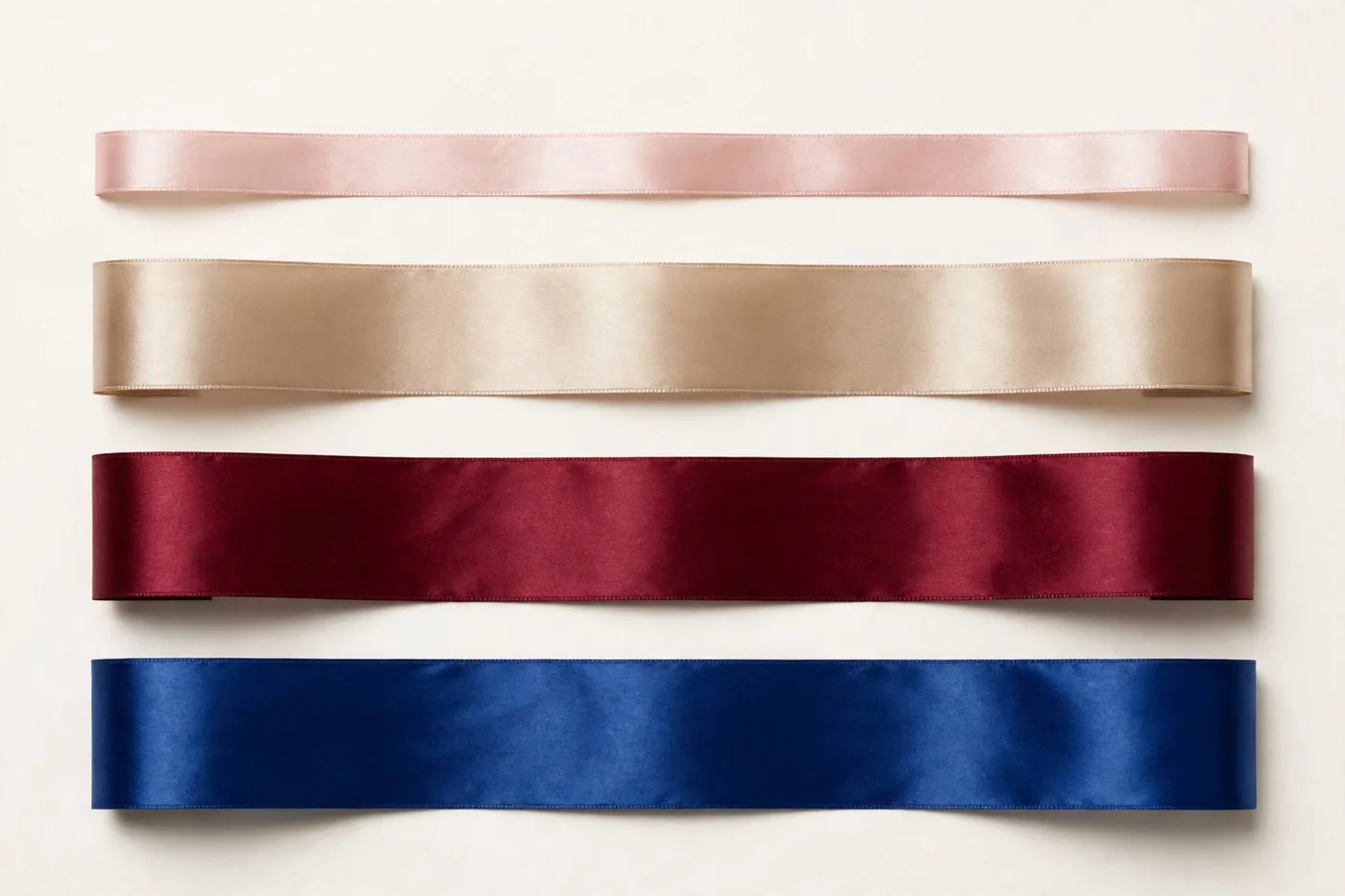
Ribbon widths are sold in both millimetres and inches. A university printing guide from CUNY groups widths this way: under 0.38 inches for small projects, 0.38 inches to 0.63 inches as a versatile middle range, 0.63 inches to 1 inch for fashion and larger bows, 1 inch to 1.5 inches for bigger decorations, and over 1.5 inches for large-scale decor. Converted, those bands are about 10 mm, 16 mm, 25 mm, and 38 mm.
| Width band | Best for | Why it fits |
|---|---|---|
| Under 10 mm | Card making, gift tags, casings, fine garment detail | Thin enough to thread and knot without bulk |
| 10 mm to 16 mm | Everyday wrapping, small bows, hair ties, corsage accents | Wide enough to show the shine, narrow enough to tie easily |
| 16 mm to 25 mm | Standard bows, sashes, bouquets, dress trims | Width for a full bow loop with body, still easy to handle |
| 25 mm to 38 mm | Large bows, wreath bows, chair sashes, rosettes | The loop holds its shape and reads from across a room |
| Over 38 mm | Statement bows, car bows, large event decor | Maximum presence, but needs wire edge to hold up |
One trap hides in width labels: some sellers measure the ribbon including a decorative edge, so a "25 mm" ribbon measures closer to 22 mm of satin.
What is wire-edge satin ribbon, and when is it worth it?
Wire-edge satin ribbon has a thin flexible wire woven into each long edge, so you can bend, shape, and pose the ribbon and it stays where you put it. It is worth the extra cost whenever the ribbon must hold a shape on its own, such as a wreath bow or a floral arrangement.
The CUNY guide describes wired satin ribbons the same way: thin wires on the edges, making them ideal for shapes and bows that hold better. The wire does not make the ribbon prettier. It makes it obedient. You shape a loop, pinch the wire, and the loop stays round instead of slowly collapsing through the afternoon.
Wire edge has real downsides, so do not buy it by default. It costs more and is harder to tie into a tight knot, because the wire resists the fold. It cannot go through a sewing machine needle without risk, so keep wire edge out of sewn trims. Fold cut ends under or cover them with glue, since exposed wire tips are sharp. Do not iron it flat, since heat and pressure can kink the wire.
A quick test tells you whether a spool is truly wire edge: bend a length into a loop and let go. Plain ribbon relaxes and flattens. Wire-edge ribbon keeps the curve.

What about grosgrain edge and picot edge?
Grosgrain is not an edge style on satin ribbon. It is a different ribbon weave with a ribbed texture, so do not confuse a grosgrain ribbon with a satin ribbon that has a tougher edge. Picot edge is a real edge style: a row of tiny loops along the edge of a satin ribbon.
Grosgrain ribbon has ribs running across its width. Those ribs give it grip, so a grosgrain bow stays tied better than a satin bow, and the matte ribbed surface reads as more casual and sturdy. That grip is why grosgrain is the usual pick for hair bows that must survive a school day, for lanyards, and for medal ribbons that get handled. It does not shine or drape like satin. When a project needs shine, buy satin. When it needs grip and toughness, buy grosgrain.
A "grosgrain edge" on satin ribbon usually means a ribbed or reinforced edge finish for durability. It does not turn the ribbon into grosgrain: the face is still satin, so it still shines.
Picot edge, also called feather edge in the floral trade, is a row of small loops along the edge of a double-face satin ribbon. It softens the edge, catches light, and suits wedding and baby projects where a hard edge would look harsh. It still needs sealing if you cut it, since cutting through the loops opens them.
Which ribbon fits each job?
The right ribbon follows the job, not the color chart. Start from what the ribbon must do, and let that pick the type and width. A gift bow needs shine and a full loop, a hair ribbon needs a soft face and a secure knot, and a sewn trim needs a weave that survives the needle.
Gift wrapping takes double-face satin in 16 mm to 25 mm for most boxes, and 38 mm for large boxes, since every loop shows both sides. For small boxes and tags, drop to 10 mm.
Hair takes soft double-face satin in 10 mm to 25 mm: narrow ribbon for a small bow at the end of a braid, wider ribbon for a full ponytail bow. Satin is kind against hair because its long floats slide rather than catch. For more on satin and hair, see the satin bonnet guide. Tie hair ribbon in a double knot, since a single knot loosens.
Sewing and garment trim takes single-face or double-face satin in 10 mm to 25 mm, without wire, matching the garment fiber. Polyester suits most garments because it washes well. Silk suits occasion wear that will be dry cleaned. Pin the ribbon in place, use a sharp needle, and sew slowly, since satin shifts under the foot. The full technique is in the how to sew satin guide.
Crafts and card making take single-face satin in widths under 16 mm, since only one side shows. Narrow ribbon threads through punched holes and ties around card folds.
Corsages and boutonnieres take wire-edge double-face satin in 25 mm to 38 mm. The wire holds the bow loops open around the flowers, and the double face keeps every loop shiny.
Medals and award rosettes take wide satin in 38 mm and up for rosettes, and ribbed ribbon for neck ribbons that will be handled often. A rosette needs width to pleat into folds. A neck ribbon that will be pulled, pinned, and stored benefits from the grip of a ribbed weave.
Bouquets and floral wrapping take wire-edge double-face satin in 25 mm to 38 mm. The wire shapes the bow, the width gives presence against the flowers, and the double face keeps the bow finished from all sides.

How do you tie a bow that holds its shape?
A bow holds its shape when the ribbon, the knot, and the loops all work together. Pick wire-edge or double-face ribbon in a width that matches the box, tie a firm double knot, and shape the loops before you trim the tails. Satin is slippery by design, so a single knot will loosen.
Start with more ribbon than you think you need: three times the box width for the wrap, plus enough for two loops and two tails. Wrap the ribbon around the box, cross it underneath, and bring it back to the top. Tie a firm knot, then form two equal loops and cross them into a bow knot. Pull the knot snug, not tight enough to crush the loops flat.
Now shape. Pull each loop out to a round shape. Twist any loop that shows its dull side so the shiny face turns outward, or switch to double-face ribbon next time. For wire-edge ribbon, pinch the wire at the base of each loop to lock the shape. For plain ribbon, leave the tails longer, since short tails slip out faster. If the bow still collapses, the ribbon is usually too narrow or too soft for the bow. Move up a width band, or switch to wire edge.
How do you cut, seal, and store satin ribbon?
Cut satin ribbon with sharp scissors on a clean diagonal or a V notch, then seal the cut end with a quick pass of heat so the woven edge cannot unravel. Store spools upright in a dry place away from sunlight, and never fold ribbon sharply for storage, since a hard crease is difficult to press out.
Sharp scissors matter most here. Dull blades chew the woven edge and start fraying before the ribbon is even used. Cut on a diagonal for a simple tail, or fold the end in half lengthwise and cut at an angle for a neat V notch. Both finishes resist fraying better than a straight blunt cut.
Sealing is the step most people skip, and it is the one that saves ribbon. Hold the cut end briefly near a flame, just close enough for the fibers to melt and fuse. Do this with polyester or nylon ribbon only. Silk ribbon does not melt, it burns, so seal silk ends with a tiny dot of clear fabric glue instead. Test on a scrap first.
Keep spools on a dowel or upright in a box so the ribbon unwinds without tangling. Keep them out of direct sun, since light fades color over time, and away from damp, since damp can mark satin. Do not wind ribbon tightly around cardboard for months, since the tight bend can leave a permanent wave.
How do you wash satin ribbon?
Wash satin ribbon by hand in cool water with a mild detergent, roll it in a towel to remove water, and lay it flat to dry. Heat and rough handling are what damage the shine. The fiber decides the details: polyester ribbon tolerates a gentle machine cycle, while silk ribbon needs hand washing only.
The washing rule follows the fiber, not the weave. Polyester ribbon can go in a mesh bag on a gentle cycle in cool water, then air dry. Silk ribbon should never see a machine cycle or hot water, since heat and agitation dull the face. Nylon sits closer to polyester, but hand washing is still the safer default. The full per-fiber routine is in the how to wash satin guide.
Press from the back on a low setting with a pressing cloth, and never press wire-edge ribbon flat, since the wire will kink. If a ribbon comes out of storage wrinkled, hang it in a steamy bathroom first. Steam relaxes satin without scorch risk.
A ribbon-trimmed pillowcase follows the same rule: wash the whole piece the way the most delicate part demands. That habit is behind the satin pillowcase guide.

What should you read next?
Two guides on this site go deeper on the ideas behind this one. The what is satin weave guide explains the weave structure behind the shine. The types of satin guide covers the wider satin family, from charmeuse to duchess.
Frequently asked questions
Can you iron satin ribbon?
Yes, from the back, on a low setting, with a pressing cloth. Never iron wire-edge ribbon flat, since the wire kinks. For light wrinkles, hang the ribbon in a steamy bathroom first.
Does satin ribbon fray?
Yes, at the cut ends, because cutting across the weave opens the yarns. The long woven edges do not fray. Seal cut ends with heat for polyester and nylon, or with clear fabric glue for silk.
What width of satin ribbon is best for a gift bow?
Use 16 mm to 25 mm for most gift boxes, and 38 mm for large boxes. For a bow that must hold its shape, choose wire-edge ribbon in the same width rather than going wider.
Can you sew wire-edge ribbon?
No, not through a machine. The wire can damage the needle and the machine, and it will not feed evenly. Sew plain satin ribbon for trims, and use wire-edge ribbon only for bows, wreaths, and floral work shaped by hand.
Is satin ribbon washable?
Polyester and nylon satin ribbon wash well by hand in cool water with mild detergent, then air dry flat. Silk satin ribbon needs hand washing only, with no hot water and no machine cycle.
Why does my satin bow keep coming undone?
Satin is slippery, so a single knot loosens as the smooth faces slide against each other. Tie a double knot, leave tails longer, and use grosgrain instead if the bow must survive rough handling, since its ribbed surface grips far better.
How do you keep satin ribbon from wrinkling in storage?
Store spools upright or on a rod in a dry place away from sunlight. Do not wind ribbon tightly around cardboard for months, since tight bends leave a permanent wave in satin.
Sources: MFA Boston CAMEO on satin weave, GWU Museum and The Textile Museum on textile structure, V&A record of a silk satin ribbon from around 1600, and the CUNY Printing Technology Guide chapter on satin ribbon types, sizes, and colors. Full URLs and supporting sentences are in the package metadata.