


Are Satin Sleep Masks Good? An Honest Review
A satin sleep mask promises a small thing: darkness, without the scratchy strap and stiff fabric of a cheap eye mask. Some masks deliver that well. Others let light leak in at the nose, slip off at 3 a.m., or press on the eyes until sleep feels worse, not better.
This guide is not a product roundup, and no mask was tested for a brand comparison. It covers what a satin sleep mask is, how light blocking works, its honest limits, and how to pick one.
What is a satin sleep mask?
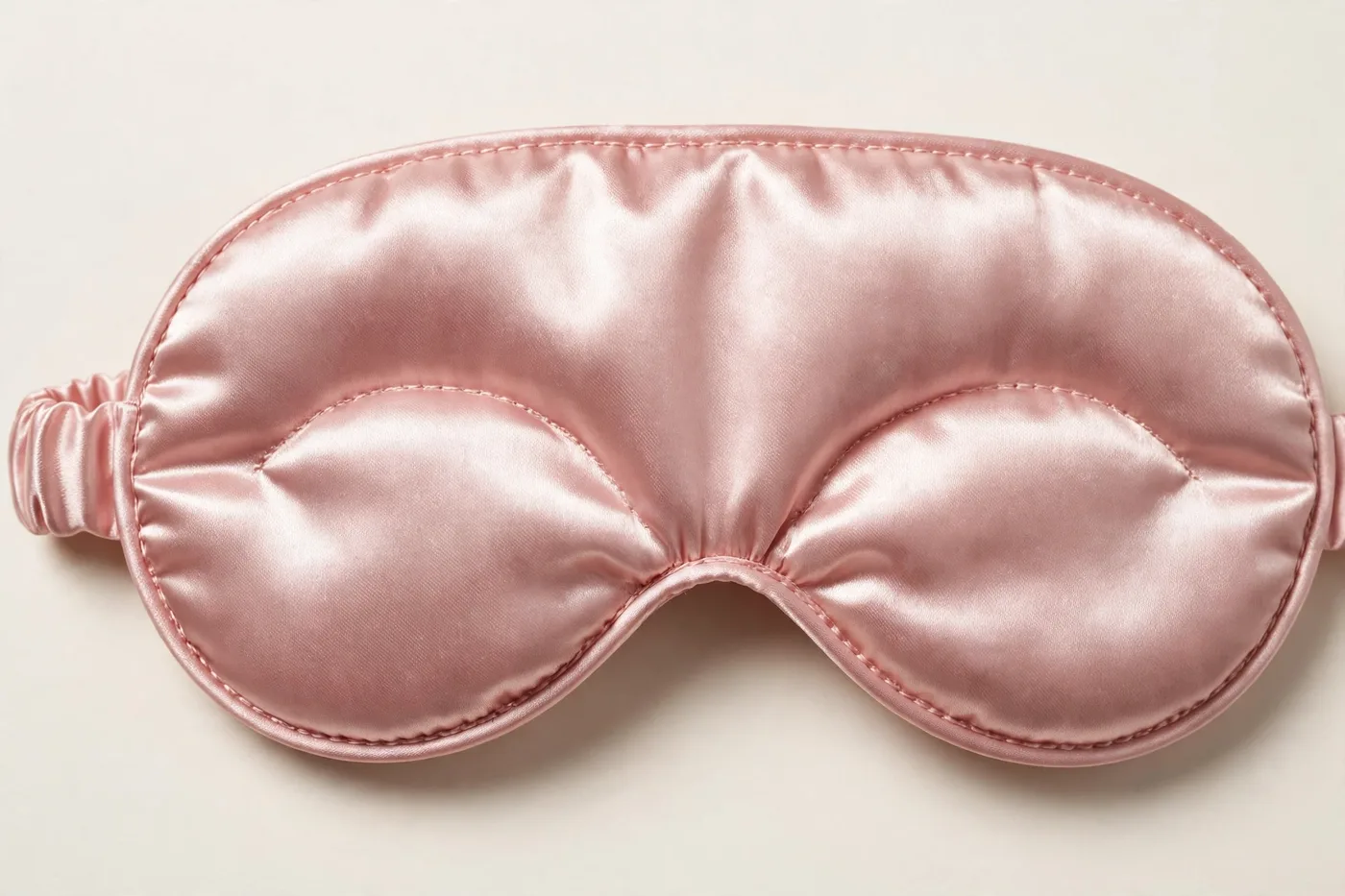
A satin sleep mask is a padded eye covering made from fabric woven in a satin weave, with a strap that holds it over closed eyes. The word satin names the weave, not the fiber, so the same mask shape can be made from silk satin, polyester satin, or another fiber woven the same way.
In a satin weave, long yarns float across the surface before dipping under, so few places lock the yarns together. <a href=”https://cameo.mfa.org/wiki/Satin_weave”>The Museum of Fine Arts, Boston, CAMEO entry on satin weave describes it plainly: the long filling threads, called floats, produce a smooth shiny surface, but are susceptible to snags. That smooth face feels gentle on closed eyelids, and it also explains why satin can catch on a rough nail or pillow edge.
Most masks have three parts: a front satin panel, a padding layer, and a backing against the face. A contoured mask has cups or raised areas over the eyes, so fabric does not press directly on the eyelids. The strap matters most in use: a wide flat strap spreads pressure, and an adjustable strap lets you set tension once.
Are satin sleep masks good for sleep?
A satin sleep mask is good for sleep when it blocks light without pressing on your eyes, slipping off, or waking you with a tight strap. It is not a sleep treatment, and it cannot fix a noisy room, a late caffeine habit, or a sleep schedule that shifts every night.
Light is the mechanism to understand first. Your eyelids are not blackout curtains. Research published through the National Library of Medicine found that light delivered through closed eyelids could suppress melatonin and shift the timing of melatonin onset in study participants. That study used a prototype light mask to deliver light, not a dark mask to block it, so it does not prove a satin mask improves sleep. It does show why leakage matters: light through a closed lid can affect the body clock.
Public health guidance points the same way, in plainer language. The Centers for Disease Control and Prevention, in its guidance on creating a good sleep environment, advises making the bedroom very dark and notes that if other steps do not work, you can wear an eye mask, but for it to be effective you should keep it on for the entire desired sleep episode. That sentence carries the practical test for any mask: a mask that ends up on the pillow at midnight has stopped doing its job, even if it blocked light perfectly for the first hour. Judge a mask by light blocked, time worn, and disturbance while worn. Shift workers sleeping in daylight and travelers in bright hotel rooms are most likely to notice a benefit.
What can a satin sleep mask do for skin and hair?
A satin sleep mask can reduce rubbing on the delicate skin around the eyes and can keep hair near the face from catching on a rough mask edge, but it will not repair skin, regrow hair, or replace a proper skin or hair routine.
On skin, claims get inflated fastest. A smooth satin face slides more easily than a rough cotton face, so there is less dragging across the eyelids when you shift in sleep. Less dragging is a reasonable comfort benefit. It is not the same as preventing wrinkles, fading dark circles, or treating puffiness. No opened source in this guide supports those treatment claims, so this guide does not make them. Pressure cuts the other way: a mask that presses hard can leave temporary creases in the morning. A contoured mask that cups around the eyes reduces direct pressure on the lids.
Hair benefits are narrower. A smooth, wide strap reduces catching and denting compared with a rough elastic band. That is a real, modest benefit. A sleep mask does not protect the hair on the back of your head, and it does not do the work of a satin pillowcase or a satin bonnet, which cover far more hair through the night. If hair protection is your main goal, a mask is the wrong tool for most of the job. One more limit: a mask traps warmth against the face, so wash it often and pause use if irritated skin feels worse.
Silk satin or polyester satin: which fiber should you pick?
Silk satin usually feels cooler, softer, and more breathable against the face, while polyester satin usually costs less, holds its shape, and tolerates machine washing better. Pick silk satin for comfort and a cooler feel, and pick polyester satin for easy care and a lower price.
Silk satin has a soft, fluid drape that follows the face without stiffness. That drape helps a contoured shape sit close at the nose and cheeks, where light leaks in. The trade-offs are price and care. Silk satin masks usually cost more, and many need hand washing or a gentle cycle and air drying. Silk can also spot if it gets wet unevenly, so a silk mask washed carelessly can look worse long before it wears out. Polyester satin is the workhorse choice: it keeps its shine through repeated washing, resists wrinkles better than silk in most cases, and is far cheaper to replace when a strap wears out. The trade-off is warmth, since polyester does not breathe the way silk does, so a thickly padded polyester mask can feel warm on a hot night. For a first mask while you learn what shape you like, polyester satin is the sensible starting point. The how to wash satin guide explains care by fiber in more detail, and the same rule applies here: follow the label on your actual mask.
How should a satin sleep mask fit?
A satin sleep mask should fit snugly enough to block light at the nose and cheeks, loosely enough that you can blink freely, and evenly enough that no single strap line digs into your head or leaves a deep mark by morning.
Fit starts with the nose bridge, where most light leaks in. A mask with a soft, shaped nose area, or a flexible nose wire covered in fabric, can close the gap that a flat panel leaves open. Press the mask gently against your face in a lit room and look down: if you see light at the nose, that gap will be worse at dawn, when you lie on your side and the mask shifts. A flat panel with no nose shaping is the shape most likely to leak. Eye space is the second test. Close your eyes, put the mask on, and blink several times. If your lashes brush the fabric on every blink, the mask will feel intrusive over a full night. Contoured masks with eye cups give lashes room to move, while a flat mask pulled tight will flatten against the eyes.
Strap tension is the third test, and people usually get it wrong by tightening too much. A strap should hold the mask when you turn your head, not when you pull it hard. Set it so the mask stays put with a gentle shake of the head, then lie down and turn to each side. If the mask rides up or gaps at the cheek on your usual sleep side, adjust the shape or strap position before tightening further. A strap across the ears will hurt, while a strap above or below the ears spreads pressure better. Side sleepers should also check the back of the mask, since a hard slider can press into the pillow.

How do you choose a satin sleep mask?
Choose a satin sleep mask by shape first, strap second, fiber third, and color last overall, because shape decides light blocking, the strap decides whether it stays on, fiber decides care and comfort, and color decides almost nothing about sleep.
Shape comes first. Flat masks are thin, pack small, and suit travel and side sleeping. Contoured masks have eye cups, suit people who want lash room, and suit back sleepers best. Wrap masks extend further around the sides of the head and can block side light, but they can feel warm and bulky. A mask with nose shaping suits people who wake to light leaking at the nose. The table below puts those trade-offs side by side, so you can rule out shapes quickly instead of buying one of each.
| Mask shape | Light blocking | Eye and lash room | Best for | Watch out for |
|---|---|---|---|---|
| Flat padded mask | Good if the nose fits well | Little, lashes may brush fabric | Travel, side sleepers, first masks | Light leaks at the nose, pressure on lids if pulled tight |
| Contoured cup mask | Very good, cups seal around eyes | Generous, lashes move freely | Back sleepers, light sleepers, lash wearers | Bulk on the pillow for side sleepers, warmth on hot nights |
| Wrap mask | Very good, covers side light too | Depends on the cup depth | Shift workers, bright rooms, travelers | Heat, bulk, and a strap that may sit across the ears |
Strap choice comes second. Look for a wide, flat strap rather than a thin cord, and for an adjustable closure rather than a fixed loop. A slider lets you fine tune tension without stretching the elastic out. If you have thick or curly hair, a smooth strap that sits above the bulk of your hair will stay in place better than a narrow band that sinks into it. The is satin good for hair guide covers how satin interacts with hair in more depth. Fiber is the third filter, covered in the previous section. Weight matters too: a very light mask may let light through, while a very heavy mask may trap heat. Color and extras come last. Dark colors do not block more light if the panel is thick enough, because blocking comes from layers and fit, not dye.
How do you wash and care for a satin sleep mask?
Wash a satin sleep mask by following its own label first, and by default hand wash silk satin in cool water with a gentle detergent, then air dry flat, while polyester satin can usually take a gentle machine cycle in a mesh bag.
Care by fiber protects both the satin and the strap. Silk satin needs the gentler route: cool water, a small amount of gentle detergent, no harsh rubbing, and no wringing, which can distort the padding and shape. Press water out gently with a clean towel, reshape the mask, and lay it flat to dry away from direct heat. Polyester satin is more forgiving, and many polyester masks survive a gentle machine wash in a mesh bag. Even for polyester, skip high dryer heat, which can weaken elastic.
A mask sits against closed eyes and skin oils for hours every night, so it collects skin oil, sweat, and any night cream you use. Washing once a week is a reasonable routine for a nightly mask, and more often if you use heavy night products or the mask starts to smell. A second mask in rotation means washing never leaves you without one. Watch for wear signs that mean replacement: a strap that no longer holds tension, or padding gone lumpy or flat in one eye cup.

Who should skip a satin sleep mask?
Skip a satin sleep mask if you have an eye condition that needs medical advice, if pressure on your eyes causes pain, or if a mask repeatedly wakes you, irritates your skin, or makes breathing feel harder in any way.
If you have glaucoma, a recent eye surgery, an eye infection, chronic dry eye that a doctor is treating, or any condition where pressure on the eye is a concern, ask your eye doctor before using any mask that presses on the lids. A contoured mask reduces direct pressure but does not remove it, and a tight strap can still add pressure. Pain, blurred vision, or lasting redness are reasons to stop and seek advice.
Sleep apnea and breathing deserve a separate warning. A mask does not treat sleep apnea, and it should never be used as a substitute for a prescribed device. If you use a continuous positive airway pressure device, a mask strap can interfere with the headgear and break its seal. If you snore loudly or wake gasping, talk to a doctor about sleep testing rather than shopping for a better mask. Skin and comfort reasons are simpler: if every mask you try leaves you hot, itchy, or marked, or if you wake repeatedly to adjust it, the mask is costing you more sleep than the light it blocks. A dark room can solve the light problem without anything on the face. A small child should not use an adult mask with a tight strap.
Frequently asked questions
Here are the questions readers ask most about satin sleep masks, answered plainly in this section, with the limits stated clearly wherever a claim is not supported by an opened source or where personal fit matters more than a general rule.
Are satin sleep masks better than cotton sleep masks?
Satin sleep masks feel smoother against closed eyelids than most cotton masks, and that smooth face can mean less dragging on skin. Cotton masks can grip better and may stay in place more easily, and cotton is often easier to wash at higher temperatures. Neither fabric blocks light on its own: thickness, layers, and fit decide light blocking.
Do satin sleep masks help you fall asleep faster?
A satin sleep mask can help you fall asleep faster if light is what keeps you awake, because blocking light removes that disturbance. If noise, worry, caffeine, or an irregular schedule keeps you awake, a mask will not fix those causes. The CDC guidance supports a dark room and an eye mask when other steps are not enough, but it does not promise faster sleep for everyone.
Are satin sleep masks good for eyelashes?
Contoured satin sleep masks are usually kinder to eyelashes than flat masks, because the cups leave room for lashes to move without brushing fabric on every blink. Flat masks that press on the lids can bend lashes and feel uncomfortable over a full night.
Can you sleep on your side with a satin sleep mask?
Yes, many people sleep on their side with a satin sleep mask, but shape and strap matter more for side sleepers than for back sleepers. A thin, flexible mask with a flat strap usually works better on the side, because a thick cup or a hard slider can press into the pillow and push the mask out of place. Test it on your usual side, with the strap above or below the ears.
Is silk satin or polyester satin better for a sleep mask?
Silk satin is better for a cooler, softer feel and a fluid drape that follows the face, while polyester satin is better for easy care, durability through washing, and a lower price. Neither is better in every way, so the right choice depends on your priority. Start with polyester satin to learn your shape, or silk satin for a cooler feel if you are happy to hand wash.
How often should you wash a satin sleep mask?
Wash a satin sleep mask about once a week if you wear it nightly, and more often if you use heavy night creams or notice odor or buildup. Follow the label on your mask for the exact method: silk satin usually needs hand washing in cool water and air drying, while polyester satin can often take a gentle machine cycle in a mesh bag.
Can a satin sleep mask damage your eyes?
A well fitting satin sleep mask should not damage healthy eyes, but a mask that presses hard on the eyeballs can cause discomfort, temporary marks, and blurred vision on waking. Stop using a mask that causes pain, and ask an eye doctor for advice if you have an eye condition, recent eye surgery, or lasting symptoms after removing the mask.
Should you wear a satin sleep mask every night?
You can wear a satin sleep mask every night if it fits well, stays on without waking you, and does not irritate your skin or eyes. Wearing it nightly is fine for most people, as long as you wash it regularly and replace it when the strap or padding wears out. Use it when light is a problem, and leave it off when it is not.

A final honest check before you buy
A satin sleep mask is worth buying when you have a light problem, a shape that fits your face, and a strap that stays put without hurting. It is not worth buying as a beauty treatment, a sleep cure, or a substitute for a dark room, a regular schedule, or medical advice where that advice is needed.
Run these checks before you keep a mask: hold it to a lamp, check the nose gap, blink with it on, and lie on your usual sleep side. A mask that passes, in silk satin or polyester satin, is a good mask. Pair it with a satin sheets guide and a satin scrunchie for the rest of the setup.


