


Satin vs Charmeuse: Not Really a Versus
Charmeuse is a light type of satin, not a rival cloth that sits beside satin. The two words overlap, because charmeuse uses a satin weave with a lighter weight and a softer face. So the real choice is between one light satin and the wider satin family, and the label, weight, and cut tell you which one you hold.
What does charmeuse actually mean?
Charmeuse means a light cloth woven in a satin weave, with a smooth shiny face and a dull back. The word names a weight and a feel inside the satin family, rather than a new fiber or a new weave of its own.
The Museum of Fine Arts, Boston, through its CAMEO record, calls charmeuse “a lightweight fabric woven with a satin weave, in which the warp threads cross over four or more of the backing (weft) threads.” The same record adds that the float threads give the front a smooth shiny finish while the back stays dull. That face and back split is the first test you can run with your eyes and your hands.
Charmeuse also differs from plain satin in weight and float ratio, according to that same CAMEO record, which says charmeuse “has a different ratio of float (face) threads, and is of a lighter weight.” In plain terms, charmeuse uses a lighter build, so it falls closer to the body and moves with less body of its own. It feels soft and fluid in the hand, and it shows shine on one side only, which matters when you plan seams, hems, and linings. For a closer look at this cloth on its own, see our charmeuse satin guide.

Is charmeuse a type of satin?
Yes, charmeuse is a type of satin, in the same way that a light cotton shirt is still a cotton shirt. Satin names the weave, and charmeuse names one light member of that weave family, with its own weight, float ratio, and hand.
Satin weave is the base pattern. In a satin weave, long threads float on the face of the cloth before they lock down, which gives a smooth surface and a broad sweep of light. CAMEO states: “The floating threads highly reflect light, thus producing the characteristic satin sheen.” The same record notes that this weave drapes well but snags with ease, a trade off that runs through the whole satin family, charmeuse included.
Think of satin as a family name and charmeuse as a given name inside that family. Duchess satin is a heavier, firmer member, while charmeuse is a lighter, softer member, and both still use satin weave. That is why a shop can sell a “satin gown” and a “charmeuse gown” side by side without either name being false. The gown names differ because weight and hand differ, while the weave family stays the same. Our guide to the types of satin puts charmeuse beside duchess, crepe back, and other members so you can see the family at a glance.
Britannica gives the same picture from the weave side, noting: “Satin weaves have a sheen produced by exposing more warps than fillings on the right side of the fabric.” That exposed warp is the float, and the float is what gives both satin and charmeuse their shine. Read that line beside the CAMEO record, and the family picture is firm on two museum and reference sources, not on shop talk alone. See the Britannica weaving guide for the weave family in full.
How do satin and charmeuse differ on the cloth itself?
Satin and charmeuse differ most in weight, body, and how much light each face throws back. Charmeuse is light, soft, and fluid, while heavier satins carry more body and a firmer fall. The gap is one of degree inside one weave family.
Weight is the clearest gap. Charmeuse feels light in the hand and falls in soft folds that follow the body, so it suits cuts that need movement and closeness. A heavier satin feels denser, holds a shape with more confidence, and gives a gown or a jacket a line that stands away from the body. When you lift two lengths side by side, the heavier satin drops with a thud of body, while charmeuse slips through your fingers and pools in soft waves.
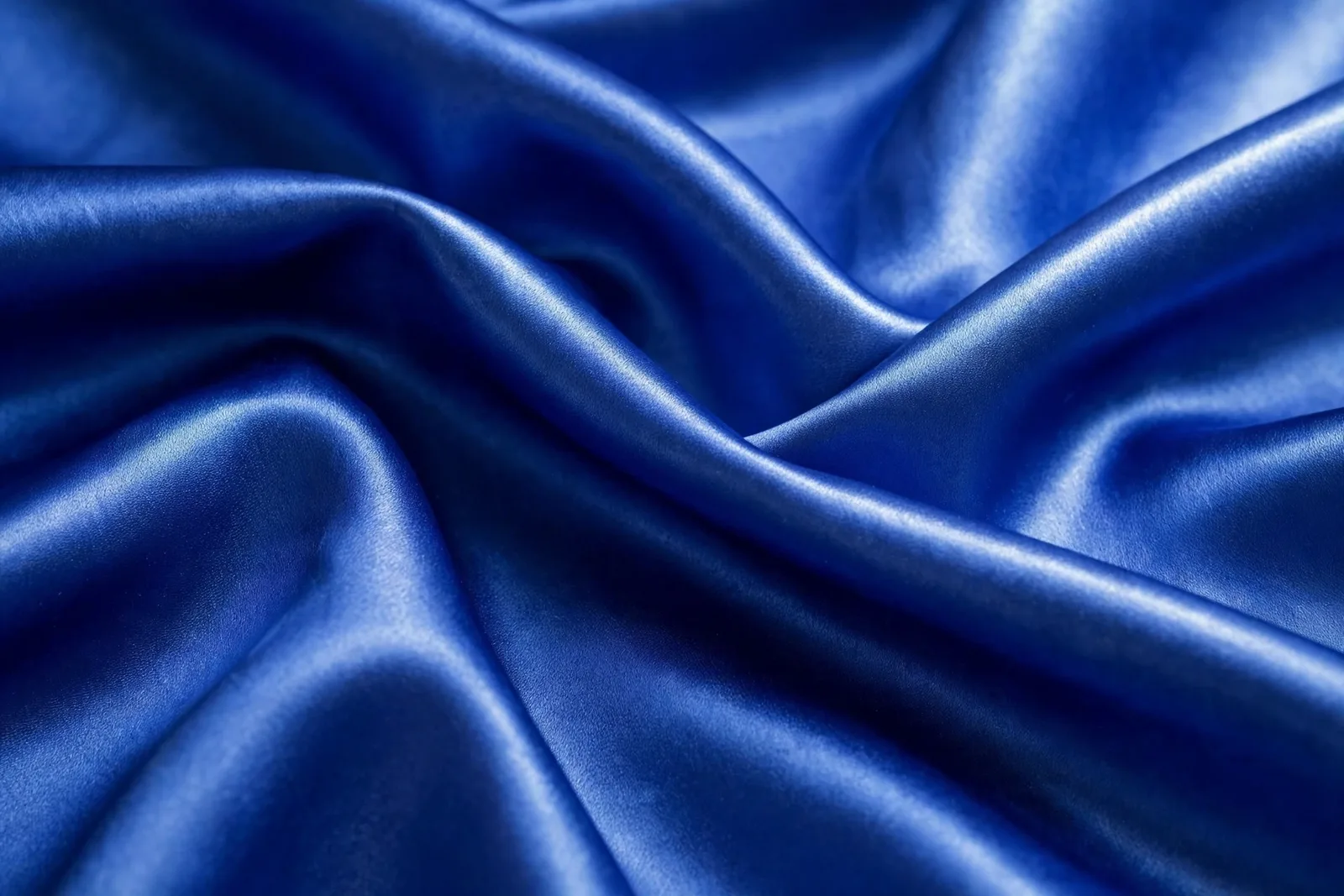
Shine is the second gap, and it is subtler. Both cloths shine on the face and stay dull on the back, since that split comes from the satin weave itself. Charmeuse shine reads softer and more broken by movement, because the light cloth shifts as you move and the folds catch light in small patches. Heavier satin shine reads broader and more even, since the firmer cloth holds larger flat areas that reflect light in one sweep. In photos, charmeuse can look like liquid, while a heavy satin can look like polished glass.
Why do shops use the two words so loosely?
Shops use satin and charmeuse loosely because each word sells a different promise, and few buyers check the weave behind the name. Satin promises shine, while charmeuse promises softness and a fluid fall. A seller picks the word that matches the look they want to sell.
One cause is that satin is both a weave and a shop word. As a weave, satin covers a wide family, from light charmeuse to heavy duchess. As a shop word, satin often means any shiny cloth, even when the weave or fiber differs from what the name suggests. A buyer who hears satin and pictures a heavy formal cloth may be surprised by a light charmeuse blouse, and a buyer who hears charmeuse and pictures a rare cloth may be surprised to learn it shares a weave with common satin.
A second cause is fiber. Charmeuse can be silk, polyester, or rayon, and CAMEO lists all three, with blends growing more common. A silk charmeuse and a polyester charmeuse share a weave and a light hand, but they differ in wash, heat care, price, and feel against the skin. Shops often lead with the weave name and leave fiber in small print, so two garments that share a name can behave quite differently in wear and in care.
A third cause is the crepe back link. Some charmeuse has a crepe style back, which gives the reverse a grainy grip and helps the cloth sew with less slip. Sellers may call that cloth charmeuse, crepe back satin, or just satin, depending on which feature they want to stress. None of those names is wrong on its own, but the mix makes it hard to compare two lengths by name alone. A swatch, a weight check, and a label read beat a name every time.
What does the label tell you that the name does not?
The label tells you the fiber, and fiber decides wash, heat care, price, and much of the feel, while the name charmeuse tells you only weave and weight. Read fiber first, then weave, then weight. A silk, polyester, and rayon charmeuse share a weave yet need different care.
Silk charmeuse feels soft and cool, and it often needs dry cleaning or a very gentle wash, since silk can water mark and lose strength with rough handling. Polyester charmeuse feels slick, holds shape well, and often tolerates machine washing better, though heat still needs care and a hot iron can still flatten shine. Rayon charmeuse feels soft and fluid, but it can lose strength when wet, so it needs the gentlest wash of the three and a careful press. The fiber line on the label is the line that sets your care routine.
Care symbols complete the picture. A dry clean only mark on silk charmeuse is a real cost over the life of a garment, while a machine wash mark on polyester charmeuse changes how often you can wear it. Check for heat limits too, since satin weave floats can flatten under a hot iron and lose their even shine. For a fiber by fiber look, see our silk satin guide, which covers how silk satin behaves in wear and care.
How can you tell what you are holding in a shop?
You can tell charmeuse from heavier satin by a short hands on test: check face and back, weight, drape, and slip, in that order. Charmeuse shows a shiny face and a dull back, feels light, and falls close to the body.
Start with face and back. Turn the cloth over and look at both sides under shop light. Charmeuse should show a clear split: one side catches light in a smooth sweep, while the other side looks matte and calm. If both sides shine alike, you may hold a different satin finish, or a cloth with a finish that changes the usual split. If neither side shines much, you may hold a matte satin rather than charmeuse.
Next, test weight and drape. Gather a length in one hand and feel how much cloth fits in your palm, then let it fall from one edge and watch how it moves. Charmeuse gathers small, falls in soft folds, and pools with little body of its own. Heavier satin gathers larger, falls in broader folds, and keeps a shape as it drops. Drape it over your forearm and walk a few steps: charmeuse will follow your arm closely, while heavier satin will swing away and back with more body.

Which one suits a bias cut dress?
Charmeuse suits a bias cut dress better than heavier satin, because its light weight and fluid drape let the diagonal cut do its work. A bias cut needs cloth that falls close to curves, and charmeuse gives that fall with ease.
A bias cut turns the weave on its side, so cloth that felt firm on the straight grain gains give on the diagonal. Charmeuse, being light, gains that give with grace: it stretches just enough to hug curves, then settles into soft folds that move with the body. A heavy satin on the bias still stretches, but its body resists the close fall, so the dress may stand away from the body where a bias dress should cling. That gap shows most at the hip and waist, where a bias cut should trace the body line.
CAMEO links charmeuse with bias cut garments directly, noting its use “especially garments with a bias cut.” That link is no accident: makers have long picked light satin weave cloth for bias slips, gowns, and skirts, because the cloth and the cut share one goal, a close fluid line. If you plan a bias dress, start with charmeuse, then judge heavier satin only if you want a grander line with more stand away from the body.
For the heavier end of the same family, see our duchess satin guide, which covers structured gowns, firmer bodices, and falls that hold a line. Duchess satin shows what happens when the same satin weave is built heavier, with more body and a grander drape. Put duchess beside charmeuse, and the weight range inside satin becomes clear in one glance, from close fluid fall to firm structured line.
Which one suits bedding, linings, and everyday clothes?
Heavier satin suits bedding and structured everyday clothes better than charmeuse, while charmeuse suits light linings and fluid blouses better. The split comes down to body, and the shape you want should drive the pick. Bedding needs body, while linings need slip and a close fall.
For bedding, a heavier satin gives a pillowcase or a duvet cover a smooth face that holds its shape through the night and through washing. Charmeuse can work for a light pillowcase, and many buyers like its soft hand, but its light weight can feel too fluid for a cover that needs to stay in place. If you want a pillowcase that feels cool and smooth yet keeps its shape, a medium weight satin often beats a very light charmeuse.
For linings, charmeuse shines. A light satin weave lining slips over clothes with ease, lets a jacket slide on and off, and adds little bulk to a garment. Heavier satin linings can feel stiff inside a light jacket, and they add weight where none is needed. That is why many makers line light jackets and dresses with charmeuse or a light satin, and save heavier satin for outer cloth or for structured pieces that need body.
Our guide to the satin weave explains how weave, fiber, and weight combine to set that shape, and why a light weave cloth can still feel firm when fiber and finish change. Weave sets the shine and the face, fiber sets wash and hand, and weight sets body and fall. Judge all three together, and you will pick the right cloth for bedding, lining, or a blouse without guessing from a name.
How do you sew and care for each?
Sewing and care differ little between charmeuse and heavier satin in method, but charmeuse needs more patience because its light weight slips and shifts more. Both need fine pins, a sharp needle, slow sewing, and gentle heat. Fiber on the label sets wash rules for both cloths.
Start sewing with a sharp fine needle and test stitches on a spare piece, since satin weave floats can snag and a dull needle can pull threads that show in the shine. Pin well inside the seam line so pin marks stay out of sight, and keep pieces flat until they are sewn, since charmeuse layers slide as they feed through a machine. A slower pace helps more than any gadget: feed the cloth with care, let the machine do the work, and check seams as you go rather than at the end.
Care follows fiber, not weave name. Silk charmeuse often needs dry cleaning, polyester charmeuse often allows a gentle machine wash, and rayon charmeuse needs the gentlest wash of all. Water can mark some satins, so spot test a hidden area before you wash a whole garment, and dry flat or hang with care so a light cloth does not stretch out of shape. Store satin and charmeuse away from rough hooks and zippers, since snags start with a rough edge and show fast in a shiny face.

Satin and charmeuse side by side
This table puts the two names in one frame, so you can see where they overlap and where they part. Charmeuse sits inside satin as a light member, while heavier satin sits at the other end of the same family. Use the table as a quick check, then run the hands on tests above before you buy.
| Feature | Charmeuse | Heavier satin |
|---|---|---|
| Weave | Satin weave, light build | Satin weave, denser build |
| Weight | Light, fluid, easy to gather | Medium to heavy, more body |
| Face and back | Shiny face, dull back | Shiny face, dull back, broader shine |
| Drape | Close, fluid, follows curves | Grander, holds its own line |
| Best cuts | Bias cuts, fluid blouses, light linings | Structured gowns, jackets, bedding |
| Sewing | Slips most, needs slow careful work | Slips too, but body helps it stay put |
| Care | Fiber decides wash and heat | Fiber decides wash and heat |
Read the table as a family portrait, not a contest score. Charmeuse wins on fluid fall and closeness, heavier satin wins on body and line, and both share the same weave, the same face and back split, and the same need for gentle care. If a seller frames charmeuse and satin as rivals, ask which satin they mean, since the answer changes with weight.
Frequently asked questions
Is charmeuse the same as satin?
Charmeuse is a light type of satin, so the two share a satin weave, but charmeuse is lighter and more fluid than heavier satin. Think family and member, not rivals.
Is charmeuse silk?
Charmeuse can be silk, polyester, or rayon, and blends are common too. The fiber line on the label tells you which one you hold, since charmeuse names weave and weight, not fiber.
Is charmeuse shiny on both sides?
No, charmeuse shines on the face and stays dull on the back, which is the usual satin weave split. That split helps you spot charmeuse and plan seams and linings.
What is charmeuse best for?
Charmeuse suits bias cut dresses, fluid blouses, evening gowns, and light linings, where a close fluid fall is the point. Heavier satin suits structured gowns, jackets, and bedding better.
How do I tell charmeuse from heavier satin?
Check face and back, then weight and drape. Charmeuse feels light, gathers small in your palm, and falls close to the body, while heavier satin feels denser and holds a broader line.
Can I wash charmeuse at home?
It depends on fiber. Polyester charmeuse often allows a gentle machine wash, silk charmeuse often needs dry cleaning, and rayon charmeuse needs the gentlest wash. Read the care label first.
Does charmeuse snag easily?
Yes, like other satin weave cloths, charmeuse can snag, since long floats sit on the face. Keep it away from rough hooks and zippers, and handle it with smooth hands.
Where to go next
Start with the cloth in your hands, not the name on the tag, and let weight, face, back, and fiber settle the choice. If you want a close fluid fall, charmeuse is a strong pick, and if you want body and line, a heavier satin will serve you better.
From here, compare charmeuse with the wider family in our satin vs silk guide, which covers how fiber changes satin behavior, or return to the types of satin guide for the full family picture. Either way, keep the swatch test in mind: a minute with the cloth tells you more than a name ever will.


