Can You Bleach Satin? What Works, What Ruins It, and What to Do Instead
Can you bleach satin? Only some types survive it. Oxygen bleach suits cotton satin, chlorine bleach ruins silk and polyester satin, and patch testing comes first. The short answer hides the real point: satin is a weave, not a fiber, so the fiber under the shine decides what bleach will do.
That one fact explains why advice about bleaching satin sounds so mixed: one person bleaches a white cotton satin pillowcase and it comes out bright, while another puts chlorine bleach on a silk satin dress and watches it thin and tear. Before any bleach touches your satin, know the fiber, the label, and which bleach type fits it.
What Does Bleach Do to Satin?
Bleach breaks apart the colored molecules in a stain or in the fiber itself, and that action can also break apart the fibers that hold the cloth together. The satin weave makes the risk easy to see, because its long surface threads are the first to weaken and pull when the fiber underneath is hurt.
Chlorine bleach, sold as liquid household bleach, is the strong one. The American Cleaning Institute says: “Sodium hypochlorite bleaches (also called chlorine or liquid household bleach) are the more powerful laundry bleaches; they disinfect, as well as clean and whiten. They work on many whites and colorfast washables – but not on wools or silks.” Oxygen bleach, often sold as a powder, is the gentler one. The same guide says: “Oxygen (color-safe) bleaches are gentler, working safely on all washable fabrics.” That contrast is the backbone of this guide.
Can You Bleach Satin at All?
Yes, you can bleach some satin, and you must never bleach other satin, and the line between the two runs through the fiber content, not through the shine. White cotton satin is the best case, silk satin is the worst case, and polyester satin sits in between, because chlorine bleach can turn it yellow instead of white.
The safe habit is simple: read the fiber content, read the care label, patch test on a hidden spot, and start with oxygen bleach. If any of those steps says no, believe it. A stained satin dress is a problem, but a bleached satin dress with a hole in it is a loss.
How Do You Tell Which Fiber Your Satin Is?
You can tell which fiber your satin is by reading the label first, then checking how the fabric feels, and by treating any guess as a reason to patch test. The care label lists the fiber content: silk, cotton, polyester, nylon, rayon, acetate, or a blend.
Blends follow the weakest fiber in the mix, so a silk and cotton blend gets treated like silk. If the label is gone, feel can point you in the right direction: silk satin feels warm and drapes in liquid folds, cotton satin feels cooler and crisper, and polyester satin feels slick. None of those feel tests proves the fiber on its own. If you cannot find the fiber content at all, treat the piece as silk: no chlorine bleach, oxygen bleach only after a patch test, and a dry cleaner for anything valuable.

Can You Bleach Silk Satin?
No, do not use chlorine bleach on silk satin. Use oxygen bleach only with great care, a patch test, and a short, cool soak, because silk is a protein fiber and chlorine attacks protein fibers directly, weakening the threads and leaving the fabric prone to tearing at the seams.
The Canadian Conservation Institute explains the split in plain terms: “Cotton and flax are vegetable fibres composed of cellulose. Silk and wool are protein fibres that are made up of various amino acids.” It then warns: “Both wool and silk are particularly vulnerable to damage by chlorine.” A silk satin dress can look fine after washing, then split at the shoulder when first worn, because the harm was done to the fiber even though the color looked unchanged. Much silk satin is labeled dry clean only, and that label warns about water as well as bleach, since water alone can leave marks and dull its shine. For a wedding dress, an heirloom piece, or any silk satin you cannot replace, skip home bleaching and let a silk cleaner decide.
Can You Bleach Cotton Satin?
Yes, cotton satin is the one satin that takes bleach best, and oxygen bleach is still the first choice, because cotton is a cellulose fiber that stands up to oxygen bleach well. Oxygen bleach suits white and colored cotton satin alike when the label allows bleach, and it lifts yellowing and dullness.
Chlorine bleach has a narrow place with cotton satin. Use it only on sturdy white cotton satin, only when the care label shows an empty triangle, only well diluted, and never on colored cotton satin, because chlorine strips the color unevenly and leaves pale blotches. Never pour it straight onto the fabric: mix it into the water first and keep the contact short. If your cotton satin is thin, old, or worn at the seams, skip chlorine bleach even when the label allows it.
Can You Bleach Polyester Satin?
No, you should not use chlorine bleach on polyester satin, because chlorine bleach can turn polyester yellow instead of whitening it, and that yellow cast is hard to remove once it sets. This surprises people, because polyester feels tough and resists wrinkles, so it seems like a fabric that could take a strong cleaner.
The trouble is chemical, not a matter of toughness, so the strong bleach is the wrong tool even though the fabric feels hardy. Oxygen bleach is the right choice: gentler, made for color safe use, and it suits white and colored polyester satin when the label allows bleach. Use cool to warm water, dissolve the powder fully first, and keep the soak modest. Oxygen bleach can help yellowed white polyester satin, but it cannot undo yellowing chlorine bleach has already caused, so the order matters: oxygen first, chlorine never. If you are comparing the two cloths, our guide on satin vs polyester explains how they differ.
What About Nylon, Rayon, and Acetate Satin?
Do not use chlorine bleach on nylon, rayon, or acetate satin. Use oxygen bleach on these fibers only after a patch test, because each has its own weak point that chlorine bleach will find. Nylon satin is strong and springy, but chlorine bleach can weaken it and yellow it.
Rayon satin is made from processed cellulose and loses strength when wet, so a harsh soak can leave it thin and prone to tearing, and hot water can shrink it. Acetate satin is the most fragile of the three: chlorine bleach can damage it, and it is often labeled dry clean only for good reason. The Museum of Fine Arts, Boston, lists acetate and rayon alongside silk as fibers used in a satin weave. See the CAMEO entry for satin: “A smooth, shiny fabric made with silk, acetate, or rayon fibers in a satin weave.” For rayon satin, support the fabric when you lift it out of the water, since wet rayon is weaker than dry rayon, and lay it flat to dry instead of hanging it.
Fiber and Bleach at a Glance
The table below sums up the verdict for each fiber, so you can check your own satin in seconds. Keep in mind that the care label on your own garment always wins over a general table, because the maker tested that exact piece.
| Fiber | Chlorine bleach | Oxygen bleach | Verdict |
|---|---|---|---|
| Silk satin | No, damages protein fibers | Only with care, patch test, cool water, short soak | Dry cleaner safest, never chlorine |
| Cotton satin | Only diluted, sturdy white cotton, label allows | Yes, best choice for white and colored cotton satin | Oxygen bleach first, chlorine only as a last resort |
| Polyester satin | No, turns white fabric yellow | Yes, suits white and colored polyester satin | Oxygen bleach only |
| Nylon satin | No, weakens and yellows the fiber | Only after a patch test, cool water, short soak | Oxygen bleach only, with care |
| Rayon satin | No, weakens wet fiber, changes shape | Only after a patch test, cool water, short soak, lay flat to dry | Oxygen bleach only, with care |
| Acetate satin | No, damages the fiber | Only after a patch test, often dry clean only | Dry cleaner safest, never chlorine |
How Do You Read the Bleach Triangle on the Care Label?
You read the bleach triangle on the care label by looking at the small triangle symbol, because that triangle is the bleach instruction, and its marks tell you whether any bleach is allowed and which kind. An empty triangle means any bleach is allowed, while a triangle with two diagonal lines inside it means oxygen bleach only.
A solid black triangle, or a triangle with a large X through it, means do not bleach at all. Some labels use words instead of symbols, such as “do not bleach” or “use non-chlorine bleach only,” and those words mean the same. If your label has no triangle at all, treat the piece as do not bleach until you know the fiber and have patch tested oxygen bleach on a hidden spot. The triangle is small and easy to miss, so check the whole label before you start: a garment that allows warm water may still forbid bleach. For more on washing satin, see our guide on how to wash satin.
How Do You Patch Test Bleach on Satin?
You patch test bleach on satin by testing a weak mix of the bleach on a hidden spot first, waiting, and checking the spot in daylight before the bleach ever touches the rest of the garment. The American Cleaning Institute gives the core of the method: “Dip a cotton swab in the bleach/water solution and dab on an inside seam.”
That small test is the whole point: a tiny hidden spot can tell you what a full soak would do, without risking the whole piece. Never skip this step, because satin shows damage fast and the damage does not wash out.
- Mix a small amount of the bleach in water at the same dilution you would use for the full soak, and never test with undiluted bleach.
- Pick a hidden spot, such as an inside seam.
- Dab the mix on the hidden spot with a cotton swab, then leave it alone for a few minutes.
- Rinse the spot with cool water, pat dry, and let it dry fully.
- Check the spot in daylight for any change in color, shine, or hand, and pull gently at the threads.
- If you see any change at all, do not use that bleach on that piece; take it to a cleaner instead.
If the patch test passes, go ahead with the full soak, but keep the same dilution and water temperature you tested with. Never pour bleach directly on a stain on satin, because it hits one spot hard and leaves a pale mark with a sharp edge. For stain removal steps that do not need bleach at all, see our guide on how to remove stains from satin.
How Do You Use Oxygen Bleach on Satin Safely?
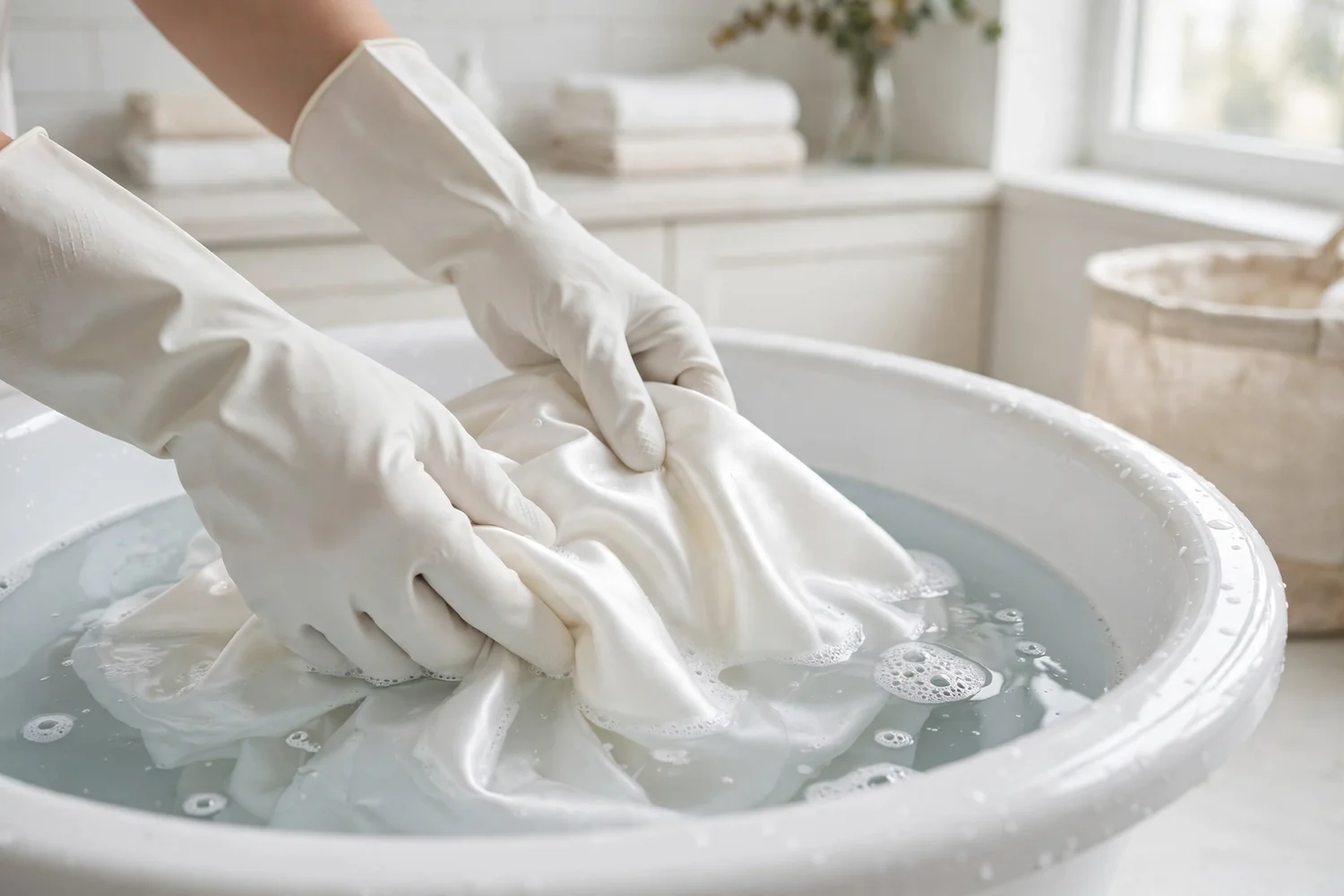
You use oxygen bleach on satin safely by dissolving the powder first, soaking in cool to warm water for a short, timed period, and rinsing well at once, after a patch test. Oxygen bleach is gentler, but it is still a chemical at work on fine threads, so the steps and the order matter.
- Dissolve the oxygen bleach fully in cool to warm water, using the amount the product label suggests.
- Place the satin in the water, press it gently under the surface, and keep it loose, so the mix reaches all of it.
- Soak for a short time, checking every few minutes, and lift the piece out as soon as the stain has lifted.
- Rinse in cool water until it runs clear, then press the water out gently without wringing or twisting the satin.
- Lay the piece flat on a clean towel to dry, out of direct sun, and let it dry fully before you judge the color.
Do not leave satin soaking for hours, and do not add more powder halfway through: the extra dose adds risk without adding much cleaning power. Do not use hot water on silk, rayon, or acetate satin, even with oxygen bleach, because heat adds its own stress to fibers already under chemical action. Rinse well, because bleach left in the fibers keeps working after the wash. If the piece still looks dull after one careful soak, repeat the soak once with a fresh mix. If you want to change the color of a satin piece instead of cleaning it, read our guide on can you dye satin first, since dyeing follows different rules.
What Should You Do Instead for Yellowed White Satin?
You should try oxygen bleach, fresh air, and a gentle wash first for yellowed white satin, because yellowing often comes from age, body oils, and storage rather than from a single stain, and a harsh bleach can set the yellow in place instead of lifting it.
The yellow often sits in the fibers rather than on the surface, so a single strong treatment rarely fixes it. Wash the piece gently in cool water with a mild detergent, rinse well, and dry it flat. If it still looks yellow, try an oxygen bleach soak with a patch test first and a short soak. For cotton satin, a second soak is fine; for silk satin, one short soak is enough, then take the piece to a cleaner if it does not work. Airing helps, so hang white satin in fresh air out of direct sun for a few hours. Do not hang it in strong sun to bleach it, because sun can yellow silk and weaken fibers. Check your storage, too: plastic bags and cardboard boxes can trap acids that yellow fabric over time, so keep white satin in a clean cotton bag, away from heat, and wash it before you put it away.
What Mistakes Ruin Satin When Bleaching?
The mistakes that ruin satin when bleaching are pouring bleach straight on the fabric, skipping the patch test, mixing chlorine bleach with other cleaners, using hot water on fine fibers, and soaking for far too long. Pouring bleach on satin is the most common error, and it leaves a pale spot with a hard edge.
Skipping the patch test turns a small risk into a whole garment risk, because the test shows how your exact piece reacts. Never mix chlorine bleach with ammonia or vinegar, because the mix can make toxic fumes, so keep chlorine bleach away from toilet cleaners, glass cleaners, and any product that lists ammonia. Hot water on silk, rayon, or acetate satin is a quiet error, because the water feels harmless. Soaking for hours is another quiet error, because the fabric looks no worse when you lift it out, and the weakness shows up later as a tear, so set a timer and pull the piece out on time. Wringing wet satin harms the weave, so press the water out gently and lay the piece flat. Bleaching a colored satin with chlorine bleach cannot be undone, because chlorine strips dye unevenly. If wrinkles are your worry after washing, see our guide on how to get wrinkles out of satin, and if you are unsure whether your satin will shrink, read does satin shrink before you soak it.
Frequently asked questions
Can you bleach white satin sheets?
Yes, for cotton or polyester satin sheets, oxygen bleach is the safe choice. Patch test first and follow the care label. Chlorine bleach suits only sturdy white cotton satin, and it can turn white polyester satin yellow. For silk satin sheets, take them to a cleaner.
Can you use bleach on a white satin wedding dress?
No. Do not use chlorine bleach on a white satin wedding dress, and do not use oxygen bleach at home unless the label says the dress is washable and a patch test passes. Most wedding dresses are silk or acetate satin and labeled dry clean only, so take yours to a gown cleaner.
Will bleach turn satin yellow?
Yes, chlorine bleach can turn white polyester and nylon satin yellow, and it can yellow silk satin by damaging the fibers. Oxygen bleach is less likely to cause yellowing, so it is the first choice for white satin. If your satin looks yellow, try an oxygen bleach soak first.
Can you bleach colored satin?
You can use oxygen bleach on colored satin when the label allows bleach, but never chlorine bleach, since it strips dye unevenly and leaves pale blotches. Patch test on a hidden seam first, use cool water, keep the soak short, then rinse well and check the color.
How long should you soak satin in oxygen bleach?
Soak satin for a short time, checking every few minutes, and lift it out as soon as the stain has lifted or the white looks bright again. The product label gives a suggested time as a rule of thumb. Do not leave satin soaking for hours, since a long soak can stress the weave.
Is oxygen bleach safe for all satin?
Oxygen bleach is gentler than chlorine bleach and suits most washable satin, but not every piece. Dry clean only satin should not be soaked at home, and silk, rayon, and acetate satin still need a patch test, cool water, and a short soak.
What should you do if bleach leaves a spot on satin?
Stop bleaching at once, rinse the spot with cool water, and let the fabric dry flat so you can see the true extent of the mark. A pale bleach spot cannot be washed out, because the bleach has changed the fiber or the dye. A cleaner or dye specialist may be able to help.